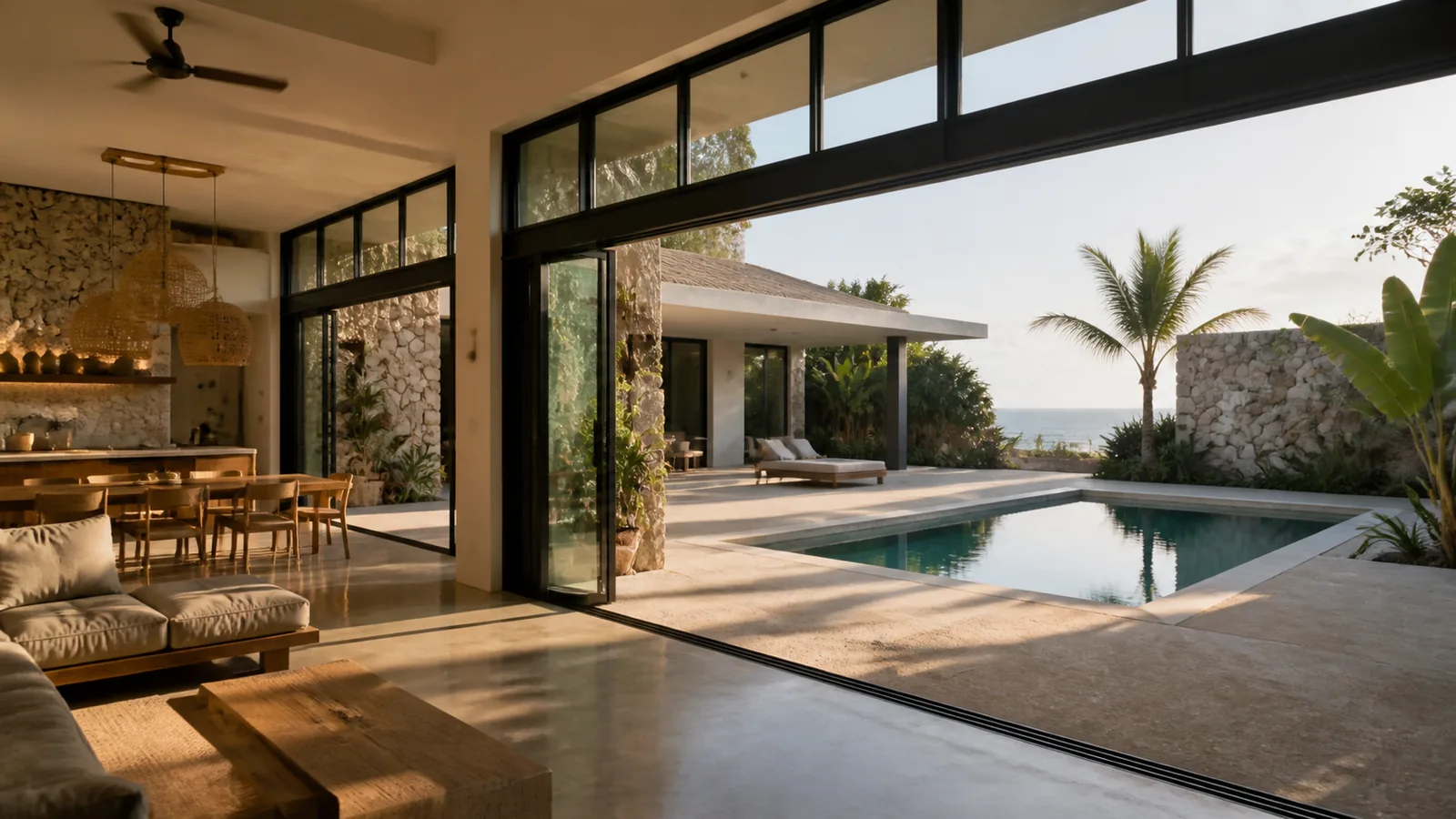
Two listings arrive in your inbox. One is a cliff-view villa in Uluwatu — ocean horizon, infinity pool, surf break walkable on a good day. The other is a Canggu pool villa: walkable to cafés, established management company, airport thirty-five minutes away. Both quote rental yields. Neither discloses lease-term decay, zoning compliance, or whether a rental operating licence actually exists.
That gap — between the listing photo and the operating reality — is where the uluwatu vs canggu property comparison actually begins.
A note on how we work: We assist foreign buyers comparing Bali areas before they commit to viewings. We do not represent developers, hold live inventory, or receive commissions from sellers. This guide is written from the buyer side.
What Most Guides Miss
Most articles comparing Uluwatu and Canggu sell lifestyle: surf breaks, café scenes, sunset views. What those pages omit is the buyer-side filter that should come before any viewing.
Zoning and coastal enforcement. The August 2025 Bingin demolitions removed dozens of businesses operating in restricted coastal zones — not hypothetical risk, but confirmed enforcement affecting existing operators on the Bukit Peninsula.
Road access and water supply. Cliff-facing villas in Pecatu, Bingin, and Padang Padang commonly require narrow private roads and trucked water. Neither is disclosed upfront in most listings.
Lease-term decay. A 25-year leasehold with 15 years remaining is a materially different asset from a fresh 30-year lease. The headline price rarely reflects the remaining term. Investlandbali’s due diligence guide outlines why remaining term is one of the first variables to verify.
Rental licensing. Villa rental income requires a specific operating licence (Pondok Wisata or equivalent). Operating without one creates compliance exposure — not just a tax issue. The Prestige Property Bali checklist covers this in detail.
Duplicate and stale listings. The same villa frequently appears across multiple portals at different prices, some with availability that no longer reflects current owner intentions.
Canggu carries its own version of these risks — different zoning pressures, wet-season flooding in some subdistricts, and a construction environment noisier than its reputation suggests. The comparison only makes sense once both areas are filtered through the same verification lens.
Area Snapshot: Side-by-Side
| Factor | Uluwatu / Bukit | Canggu |
|---|---|---|
| Terrain | Limestone plateau, cliff access | Flat coastal plain |
| Airport distance | 40–60 min (subarea dependent) | 25–40 min |
| Water supply | Often trucked or deep well | Mostly PDAM available |
| Hospital access | Limited on Bukit | Better access via Denpasar |
| Zoning enforcement exposure | High (coastal setbacks active) | Moderate (flood zone risk in parts) |
| Rental guest profile | Surf, wellness, retreat | Surf, digital nomad, short-break |
| Typical lease terms | Mix: short and long available | Mix: increasingly short near Batu Bolong |
| Infrastructure density | Lower — quieter, more private | Higher — busier, more urban |
| Primary pricing signal | Ocean view, cliff position | Pool villa, walkability, noise |
This table is a starting framework. Subareas within each market vary significantly, and no single listing can be assessed from area-level data alone.
How the Two Areas Compare
Location, Access, and Infrastructure
Canggu’s main operational advantage is accessibility. The flat road network — despite traffic — gives reliable routes to Denpasar, the airport, hospitals, and international schools. Guests arrive independently. Property managers can service multiple sites without routing through cliff roads.
Uluwatu and the wider Bukit Peninsula sit on a limestone plateau at Bali’s southern tip. The elevated terrain creates the cliff views and wave exposure that buyers pay premiums for — but it also means longer airport transfers, limited nearby hospital access, and in cliff-side subareas, roads that are difficult for larger vehicles. For owner-occupiers seeking seclusion, this is a feature. For rental operations targeting airport arrivals on a timeline, it adds friction.
Water supply on the Bukit is structurally different from Canggu. Many properties rely on trucked water or deep wells rather than PDAM municipal supply. Area guides for Bingin note dry-season water availability as a specific planning variable. Verify the source, storage capacity, and dry-season reliability before any offer.
Subarea Fit Within Each Market
Uluwatu/Bukit subareas to understand:
- Pecatu and Ungasan — larger land plots, more residential-adjacent, villa resort development, less direct surf-walk access, lower zoning enforcement exposure than cliff-side zones
- Bingin and Padang Padang — tight cliff access, high rental demand from surf tourism, highest coastal enforcement exposure in the current environment
- Balangan — quieter, less established, longer drives to services, potentially lower entry but thinner exit liquidity
Canggu subareas to understand:
- Berawa — more developed, pool villa density, stronger long-term rental base
- Pererenan — lower density, wet-season flood risk in parts; check land certificates for agricultural classification
- Echo Beach / Batu Bolong — high foot traffic, shorter lease terms increasingly common, active construction noise
Neither area is monolithic. A villa in Ungasan and a villa on Bingin cliff face different risk profiles even though both are marketed as “Uluwatu.” Ulu-homes covers these distinctions in their area guide.
Ownership and Lease Structure
Foreign buyers in both areas access property through leasehold arrangements or Indonesian-entity structures. No route eliminates legal complexity — any agent or platform that implies otherwise should be treated with caution.
Key variables to verify for any leasehold:
- Total term and remaining years at point of purchase
- Extension rights: contractually guaranteed in the agreement, or subject to future renegotiation
- Ground rent escalation clauses through the term
- Notarial certification and BPN land certificate status
- Whether underlying title is HGB or HM — the former is buildable leasehold, the latter is freehold not directly accessible to foreigners
For Canggu villas for sale and Uluwatu villas for sale, these ownership route questions apply equally. The area comparison does not change the legal structure required — but the specific risks attached to each listing (zoning, permits, land classification) do vary.
Investment Assumptions to Verify
Neither area should be underwritten on published yield estimates without your own operating model. Investlandbali’s rental yield overview notes that Bali gross yields vary widely depending on occupancy, management structure, tax treatment, and asset quality.
Before treating any projection as a decision basis:
- Confirm the property holds or can obtain the required rental operating licence
- Model three occupancy scenarios: conservative (50%), moderate (65%), optimistic (75%)
- Confirm management fee structures — typically 20–30% of gross revenue
- Account for Indonesian tax obligations on rental income
- Reserve for maintenance, pool servicing, soft-furnishing replacement, and periodic capital expenditure
- Factor in lease decay: a 20-year lease is worth less in year 10 than year 1, even if cash flows are steady
A contractual yield promise from a developer or operator is an obligation of that counterparty, not a property characteristic. Verify what happens if that counterparty does not perform, and whether the promise is backed by any security. See best areas to buy property in Bali for a broader framework.
Common Buyer Objections
“The agent says the zoning is fine.” Agent representation of zoning is not a substitute for independent GISTARU/KKPR verification. Confirm the zoning designation against official records before deposit.
“The listing shows 30 years remaining.” Ask to see the original lease agreement and confirm the start date. Lease terms are frequently described loosely in listings; the notarised document is the only authoritative source.
“The rental return is projected at X%.” Request the assumptions behind any projection: gross or net, which occupancy rate, what management fee, what tax treatment, what maintenance reserve. A projection without stated assumptions is a marketing figure.
“Other buyers are interested — I need to move quickly.” Urgency is a standard sales environment in both areas. Due diligence timelines should be set by what you need to verify, not by a sales conversation.
Before You View: A Shortlist Checklist
Request verification of the following before any site visit:
- Land certificate type and current BPN registration status
- Zoning designation confirmed against GISTARU/KKPR records, not just agent representation
- Road access width, condition, and ownership (private road or shared easement)
- Water source — PDAM, well, or trucked — with dry-season reliability confirmed
- Building permits (IMB/PBG) covering all existing structures on the land
- Rental operating licence status: held, applied for, or not yet in place
- Lease term: start date, end date, extension clause language in the notarised agreement
- Coastal setback compliance where applicable
- Any active disputes, encumbrances, or enforcement notices on the land certificate
The specific risks differ by area — Bukit zoning enforcement and cliff-road access for Uluwatu; flood zones and permit coverage gaps in some Canggu subdistricts — but the verification process is the same. Use an independent notary and, where permit questions arise, a licensed Indonesian property lawyer.
Choosing Between Uluwatu vs Canggu Property
There is no universally correct answer.
Uluwatu tends to suit buyers who prioritise privacy, ocean views, and a surf-retreat aesthetic — and who are prepared for infrastructure trade-offs and higher zoning vigilance. The buyer profile that works here understands that access limitations and water management are permanent operating variables, not temporary construction-phase issues.
Canggu tends to suit buyers who prioritise accessibility, a broader rental guest profile, and an established property management infrastructure — at the cost of more urban density and an active construction environment that changes the feel of subareas over time.
Both areas require the same buyer-side discipline: verified titles, independent legal review, realistic operating assumptions, and shortlists built from confirmed availability rather than portal aggregation.
If you are ready to move from comparison to shortlist, the most useful next step is telling us your target subarea, budget range, intended use, and lease-term floor — so we can filter against verified availability rather than generic area overviews.
Climate Comparison: What the Grid Can Support
We compared 2015–2025 hourly reanalysis at the representative Bali reference points below. The figures help screen maintenance exposure; they do not rank individual villas or replace drainage, material and building-condition checks.
| Reference point | Rainfall mm/year | Rainy days/year | Avg RH | ≥85% RH hours/year | Avg wind km/h | Strong-wind days/year† | Solar kWh/m²/day | Outdoor pressure* |
|---|---|---|---|---|---|---|---|---|
| Uluwatu and Pecatu reference | 1,630 | 261.6 | 80.2% | 1,944 | 14.4 | 31.5 | 5.69 | 29 |
| Canggu coastal corridor | 1,662 | 245.7 | 85.5% | 4,968 | 12.2 | 6.4 | 5.71 | 49 |
*Outdoor Maintenance Pressure is a relative index across five configured location requests, which resolve to four distinct populated grid cells. The raw weather metrics beside it remain the evidence. †A strong-wind day contains at least one hourly 10 m wind-speed value of 30 km/h or more; this is a comparison threshold, not a damage threshold.
Grid-resolution disclosures
- Uluwatu and Pecatu reference uses the nearest populated ERA5-Land cell at -8.8, 115.2 (13 km from the requested coordinate), so it is a broad-area proxy.
How to use this in due diligence
- Use the difference in raw rainfall, humidity and wind metrics as an inspection-priority input, not a prediction of which area will produce a better return.
- Compare roof form, drainage, shade, ventilation, materials, sea exposure and maintenance history at the actual properties.
- Do not infer mould, corrosion, flooding, repair frequency or parcel performance from an area grid.
Source: Copernicus Climate Change Service (C3S) ERA5-Land, hourly reanalysis, 2015–2025, analysed in Asia/Makassar local time. Relative humidity, wet-bulb temperature and reference evapotranspiration are derived from the source variables using the documented methodology. Data: CC BY 4.0. See the climate data methodology for formulas, thresholds and limitations. Values are area-level model estimates, not measurements at a villa; relative indices compare five configured Bali location requests (four distinct populated grid cells), not engineering, insurance, cost or yield ratings.
Frequently Asked Questions
Is Uluwatu or Canggu better for rental income? Neither area reliably outperforms the other across the board. Rental yield depends on the specific villa, its licence status, management quality, occupancy achieved, and what costs are deducted before the net figure is calculated. Compare like-for-like assumptions before drawing any conclusion from published range figures.
Can foreigners buy freehold property in either area? Foreigners cannot hold freehold (Hak Milik) title directly under Indonesian law. Access is through leasehold agreements, nominee structures, or PT PMA (foreign-owned Indonesian company) ownership of HGB title. Each structure carries different obligations, risks, and costs. This is educational information, not legal advice — consult an independent Indonesian property lawyer for your situation.
What does the 2025 Bingin enforcement mean for buyers? The August 2025 demolitions targeted businesses in coastal restricted zones. For buyers, coastal setback compliance and zoning designation are first-order verification items for any Bukit Peninsula property — not footnotes. Properties operating in or near restricted zones carry enforcement risk regardless of how long they have been operating.
How long should a lease be for a Bali villa purchase to make sense? There is no single answer, but buyers typically look for 20–30 years minimum remaining at time of purchase, with documented extension rights. Always verify remaining term from the original notarised agreement, not a listing description.
What is the first step after identifying a potential villa in either area? Request the full land certificate, building permit documentation, and lease agreement before any viewing. A shortlist built on verified documentation is more useful than one built on photos and agent briefings.
Do both areas have the same property management infrastructure? No. Canggu has a denser network of established villa management companies, which simplifies operations for remote owners. Uluwatu/Bukit has management options but the pool is smaller, and logistics for cliff-side properties add operational complexity. Factor this into your operating model before committing to a remote-managed asset on the Bukit.
This article is written for educational purposes and does not constitute legal or financial advice. Property structures, zoning designations, and regulatory enforcement in Bali change over time — verify current status with an independent Indonesian notary or licensed property lawyer before making any commitment. Last reviewed: July 2026.
Content prepared by the buyer research desk. Reviewed internally against verified area sources and the August 2025 Bingin enforcement record.