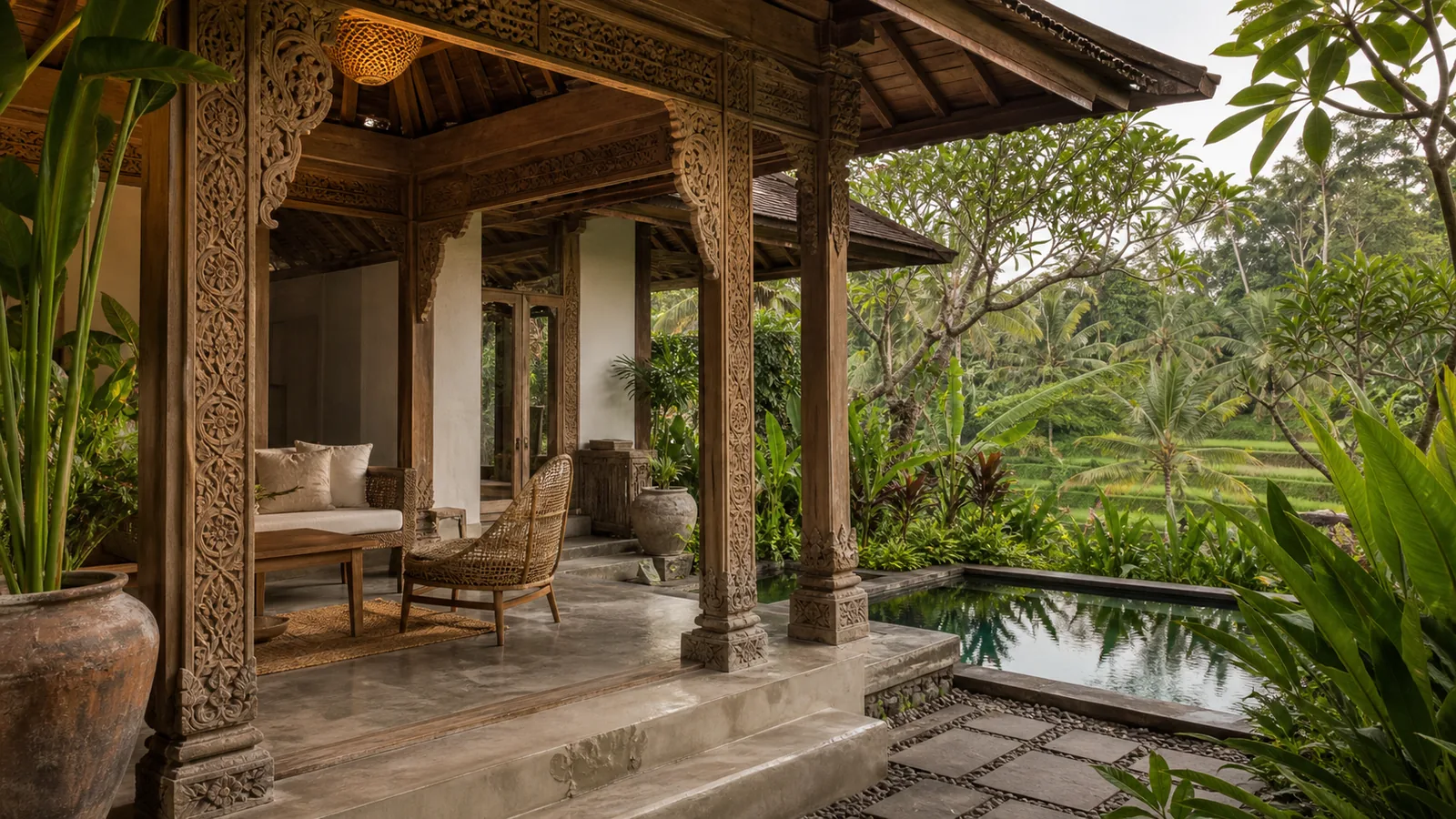
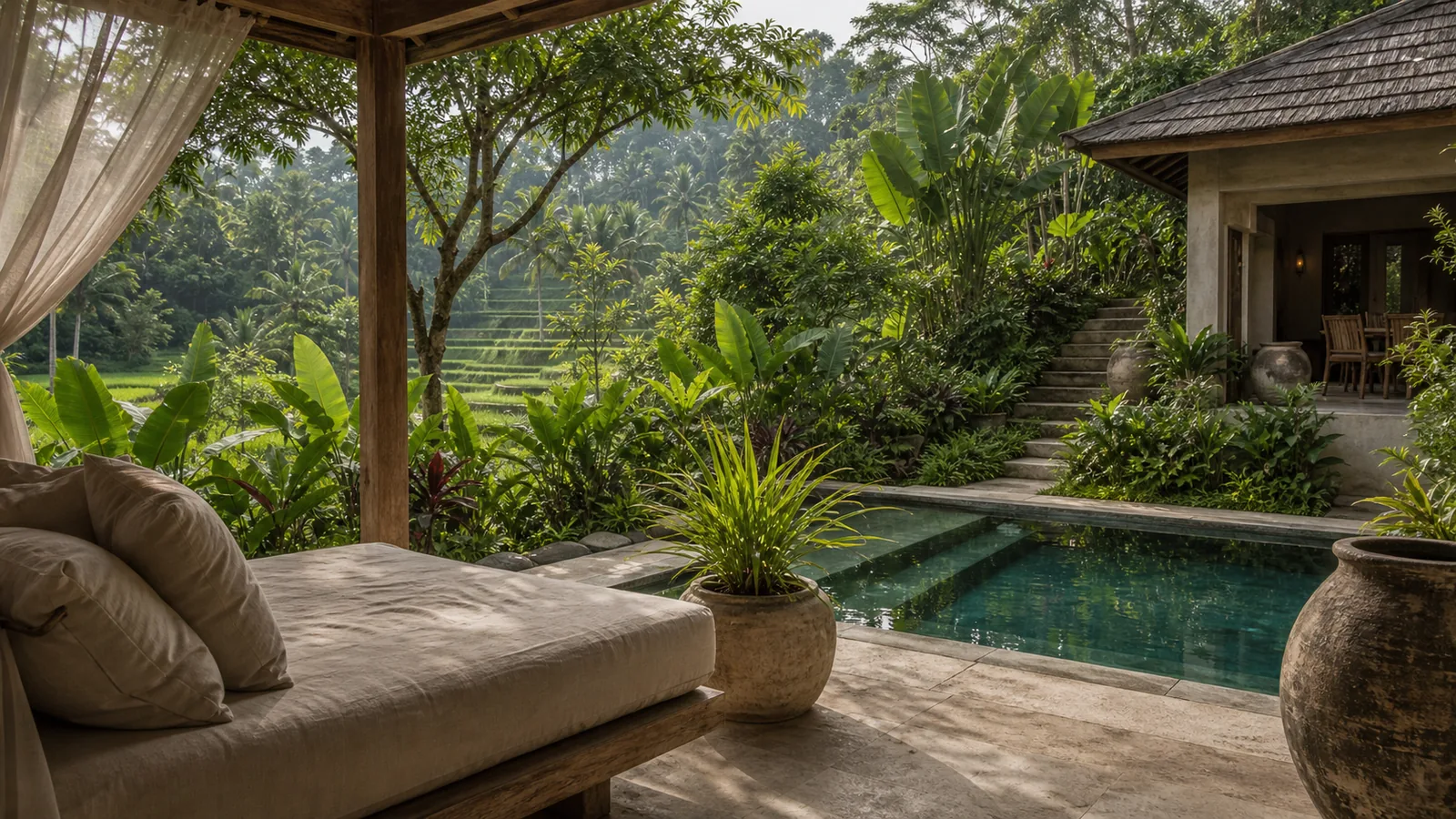
The photo looks right. Rice-field views, a yoga shala, open-air treatment rooms. The question every buyer needs answered before that photo matters is this: does the access work for a retreat van, is the licensing in place for structured programmes, and how much time is left on the lease?
This guide is for buyers and operators comparing ubud wellness retreat villas through a verification lens. It does not sell lifestyle — it maps the checks you need before you book viewings.
Who this page is for: Foreign buyers or retreat operators evaluating Ubud-area properties for wellness use, whether owner-operated or leased to a programme operator. If you are still comparing Bali regions, start with Ubud villas for sale.
What Most Guides Miss
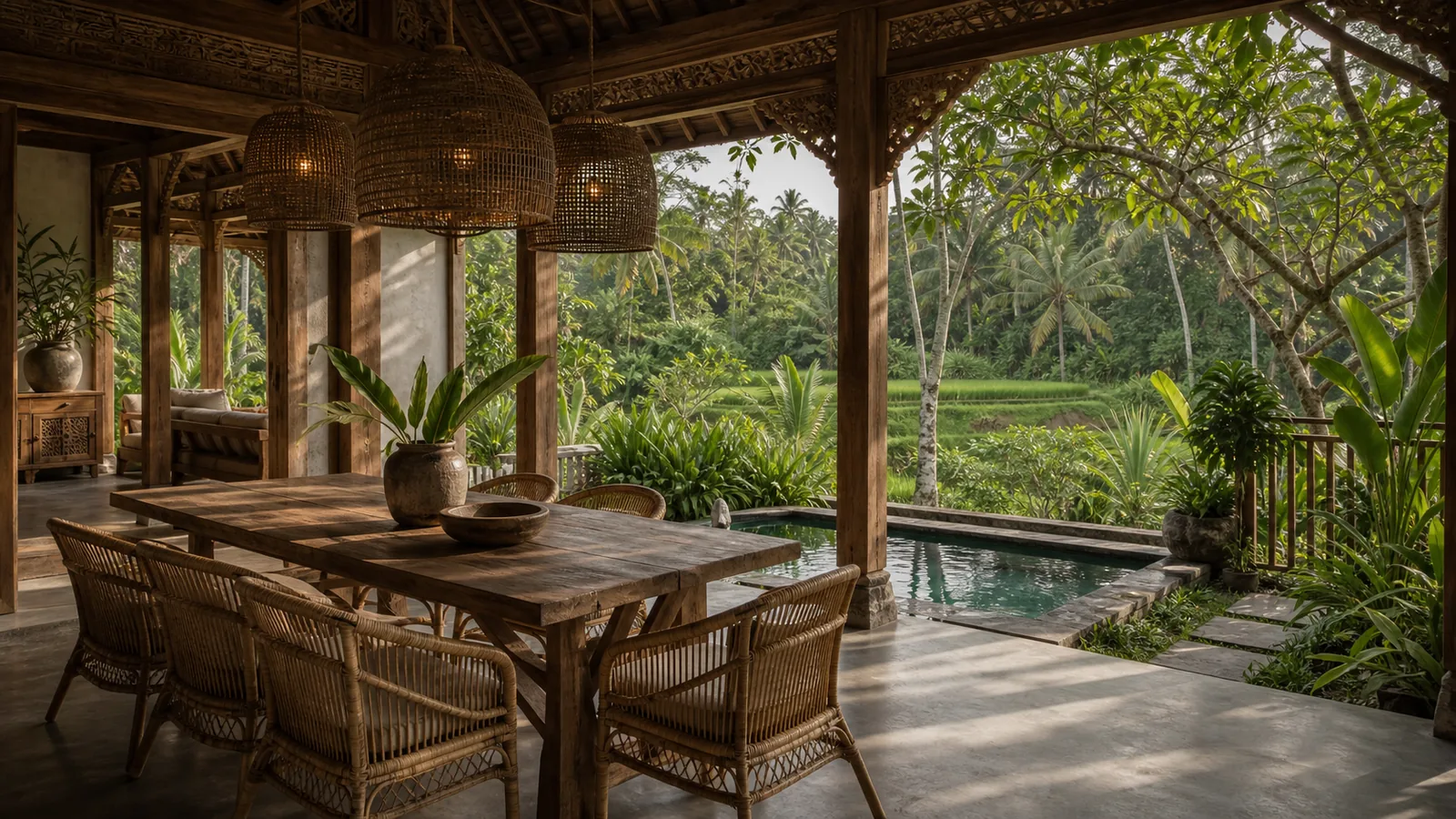
Most Ubud content leads with atmosphere. Jungle, silence, Ayurveda. All real — and none of it tells you what you need before committing.
The gaps that consistently catch buyers:
- Access is the invisible filter. Many villas sit at the end of gang roads a retreat minivan cannot navigate. Guest transfers, linen suppliers and medical emergencies all need a workable turning radius. Most listings say nothing about road width or wet-season surface condition.
- Retreat-use licensing is separate from a villa rental license. Structured wellness programmes with paying guests on defined itineraries typically require commercial permissions beyond a standard short-stay entitlement. Few sellers raise this unprompted.
- Humidity and slope carry operating costs, not footnotes. Ubud’s wet season runs roughly October through April. Timber, thatch and rendered walls on a hillside all carry predictable maintenance cycles. Independent due diligence resources like villaaudit.com consistently identify deferred maintenance as the most common hidden cost in Ubud acquisitions.
- Long-stay demand is not the same as villa-holiday demand. A retreat property running 5- and 7-day programmes depends on operator relationships and a different booking window than a two-night villa stay. Exit liquidity for a property configured around retreat operations is narrower.
- Lease term decay is invisible in photos. A 25-year lease sold in 2012 has 11 years remaining in 2026. The property looks identical. The remaining term does not.
Why Ubud Attracts Wellness Property Buyers
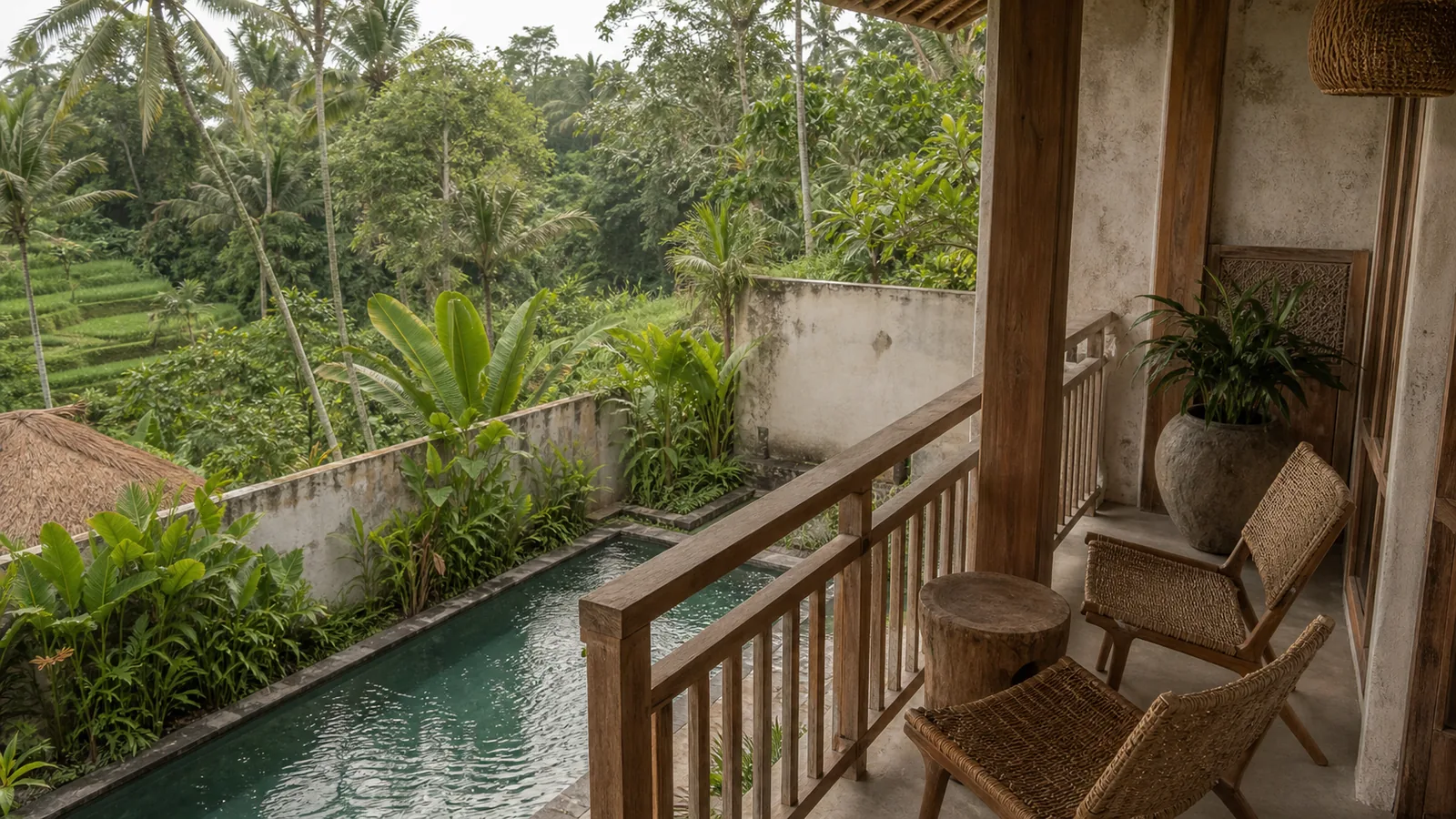
Ubud is not a beach destination, and that shapes who visits and what a viable operation looks like. The area draws visitors specifically seeking yoga, meditation, health and slow travel. Retreat operators — yoga teachers, Ayurvedic practitioners, sound-healing facilitators — have built Ubud into a recognisable international brand for this category.
A well-configured property can attract longer-stay programmes that generate consistent weekly revenue during peak months. That demand is real. What varies is whether a specific property is operationally suited to capture it, and whether the ownership structure permits you to do so legally.
Ubud Location Pockets: Access and Viability
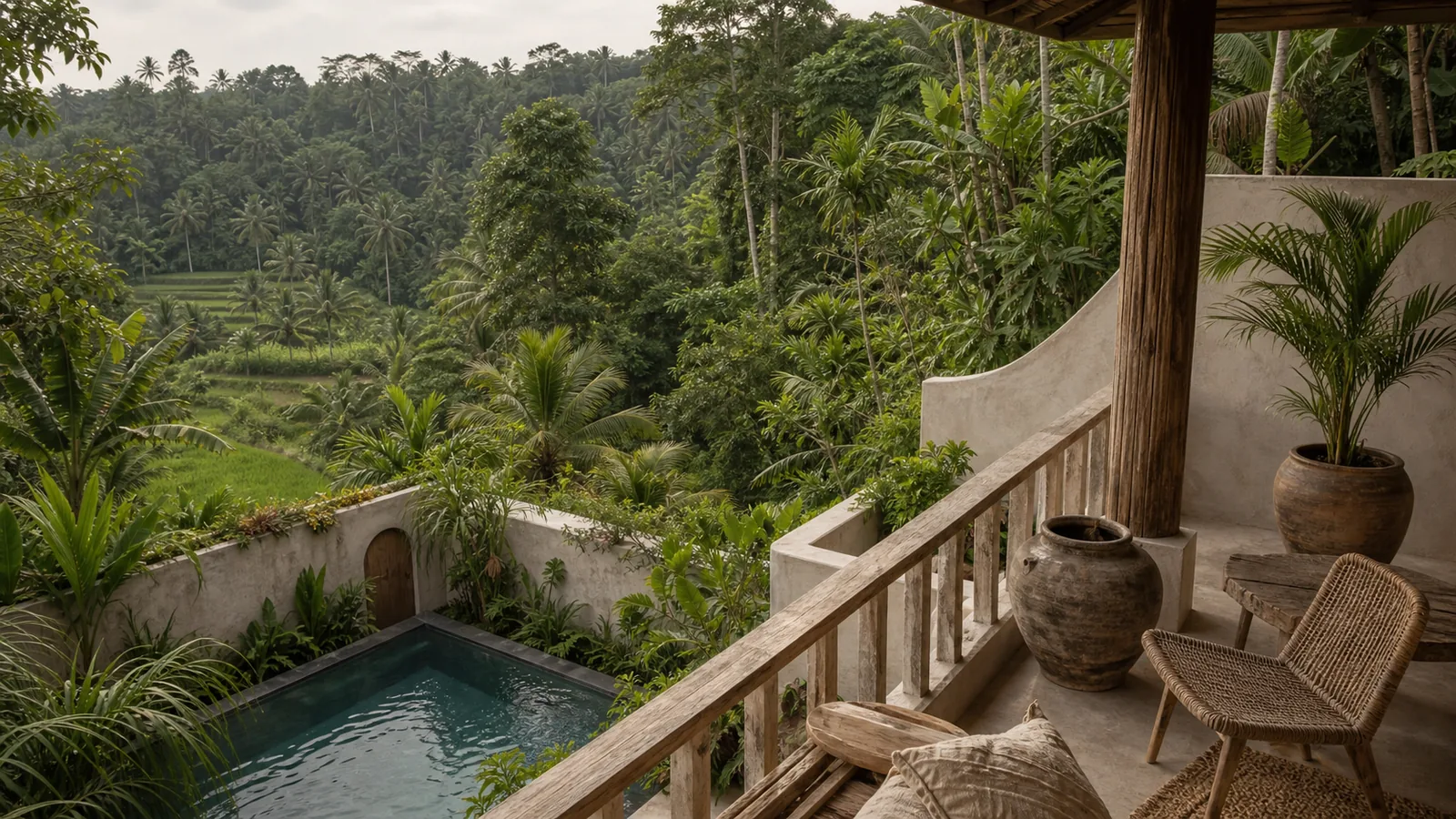
Ubud spans dozens of villages and rice-terrace pockets with meaningfully different road conditions, zoning and noise exposure. This is a comparison framework, not a ranking.
| Road Access | Retreat Scale | Noise | Notes | |
|---|---|---|---|---|
| Central Ubud / Campuhan | Near amenities, traffic | Boutique (4–8 guests) | Moderate–high | Higher land values; limited parking |
| Penestanan / Sayan / Kedewatan | Steep, narrow, cliff edges | Medium with planning | Low (riverside) | Scenic premium; transfer logistics need planning |
| Tegallalang / Payangan corridor | More vehicle-accessible | Larger (10–20 guests) | Low–moderate | Better plot sizes; distance from central Ubud |
| Mas / Lodtunduh edge | Good sealed access | Flexible | Moderate | Zoning varies — verify RDTR against certificate |
Sources including ulu-homes.id and balirealestateconsultants.com note that accessibility and zoning suitability are the two most underestimated variables in Ubud retreat acquisitions.
Evaluating Ubud Wellness Retreat Villas: Suitability Beyond Bedroom Count
A bedroom count does not define retreat suitability. These criteria separate a genuine wellness venue from a photogenic holiday villa.
Space configuration
- Dedicated yoga shala with adequate ceiling height, ventilation and group floor area
- Treatment rooms separated from sleeping areas for guest privacy
- Kitchen with commercial capacity for retreat meal programmes — not a domestic setup
- Separate staff access or quarters so operations do not run through guest areas
Guest flow and privacy
- Groups of 8–16 can move between activity zones without crossing each other’s private areas
- Pool accessible from all guest units without passing through bedrooms
- A clear arrival sequence — not a gate that opens directly into sleeping quarters
Vehicle access
- A 12-seat minivan can reach the property and turn around without reversing on a steep incline
- Staff motorbike parking that does not block the guest arrival point
- Road surface that holds in wet season — sealed, gravel or compacted dirt, confirmed on-site
Ownership and Licensing: What Needs Verification
This is educational context, not legal advice. The correct structure for a specific property and intended use requires a qualified Indonesian notary and legal advisor.
Ownership route for foreign buyers
Foreign nationals cannot hold freehold (Hak Milik) title directly. Common structures are long-term leasehold (Hak Sewa) or ownership through a qualified Indonesian entity (PT PMA). Nominee freehold arrangements carry significant legal risk. Each route has different term lengths, tax obligations and exit considerations. See the Bali zoning and property guide for a full overview.
Retreat-use licensing
A standard short-stay villa rental license does not automatically permit commercial retreat operations. Structured programmes with paying guests may require:
- A commercial hospitality license appropriate to the scale of operation
- Confirmation that the zoning certificate permits the intended use class
- Health and wellness operator registration if clinical or treatment services are offered
Request the IMB or PBG (building permit), the land certificate and any existing operational licenses in writing before proceeding. Do not rely on verbal assurances about what the property is “normally used for.”
Lease term
For leasehold purchases, confirm the remaining term on the existing title. Fewer than 15 years remaining will constrain financing and compress the resale pool. Understand whether a renewal option exists and on what terms — this is a negotiation point before purchase, not after.
ROI Assumptions: What the Numbers Require
Yield figures are assumptions, not guarantees. This is not financial advice.
Wellness retreat villa yields in Ubud vary significantly based on operator quality, programme fill rates, seasonal patterns and operating cost structure. For yield context and market comparisons across property types, see Bali villa rental yield.
Any contractual yield promise or operator promise from a management company should be read carefully: understand what conditions trigger payment, what deductions apply, and what happens if the operator exits.
Operating costs are often understated in retreat property projections:
- Annual tropical maintenance (timber, thatch, plaster, pool): typically 3–6% of property value per year, per balitecture.com
- Staff costs: cleaning, cooking, gardening, reception, security — these scale with programme frequency
- Wet-season occupancy: retreat demand is stronger April–October; November–March typically requires a different operator strategy or pricing model
- Management fee if not owner-operated: typically 20–30% of gross revenue, per investlandbali.com
A property that reaches target yield only under optimistic occupancy with no maintenance reserve warrants conservative re-modelling before commitment.
Common Buyer Objections — Addressed Directly
“The agent says it already operates as a retreat.” Current use does not confirm current licensing. Request the license documents. Use without the correct license creates compliance exposure that transfers to you on purchase.
“The ROI projections look strong.” Ask what occupancy rate the projections assume, what management fees are deducted, and whether a maintenance reserve is included. Adjust the inputs and check whether the case still holds.
“The lease has 18 years — that’s fine.” For personal use, possibly. For resale or refinancing, a lease below 20 years limits your buyer pool and financing options. Price this into the acquisition.
“It has good reviews.” Reviews reflect guest experience. They do not reflect lease decay, deferred maintenance, licensing gaps or the road condition in October. Verify independently.
Before You Book Viewings: Verification Checklist
- Confirm vehicle access with a van matching your transfer needs — do not rely on listing photos
- Request the land certificate (HGB, SHM or leasehold deed) and check remaining term
- Request the building permit (IMB/PBG) and confirm it covers all built structures
- Ask what license class currently permits short-stay or retreat use on this property
- Check the zoning map against the certificate — agricultural zoning does not permit commercial hospitality without conversion
- Walk the slope and drainage in wet-season conditions, or ask specifically about historical water ingress
- Assess staff and utility access separately from guest access
- Request price history and days-on-market
- Identify adjacent undeveloped land and ask about known construction or land-use plans
- Confirm whether any existing operator has a management contract attached to the property and on what terms it can be terminated
Frequently Asked Questions
Can a foreign buyer legally own a wellness retreat villa in Ubud? Not on freehold title directly. Foreign buyers most commonly use long-term leasehold or a PT PMA structure. Each has different term limits, costs and exit considerations. Get advice from a qualified Indonesian notary before committing to any structure.
What licenses does a retreat property need to operate legally? This depends on the scale and structure of the operation. A short-stay villa license covers different activities than a structured retreat with daily programmes, treatments and group meals. Most commercial-scale retreat operations require a separate hospitality or tourism business license. Verify against your intended use before purchase.
What makes a villa unsuitable for retreat use even if it looks right in photos? The most common disqualifiers: road access too narrow for group transfers, no separate staff access, insufficient yoga or treatment space, domestic-scale kitchen, no guest privacy separation between units, and a license class that does not cover structured programmes with paying groups.
Is Ubud a stronger retreat investment than the south of Bali? Ubud offers stronger retreat brand alignment and longer average stays, but with lower walk-in demand, more complex access, higher maintenance requirements and a smaller resale pool than Canggu or Seminyak. The investment case is more operator-dependent and requires more specific due diligence than a flexible beach villa.
How long should a retreat villa lease be to make the numbers work? Most buyer-side advisors treat 20 years minimum as the threshold for a viable leasehold acquisition when operating costs, occupancy build-up and eventual resale are factored in. Shorter terms compress the horizon and limit exit options. Renewal clauses should be verified in the notarial deed, not assumed from verbal agreements.
Ubud Climate Baseline for Villa Owners
We analysed 2015–2025 hourly reanalysis for one representative Ubud inland reference grid point. It is an area-level ownership baseline—not a weather station at the property and not evidence of mould, corrosion, flooding or repair incidence.
| Measured or derived metric | Ubud inland reference baseline |
|---|---|
| Mean annual rainfall | 2,640 mm/year |
| Rainy days (≥1 mm) | 268.5 days/year |
| Average relative humidity | 87.3% |
| Hours at ≥85% humidity | 5,948 hours/year |
| Longest observed wet run | 107 consecutive days |
| Average 10 m wind speed | 6.9 km/h |
| Strong-wind days (≥30 km/h in any hour) | 0.0 days/year |
| Mean daily shortwave energy | 5.68 kWh/m²/day |
| Daily mean temperature variability (standard deviation) | 0.93°C |
| Mean daily temperature range | 4.87°C |
| Mean wet-bulb temperature (derived) | 24.0°C |
| Mean first-layer soil moisture | 0.231 m³/m³ |
| FAO-56 reference evapotranspiration (derived) | 1,487 mm/year |
| Rainiest months (mean monthly rainfall) | February (394 mm), January (387 mm), December (364 mm) |
| Rain Burden (relative 0–100) | 100 |
| Humidity Burden (relative 0–100) | 100 |
| Outdoor Maintenance Pressure (relative 0–100) | 70 |
| Seasonal Weather Stability (relative 0–100) | 7 |
Grid-resolution note
Used as an inland comparison point in production articles; it does not represent every Ubud hillside or valley.
How to use this in due diligence
- Inspect roof junctions, drainage routes, retaining conditions and shaded exterior surfaces for signs of persistent moisture.
- Review ventilation, bathroom extraction, AC condensate drainage and timber-finishing schedules; the dataset does not measure mould incidence.
- Budget garden, pool and exterior maintenance from the villa’s actual condition and service records, not from an Ubud label alone.
Source: Copernicus Climate Change Service (C3S) ERA5-Land, hourly reanalysis, 2015–2025, analysed in Asia/Makassar local time. Relative humidity, wet-bulb temperature and reference evapotranspiration are derived from the source variables using the documented methodology. Data: CC BY 4.0. See the climate data methodology for formulas, thresholds and limitations. Values are area-level model estimates, not measurements at a villa; relative indices compare five configured Bali location requests (four distinct populated grid cells), not engineering, insurance, cost or yield ratings.
Next Step
If you are comparing properties against a wellness or retreat-use brief, the most efficient path is a structured shortlist that applies these verification filters before viewings — not after. A buyer-side desk aligns incentives with your verification needs rather than a seller’s.
This page is produced by the Verified Bali Buyer Desk — a buyer-side research and shortlisting service, not a sales agent or developer. Content is reviewed for factual accuracy and updated periodically; it is not legal or financial advice. For legal structure and due diligence, work with a qualified Indonesian notary and an independent property auditor.