This guide was produced by the Verified Bali Villas editorial team and reviewed by a Bali-based property adviser with experience in foreign buyer transactions. It is buyer education, not legal or financial advice. Verify all ownership, zoning, and licensing claims with qualified local professionals before any purchase decision.
Ubud vs Canggu Property: Which Area Fits Your Buying Thesis?
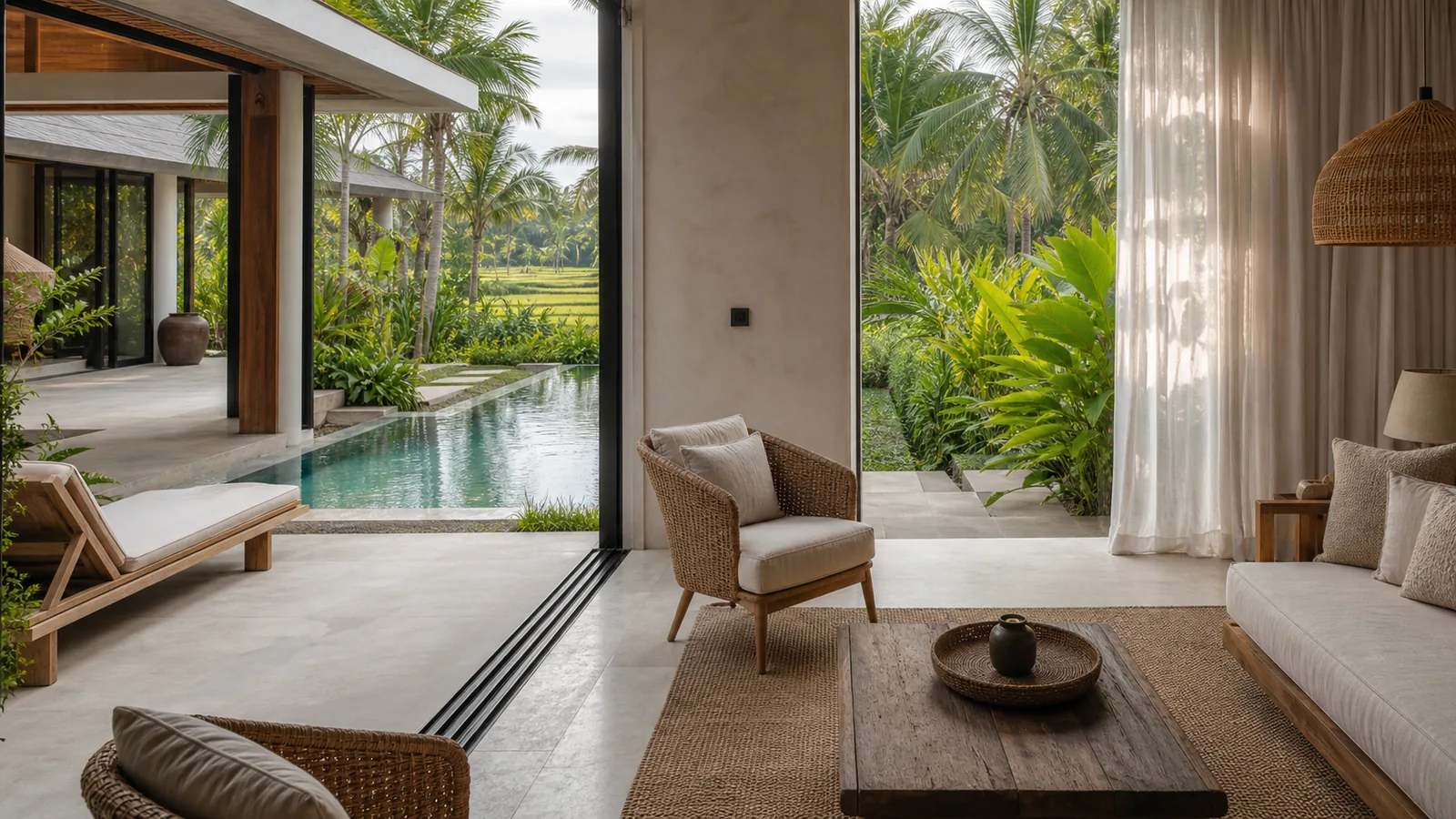
Most people searching ubud vs canggu property have already formed a picture — jungle and rice terraces versus surf breaks and co-working cafés. That picture is not what determines whether a purchase works. What matters is whether the ownership route, zoning, rental licensing, access, and exit assumptions hold up on the specific parcel you are considering.
This page is written for buyers who are shortlisting, not daydreaming. It covers what each area actually requires you to verify — and what most comparison guides quietly skip.
What Most Guides Miss
Almost every Ubud-vs-Canggu article is lifestyle copy: Ubud for “spiritual seekers,” Canggu for “digital nomads.” That framing omits the questions that determine whether a purchase holds up.
Zoning is parcel-level, not area-level. A villa photographed against Ubud rice terraces may sit in a corridor zoned for agriculture under Bali Province Perda No. 2/2023 or Gianyar Regency Perda No. 2/2023. Pink, yellow, and green shorthand in marketing materials is not a substitute for a parcel-level zoning certificate. The same applies in Canggu — coastal popularity does not confirm rental-use approval on a specific plot. See Bali zoning for foreigners for a plain-language orientation.
Ownership structure must be confirmed by a local notary. Under PP No. 18/2021, foreign buyers accessing Indonesian property through leasehold (Hak Sewa), right-to-use structures (Hak Pakai), or PT PMA arrangements each carry different terms, renewal conditions, and resale implications. No marketing summary substitutes for independent legal review.
Rental-use licensing is a sequence, not a checkbox. For a villa to operate commercially, the business classification (KBLI 55193 for Vila) must fit the NIB, the building permit (PBG) and occupancy certificate (SLF) must be in place or demonstrably obtainable, and local operating approvals must be verified. SIMBG is the official public portal for PBG and SLF records. For a step-by-step orientation, see Bali villa licensing for foreigners.
Gross yield is not net yield. Operator-quoted return figures for both areas typically exclude management fees, utilities, pool maintenance, vacancy, licensing costs, and taxes. Operating costs reduce gross figures materially. See Bali villa rental yield for a fuller breakdown of how the two numbers diverge.
How the Two Areas Compare
Ubud and Surrounds: Longer Stays, Retreat Potential, Access Trade-Offs
Ubud, Penestanan, Sayan, and Tegallalang attract guests oriented toward wellness retreats, yoga programs, longer digital-nomad stays, and private villa escapes. Longer average bookings can lower turnover costs and support retreat-package structures — but whether that applies to a specific property depends entirely on its licensing status, location, and operating competition.
What to verify before viewing an Ubud property:
- Vehicle access. Many jungle and hillside villas sit at the end of narrow or steep lanes. Confirm a standard car can reach the gate in wet season, that parking is available for guests, and what access looks like if a vehicle breaks down en route.
- Slope, drainage, and damp. Terraced positions photograph well and erode quietly. A wet-season inspection or independent surveyor report reveals whether drainage is adequate and whether slope maintenance is a recurring cost. Jungle humidity accelerates damp and structural wear; a condition survey is standard due diligence, not optional.
- Retreat-use licensing. If the intended model involves wellness programming, group classes, or food service for guests, licensing requirements extend beyond standard short-stay villa approvals. Verify NIB and KBLI fit, health and safety approvals, and local operating conditions with qualified advisers — not with agent assurances.
- Zoning under Gianyar spatial planning. Most Ubud-area land falls under Gianyar Regency’s 2023–2043 spatial plan. Request the official zoning certificate (KKPR or equivalent) for any parcel before proceeding.
BPS Bali reported 553,328 in-person foreign tourist visits to Bali in April 2026 and a 57.94% star-hotel room occupancy rate for the same month. This is island-level tourism demand context, not a forecast for any specific Ubud property.
Canggu: Coastal Name Recognition, Higher Entry Price, Saturation Risk
Canggu carries stronger name recognition on short-stay platforms and higher headline transaction prices in beachside or prime-zone positions. Resale liquidity — the pool of buyers who recognise the area — tends to be wider than for remote Ubud pockets. That comes with real trade-offs.
What to verify before viewing a Canggu property:
- Saturation. Canggu has absorbed significant new villa supply. In segments with many comparable listings, occupancy is not assured and pricing pressure from competing units is real. Market observers note that operational differentiation — management quality, photography, review scores — matters more in saturated zones than in markets where supply is thinner.
- Traffic and journey times. Canggu’s road network is constrained relative to its density. Test the drive to Ngurah Rai Airport and to other parts of south Bali at different times of day before treating access as convenient.
- Noise and construction exposure. Active development creates noise risk from neighbouring builds, road works, and nightlife corridors. Inspect at multiple times of day and check what is approved or under construction nearby before signing.
- Entry capital and exit assumptions. Canggu’s higher headline prices mean larger capital per unit. Comparative market commentary suggests entry pricing in prime Canggu zones is meaningfully above mid-Ubud pockets, though ranges vary widely by parcel and condition. The wider buyer pool on exit is an advantage — but factor in a longer potential recovery period if the market softens before you need to sell.
- Zoning under Badung regency and Bali provincial planning. Canggu falls under Badung Regency. Coastal and tourism-zone designations require parcel-level confirmation — not area-level assumption based on the neighbourhood’s reputation.
Ubud vs Canggu Property: Buyer-Fit Matrix
| Factor | Ubud Area | Canggu Area |
|---|---|---|
| Typical guest profile | Longer stays, wellness, retreats | Short stays, surf, digital nomads |
| Entry price range | Generally lower per sqm | Generally higher per sqm |
| Resale liquidity | Narrower buyer pool | Wider name recognition |
| Access complexity | Higher (lanes, slopes, terrain) | Moderate (traffic, not terrain) |
| Retreat-use licensing | Additional approvals required | Standard villa licensing applies |
| Saturation risk | Lower in outer pockets | Higher in prime coastal zones |
| Noise and construction risk | Lower where remote | Higher in active development corridors |
| Operating model fit | Long-stay, retreat packages | Short-stay platforms, high turnover |
All comparisons are general buyer observations. Parcel-level verification is required before any purchase decision.
When Diversifying Across Both Areas Makes Sense
Buyers with sufficient capital sometimes shortlist one property in each area to reduce concentration risk. Ubud and Canggu attract different guest segments at different times, which can smooth portfolio-level occupancy across the year. If one area’s licensing environment or zoning policy tightens, the other position is unaffected.
Diversification does not reduce the verification burden — it doubles it. Each property requires its own zoning confirmation, legal structure review, PBG and SLF status check, KBLI fit assessment, and building condition inspection. The best areas to buy property in Bali page covers additional pockets beyond Ubud and Canggu that some buyers include in a diversified shortlist.
Before Viewings: Buyer Verification Checklist
Work through these before committing time to physical inspections:
- Listing freshness. Confirm the property is live and the price is current. Many Bali listings circulate across multiple agents without updates.
- Ownership term and title evidence. Request the full lease or title document, confirm the seller’s authority to transfer, and have a qualified local notary review the structure under PP No. 18/2021.
- Zoning certificate. Request the KKPR or official zoning document for the specific parcel. Do not rely on agent descriptions of permitted use.
- PBG and SLF status. Search SIMBG records for the property’s building permit and occupancy certificate before assuming the structure is legally complete.
- NIB and KBLI fit. If the intended use is commercial rental or retreat operations, confirm that the NIB and KBLI cover the intended activity.
- Physical inspection. Engage a local surveyor for building condition, drainage, slope stability, and damp — especially for Ubud jungle and hillside properties.
- Access test. Drive to the gate yourself at different times of day, and in wet-season conditions where possible.
- Net yield model. Build projections using conservative occupancy assumptions, realistic management fees, and full operating costs. Compare against Bali villa rental yield benchmarks before relying on any operator-quoted return.
Frequently Asked Questions
Can a foreigner own a villa freehold in Ubud or Canggu? Indonesian freehold (Hak Milik) is not available to foreign nationals. Foreign buyers typically access property through long-term leasehold, Hak Pakai structures where available, or PT PMA (foreign-owned company) arrangements. Each route has different terms, renewal conditions, and resale implications. A qualified local notary must review the specific structure for any transaction. This is buyer education, not legal advice — confirm with your own adviser.
What is a realistic lease length to look for? Leases of 25–30 years with a documented extension option are more common, though shorter terms also circulate. The critical questions are whether the extension is binding, who holds the underlying title, whether the lease is notarially registered, and what happens on the landowner’s death or in a dispute. Request the draft lease before proceeding to viewings, not after.
Do I need a separate license for a wellness retreat in Ubud? Typically, yes. Standard villa rental licensing (KBLI 55193) covers short-stay accommodation. Retreat programming — group classes, therapeutic services, food and beverage for guests — may require additional business classifications, health ministry approvals, and local operating permits depending on the specific activities. Do not assume a standard villa license covers retreat operations without specific legal confirmation.
How do I check if a villa’s permits are genuine? The SIMBG portal allows public searches on PBG and SLF records. For NIB verification, cross-check via the OSS platform. Engage a local property lawyer or due-diligence firm to verify documents against regency records and confirm the ownership chain is unencumbered. Verbal or marketing-material permit claims should always be followed by independent document review.
Is it safe to complete a purchase without visiting Bali in person? Remote shortlisting is reasonable for narrowing options. Completing a purchase without physical inspection carries material risk. Building condition, access, noise exposure, damp, slope stability, and neighbourhood context are difficult to assess from photos or video alone. Buyer-side due diligence in person — or through a trusted local representative — before contract signing is standard practice among experienced buyers.

Climate Comparison: What the Grid Can Support
We compared 2015–2025 hourly reanalysis at the representative Bali reference points below. The figures help screen maintenance exposure; they do not rank individual villas or replace drainage, material and building-condition checks.
| Reference point | Rainfall mm/year | Rainy days/year | Avg RH | ≥85% RH hours/year | Avg wind km/h | Strong-wind days/year† | Solar kWh/m²/day | Outdoor pressure* |
|---|---|---|---|---|---|---|---|---|
| Ubud inland reference | 2,640 | 268.5 | 87.3% | 5,948 | 6.9 | 0.0 | 5.68 | 70 |
| Canggu coastal corridor | 1,662 | 245.7 | 85.5% | 4,968 | 12.2 | 6.4 | 5.71 | 49 |
*Outdoor Maintenance Pressure is a relative index across five configured location requests, which resolve to four distinct populated grid cells. The raw weather metrics beside it remain the evidence. †A strong-wind day contains at least one hourly 10 m wind-speed value of 30 km/h or more; this is a comparison threshold, not a damage threshold.
How to use this in due diligence
- Use the difference in raw rainfall, humidity and wind metrics as an inspection-priority input, not a prediction of which area will produce a better return.
- Compare roof form, drainage, shade, ventilation, materials, sea exposure and maintenance history at the actual properties.
- Do not infer mould, corrosion, flooding, repair frequency or parcel performance from an area grid.
Source: Copernicus Climate Change Service (C3S) ERA5-Land, hourly reanalysis, 2015–2025, analysed in Asia/Makassar local time. Relative humidity, wet-bulb temperature and reference evapotranspiration are derived from the source variables using the documented methodology. Data: CC BY 4.0. See the climate data methodology for formulas, thresholds and limitations. Values are area-level model estimates, not measurements at a villa; relative indices compare five configured Bali location requests (four distinct populated grid cells), not engineering, insurance, cost or yield ratings.
Next Steps
The comparison between ubud vs canggu property is ultimately a question of which ownership route, operating thesis, and risk tolerance fits your specific situation — not which area photographs better.
For verified property options and buyer-side shortlisting support, see Ubud villas for sale and Canggu villas for sale. For additional area options, see best areas to buy property in Bali. For rental yield assumptions and how to model net returns before committing to an area, see Bali villa rental yield.
Editorial note: This article was produced by the Verified Bali Villas editorial team and reviewed by a Bali-based property adviser independent of any listings featured on this site. It reflects publicly available regulatory frameworks and general market observations as of mid-2026. Spatial planning, licensing frameworks, and market conditions change — verify all claims with qualified local professionals before acting. Nothing here is legal, financial, or investment advice.