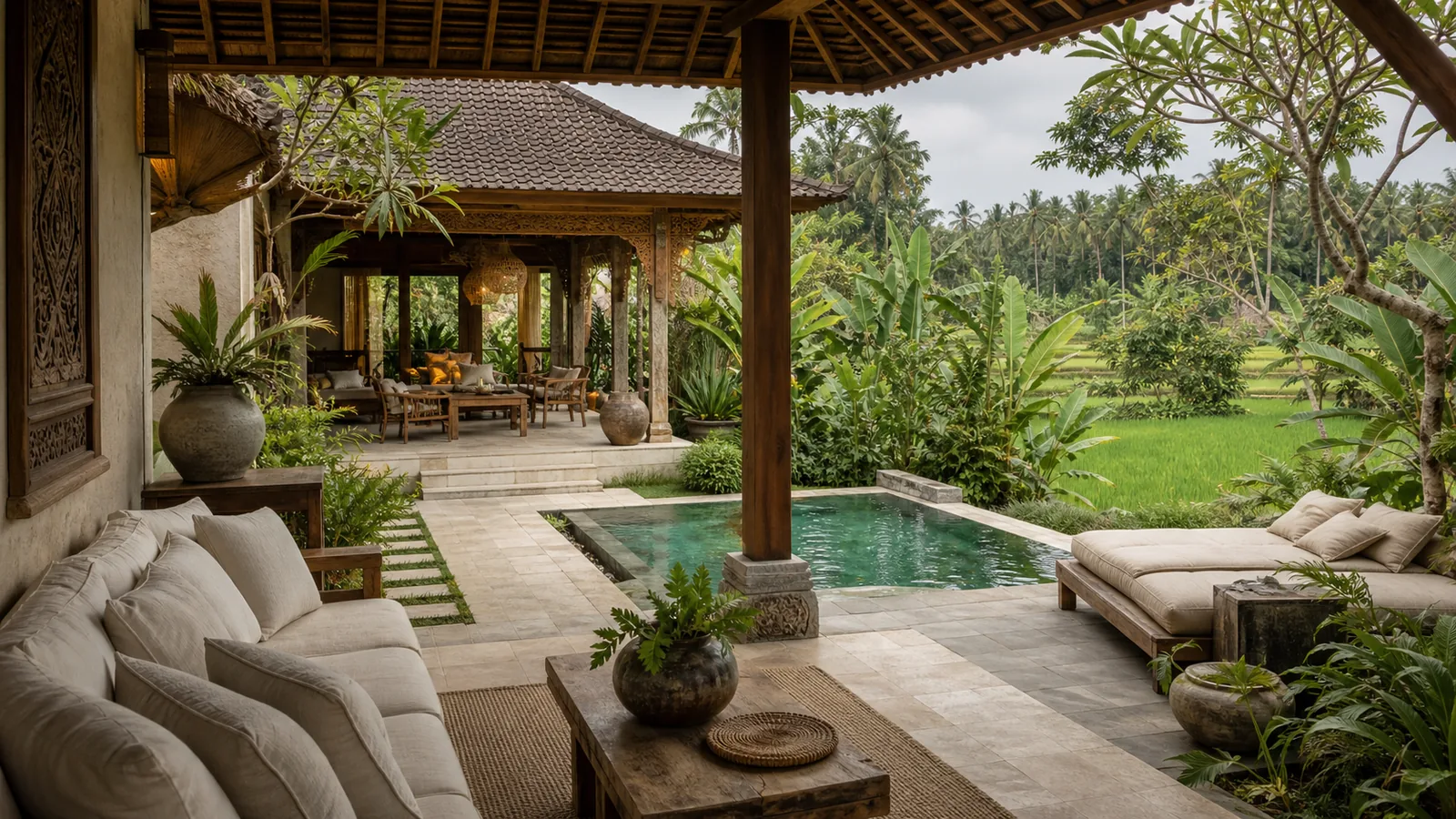
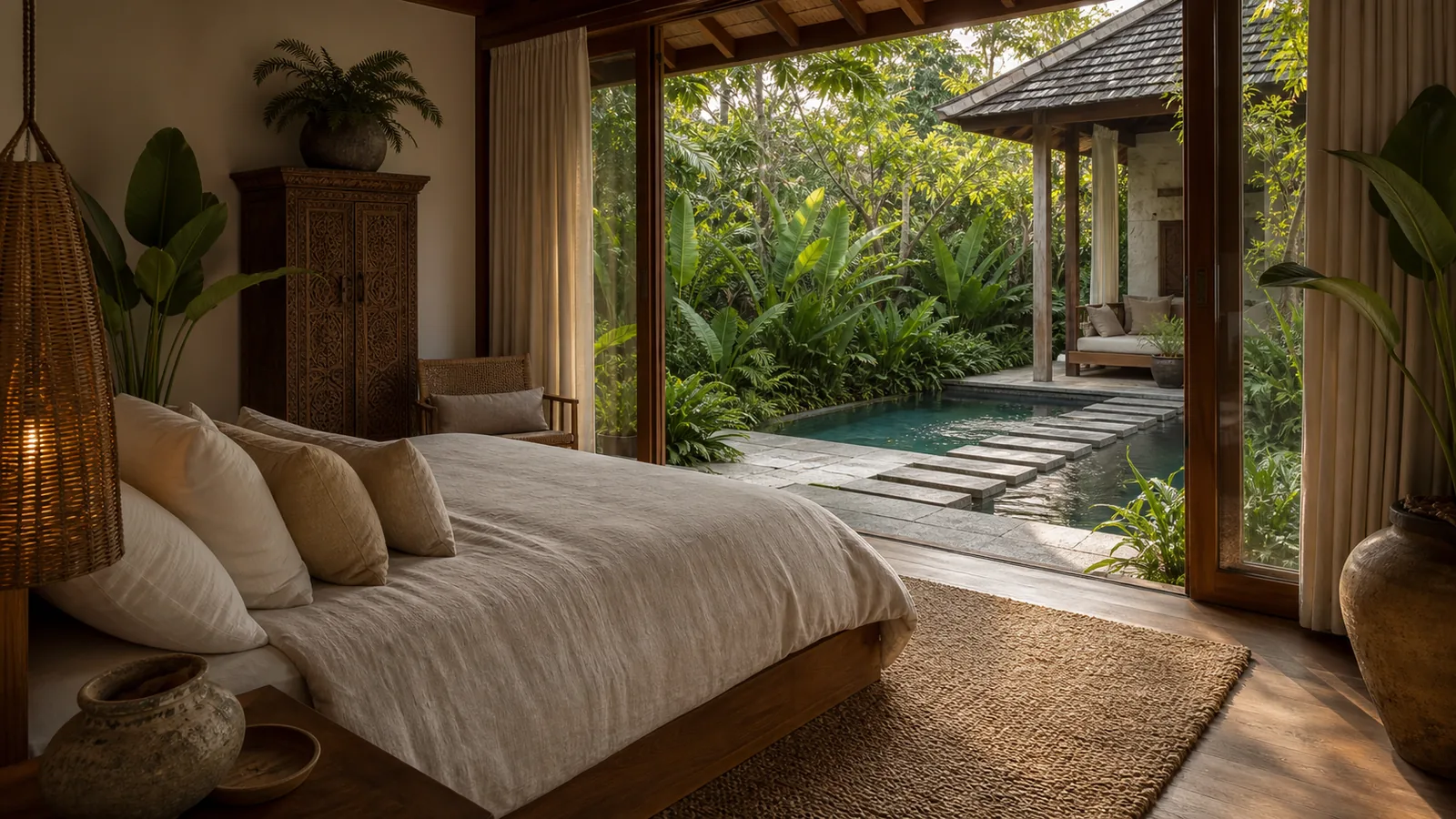
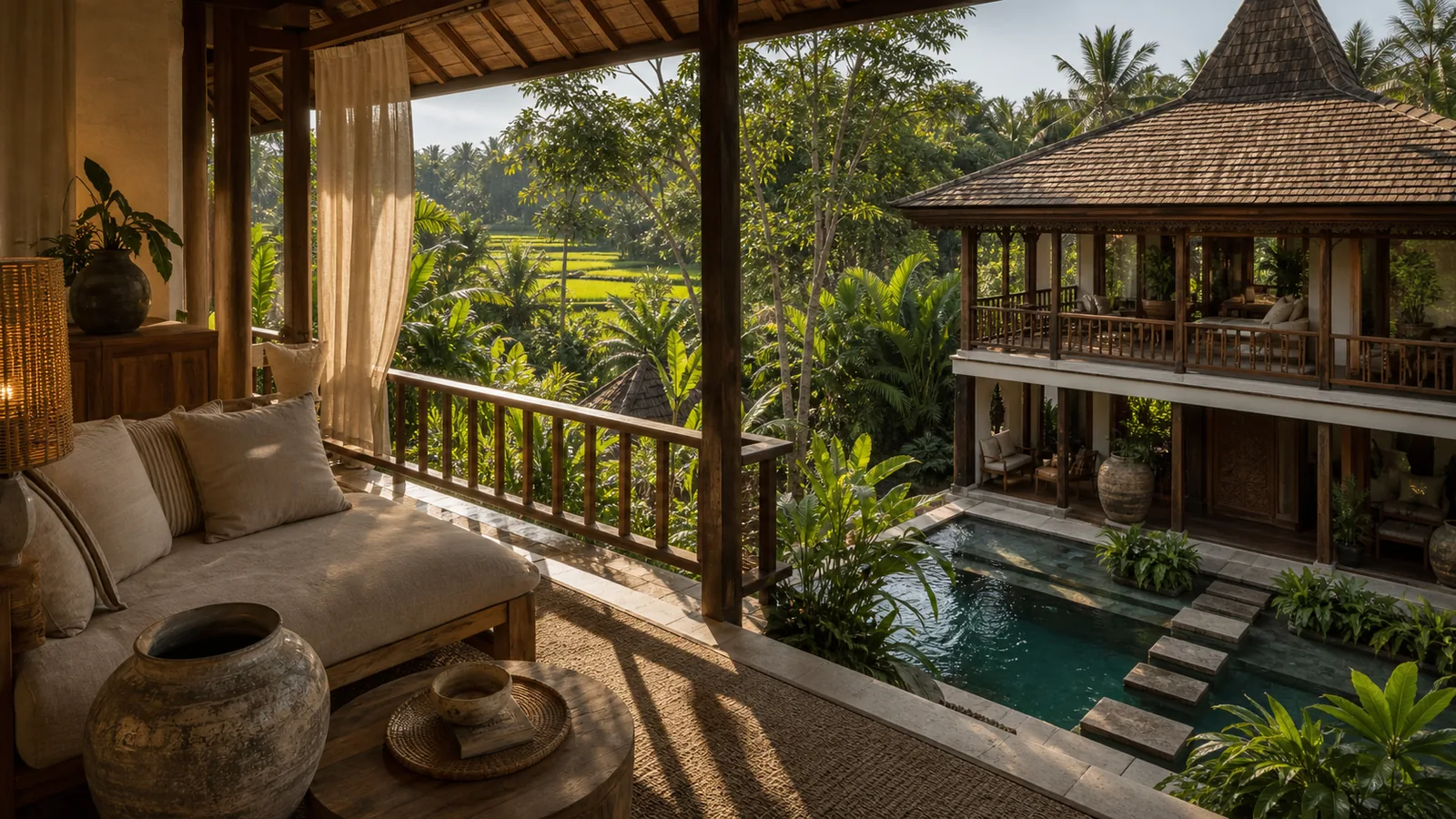
Most buyers shortlist an Ubud jungle villa the same way: a photograph does the work. Canopy framing a pool terrace, rice paddies catching afternoon light, the implied promise of mornings without traffic noise. That part is straightforward.
The harder question — the one that separates a property that holds its value from one that quietly erodes it — is what sits behind the photograph. This guide addresses ubud jungle villas for sale from the buyer’s side: what to verify, what to pressure-test, and what too many buyers skip until it is expensive to fix.
This is a buyer-side guide, not a listing platform. We do not hold inventory, and we do not promote specific properties. We help qualified buyers build a verified shortlist and run pre-commitment checks before they spend time or legal fees on the wrong asset.
What Most Guides Miss
Most Ubud villa content stops at atmosphere. Wellness potential, drone footage, spiritual energy. What rarely appears before the viewing stage:
Access reality. Roads outside Ubud’s main corridors narrow fast. A villa that photographs beautifully may sit at the end of a single-lane track that becomes impassable in heavy rain. Confirm road width, gradient, and wet-season usability before anything else — not from the listing, but from someone currently using that access route.
Slope, drainage, and damp. Jungle settings mean elevation. Elevation means retaining walls, cut faces, drainage channels, and moisture ingress. Request a visit during or immediately after rain. Check wall surfaces, ceiling boards, and subfloor ventilation. Humidity maintenance is a real recurring cost in this environment — not a footnote.
View and privacy protection. The outlook in the listing photos is not legally protected. A neighbour’s structure, a road widening, or a new development on the adjacent lot can alter the view within your lease term. Ask what sits on adjacent parcels and whether any development or infrastructure plans are registered nearby.
Retreat-use licensing. Buyers planning wellness or accommodation use must verify that the building permit (IMB) and the applicable business licence — typically a Pondok Wisata for small-scale accommodation, or a more complex hospitality licence for organised retreat programming — actually cover the intended commercial activity. A villa that operates informally is not the same as a licensed retreat business, and the distinction becomes yours to resolve after purchase.
Lease decay and exit liquidity. Many Ubud jungle properties are offered on leasehold terms. A 25-year lease with 10 years already elapsed is a materially different asset from a fresh 30-year term. Understand remaining life, extension clauses, and what a realistic resale looks like before you reach the end of the term.
How Ubud Jungle Villas for Sale Compare to the Southern Markets
Ubud’s appeal is genuine, but its risk profile differs sharply from Canggu or Seminyak. The demand profile skews toward retreat groups and long-stay tenants rather than walk-in short-stay volume. This changes the operating model significantly.
| Factor | Ubud Jungle / Rice-Field | South Bali Beach Corridors |
|---|---|---|
| Off-peak occupancy baseline | Lower; long-stay and retreat demand compensates | Higher; short-stay walk-in demand continues year-round |
| Maintenance intensity | High: humidity, timber, pool, pest management | Moderate to high: salt air, pool, tourist wear |
| Access risk | Elevated: narrow lanes, seasonal conditions | Generally lower in established corridors |
| Retreat-use licensing | Required for group programming | Uncommon use case |
| Exit liquidity | Narrower buyer pool; longer hold typical | Broader comparable transaction base |
These differences are not reasons to avoid the market. They are reasons to shortlist with precision and size operating reserves accordingly. For broader context on area and budget fit, see the Ubud villas for sale overview and the Bali villas by budget guide.
Drainage and Maintenance Risk Reference
Jungle and rice-field sites carry specific physical risks that vary by configuration. Use this as a pre-inspection orientation, not a substitute for a qualified site survey.
| Risk Factor | Elevated Risk Signals | Lower Risk Signals |
|---|---|---|
| Surface drainage | Property sits below road level; no channels visible | At or above road level; channels present and clear |
| Retaining walls | Old poured concrete; no weep holes visible | Engineer-certified block or stone; weep holes maintained |
| Roof | Thatch over three years old; dark staining on boards | Tile or treated timber; recent condition survey on file |
| Timber | Untreated or poorly ventilated structural members | Treated hardwood; annual pest inspection records available |
| Humidity control | No active ventilation; mould or efflorescence visible | Dehumidifiers installed; clean wall surfaces throughout |
Rental-Fit Scenarios by Guest Type
Ubud jungle properties attract a narrower but often higher-spending guest profile. Whether the property configuration suits the target market directly affects operating assumptions.
| Guest Type | Property Fit | Key Requirements |
|---|---|---|
| Long-stay digital nomad | Strong if workspace and connectivity are confirmed | Reliable internet; low ambient noise; functional kitchen |
| Wellness retreat group | Strong if licensed and configured for programming | Pondok Wisata or retreat licence; staff; programme space |
| Short-stay couple | Moderate; depends on management and platform presence | Active listing management; laundry; arrival protocols |
| Private long-term tenant | Good for well-maintained jungle properties | Stable utility supply; accessible property manager |
Rental yield figures across Bali vary significantly by location, condition, management quality, and licence status. Investland’s rental yield overview and Balitecture’s rental income analysis offer published reference points. No figure from either source should be treated as a projection for a specific property without verified occupancy history and full operating cost accounting.
Ownership Routes for Foreign Buyers
Foreign nationals cannot hold freehold title (Hak Milik) in Indonesia directly. The structures most commonly used in the Ubud market:
Leasehold (Hak Sewa / Hak Pakai). The most accessible route: a long-term lease, typically 25–30 years, with extension provisions negotiated at signing. Lease terms, extension rights, and treatment of structures at expiry all require careful legal review before commitment.
PT PMA (foreign-owned company). A licensed foreign investment company can hold Hak Guna Bangunan title in applicable categories. This route carries incorporation costs, ongoing compliance obligations, and sector-specific restrictions.
Nominee arrangements. Placing title in the name of an Indonesian national on behalf of a foreign buyer is widely considered to carry material legal risk by Indonesian legal practitioners and is not a recommended starting point.
This is educational context, not legal advice. All ownership structure decisions require a qualified Indonesian notary (notaris) and independent legal review before any commitment.
For buyers focused on the wellness and retreat operating model, the Ubud wellness retreat villas guide covers licensing and operational considerations in more detail.
Pre-Viewing Checklist
Before spending time — or legal fees — on any specific property, work through these verification layers.
Access and infrastructure
- Road surface and gradient from the nearest sealed road to the property gate
- Wet-season passability confirmed by a local agent or current occupant, not listing copy
- Mains water confirmed, or bore/well with documented flow rate and quality test
- PLN grid connection; note any dependency on generator or solar as primary supply
Structure and condition
- Independent building inspection within the past 24 months
- Visible damp, efflorescence, rust staining, or retaining-wall movement
- Surface-water drainage path from the property and from adjacent higher land
- Maintenance history on file: roof, pool, timber, electrical, pest treatment
Legal and title
- Title type, current holder, and — if leasehold — remaining term with documented extension provisions
- IMB reflecting current footprint and declared use
- Any existing PPJB, lease agreements, or encumbrances on the title
- Land and building tax (PBB) records for the past three years
Operating assumptions
- Licence in place for rental or retreat use — or explicit confirmation that none is held
- Staff currently employed and their contractual status
- Verifiable rental history, or clear statement that projections are based on comparable assets only
Villa Audit’s due diligence guide covers how to verify operating claims and review documentation independently.
Common Buyer Questions
“The agent says the yield is 10–12%. Is that realistic?”
Yield projections from selling agents typically reflect best-case assumptions: peak occupancy, full-price nightly rates, no vacancy gaps, no significant maintenance costs. Ask for bank-statement-backed revenue over at least 12 months, net of management fees, cleaning, maintenance, utilities, and tax. The realistic net figure is often materially lower than the headline rate. Any contractual yield promise from an operator should be reviewed by a lawyer before you rely on it.
“The lease is 25 years — isn’t that sufficient?”
It depends on how much has already elapsed. A lease with eight years remaining has a structurally limited resale market. Extension clauses that exist in principle but require landlord consent at the time of exercise are not the same as a secured extended term. Confirm extension provisions are documented and have a notary assess enforceability before signing.
“The villa already operates as a retreat — can I just take it over?”
Verify that the licence is current, in the correct name, transferable to a new operator, and covers the specific activities you intend to run. A retreat that operated informally under a previous owner’s personal arrangements is not a licensed business that transfers automatically.
Frequently Asked Questions
Can a foreign buyer legally purchase a villa in Ubud? Foreign nationals cannot hold freehold title directly. The practical paths are leasehold — the most common — or ownership through a PT PMA foreign-owned company for longer-term title access. Each carries different costs, obligations, and risk profiles. Independent advice from a qualified Indonesian notary is essential before selecting a structure.
What distinguishes a Pondok Wisata from a full hospitality licence? A Pondok Wisata covers small-scale accommodation rental, typically up to five rooms in a residential-character property. A commercial hospitality licence is required for larger operations, organised retreat programming, or food and beverage service to non-staying guests. The distinction determines permitted activities and applicable staffing and insurance requirements.
How do I verify a rental yield claim? Request booking platform data or bank statements covering at least 12 months, ideally 24. Separate gross revenue from net return after management fees, cleaning, maintenance, utilities, staff, and platform commissions. Net return against total acquisition cost — not headline gross revenue — is the figure that matters for your operating model.
How much does access quality affect value in Ubud? Materially. Access constrains guest arrival experience, maintenance contractor logistics, and the depth of your eventual resale market. Properties at the end of difficult tracks have a structurally smaller buyer and tenant pool, which affects both occupancy potential and exit timing. Assess access on foot and by car in wet-season conditions — not from a map.
Is Ubud suitable for a purely investment-motivated buyer? It can be, for buyers who understand what the operating model requires: lower walk-in demand than south Bali, higher maintenance intensity, a narrower guest profile, and longer holds typical of leasehold assets. It rewards buyers who have correctly sized the operating budget, secured reliable local management, and matched property configuration to a realistic guest type. It does not suit buyers expecting passive income from a minimal-effort purchase with thin reserves.
Ubud Climate Baseline for Villa Owners
We analysed 2015–2025 hourly reanalysis for one representative Ubud inland reference grid point. It is an area-level ownership baseline—not a weather station at the property and not evidence of mould, corrosion, flooding or repair incidence.
| Measured or derived metric | Ubud inland reference baseline |
|---|---|
| Mean annual rainfall | 2,640 mm/year |
| Rainy days (≥1 mm) | 268.5 days/year |
| Average relative humidity | 87.3% |
| Hours at ≥85% humidity | 5,948 hours/year |
| Longest observed wet run | 107 consecutive days |
| Average 10 m wind speed | 6.9 km/h |
| Strong-wind days (≥30 km/h in any hour) | 0.0 days/year |
| Mean daily shortwave energy | 5.68 kWh/m²/day |
| Daily mean temperature variability (standard deviation) | 0.93°C |
| Mean daily temperature range | 4.87°C |
| Mean wet-bulb temperature (derived) | 24.0°C |
| Mean first-layer soil moisture | 0.231 m³/m³ |
| FAO-56 reference evapotranspiration (derived) | 1,487 mm/year |
| Rainiest months (mean monthly rainfall) | February (394 mm), January (387 mm), December (364 mm) |
| Rain Burden (relative 0–100) | 100 |
| Humidity Burden (relative 0–100) | 100 |
| Outdoor Maintenance Pressure (relative 0–100) | 70 |
| Seasonal Weather Stability (relative 0–100) | 7 |
Grid-resolution note
Used as an inland comparison point in production articles; it does not represent every Ubud hillside or valley.
How to use this in due diligence
- Inspect roof junctions, drainage routes, retaining conditions and shaded exterior surfaces for signs of persistent moisture.
- Review ventilation, bathroom extraction, AC condensate drainage and timber-finishing schedules; the dataset does not measure mould incidence.
- Budget garden, pool and exterior maintenance from the villa’s actual condition and service records, not from an Ubud label alone.
Source: Copernicus Climate Change Service (C3S) ERA5-Land, hourly reanalysis, 2015–2025, analysed in Asia/Makassar local time. Relative humidity, wet-bulb temperature and reference evapotranspiration are derived from the source variables using the documented methodology. Data: CC BY 4.0. See the climate data methodology for formulas, thresholds and limitations. Values are area-level model estimates, not measurements at a villa; relative indices compare five configured Bali location requests (four distinct populated grid cells), not engineering, insurance, cost or yield ratings.
Before You Move Forward
An Ubud jungle or rice-field villa can be a genuinely compelling asset: one confirmed for access, verified on title and lease terms, stress-tested against realistic occupancy assumptions, and structured through qualified local counsel. The photograph that started your search is a legitimate signal — it just needs the verification layer that most guides skip.
Building that shortlist — and running the pre-viewing checks that protect your position — is exactly what a buyer-side desk is for.