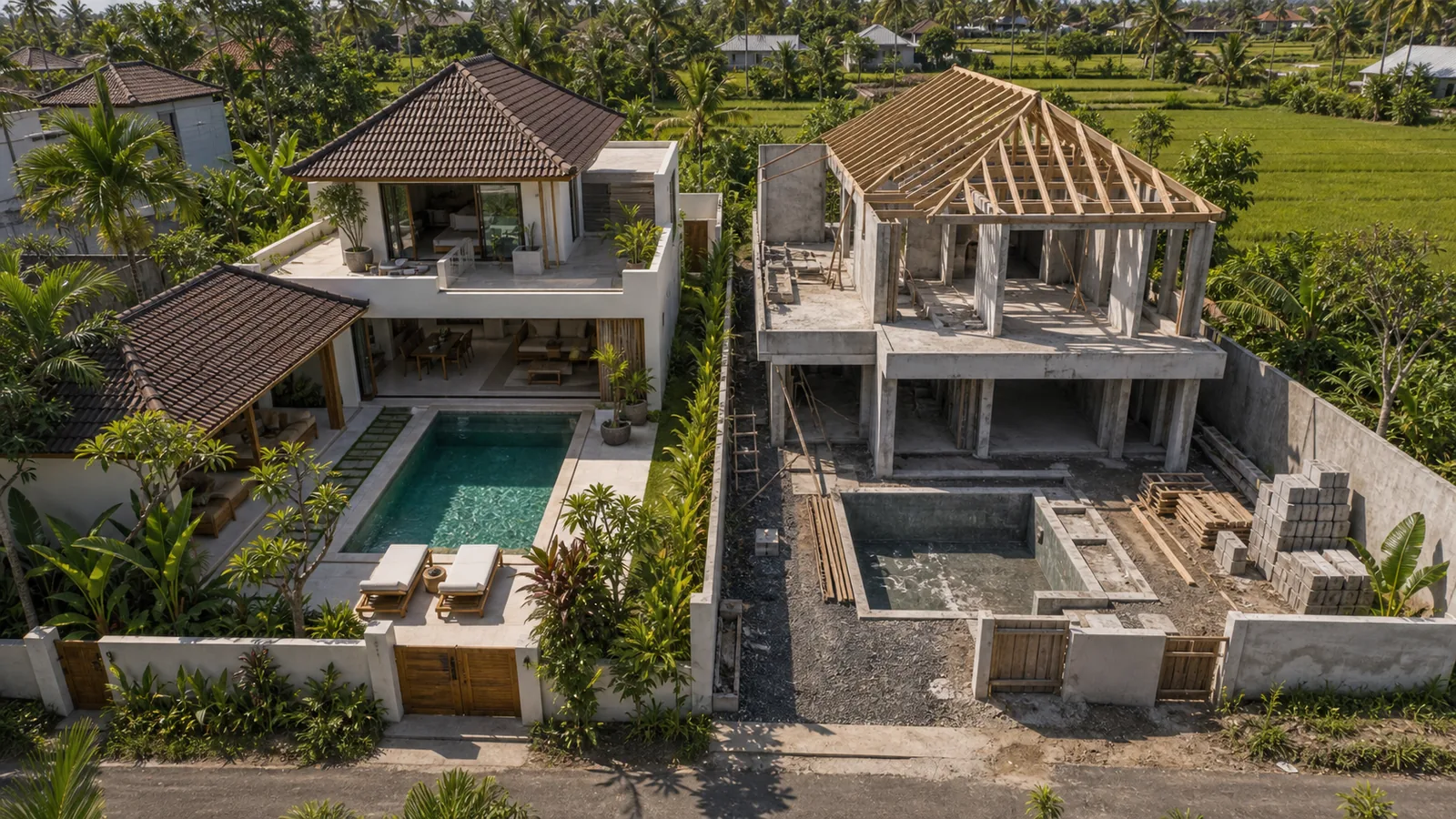
Ready Built vs Off Plan Bali: What to Know Before You Commit
Most buyers approach this decision backwards — they look at price first, then try to work out whether the numbers stack up. The better sequence when weighing ready built vs off plan Bali options is: understand the legal structure, model the real operating costs, then decide whether the price makes sense for the route you are taking.
This page maps both paths for a foreign buyer. What each one actually involves, where assumptions tend to break down, and what to verify before shortlisting. It does not argue for either option and does not constitute legal or financial advice.
Reviewer note: Yield figures and cost ranges on this page are illustrative, drawn from publicly available operator data and industry guides. They will vary significantly by location, property type, and management arrangement. Seek independent legal and financial counsel before committing capital.

What Most Guides Miss
The standard comparison frames this as price versus convenience. Off-plan costs less because you are buying before construction; ready-built costs more but you can move straight in. That framing omits the factors that matter most to a foreign buyer.
1. The legal structure matters more than the build stage. A finished villa with eleven years left on a poorly structured leasehold is a worse asset than a well-structured off-plan with a twenty-five-year term and a clean extension clause. Whether the villa exists yet is secondary to what you will actually own, for how long, and under what legal framework.
2. Off-plan delivery timelines in Bali are not fixed. Developer delays of six to eighteen months are routine, not exceptional. Buyers who plan rental income to service ongoing costs — carrying costs, living expenses, loan repayments — should treat projected handover dates as optimistic by default. A review of off-plan property structures in Bali notes that conservative planning always builds in a completion buffer.
3. The gross yield figure tells you almost nothing. A quoted ten to twelve percent gross yield bears little resemblance to what a buyer will actually receive. Once management fees, platform commissions, maintenance, insurance, local taxes, and owner usage periods are applied, industry analysis consistently shows net yields running forty to fifty percent lower than headline figures. Buyers who do not build this model before purchase are regularly surprised in year two.

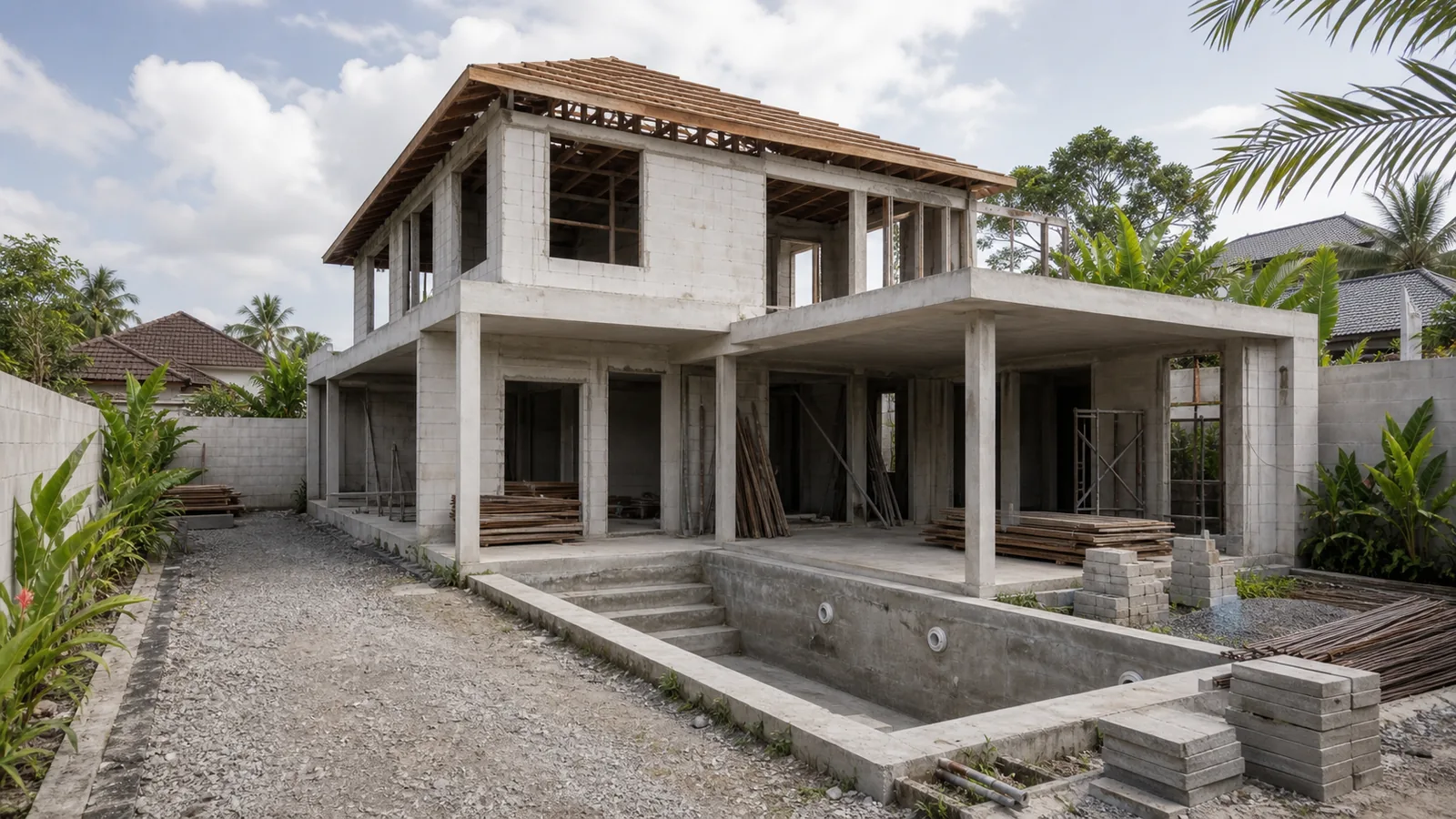
Ready Built: What You’re Actually Buying
A ready-built villa is completed and — in most cases — already operating as a short-term rental. You can inspect it in person, review actual booking records, and assess the management arrangement before signing.
What the purchase includes
- A physical asset you can verify before committing
- An existing rental operation with a documented track record (or lack of one)
- The remaining term on a leasehold, or a freehold-equivalent structure via an Indonesian legal entity or Hak Pakai for eligible buyers
- Current licensing status: IMB/PBG, operational permits, and short-term rental registration
Where ready-built buyers run into trouble
Lease decay. Buying a villa with fourteen years remaining and no written extension option means you are also buying a declining resale position. Due diligence guides for Bali villas identify this as one of the most frequently skipped verification steps. Confirm the remaining term, the extension mechanism, and who controls the extension right.
Deferred maintenance. An active rental property accumulates wear. Pools, roofs, electrics, and soft furnishings all have replacement cycles. Budget a maintenance reserve of one to two percent of property value per year and conduct a physical inspection that goes beyond the surface finish.
Inherited management problems. You may be acquiring weak review scores, unfavourable platform positioning, or a management contract with punishing termination terms. Read the management agreement in full before exchanging on the purchase. The exit clause matters as much as the fee structure.
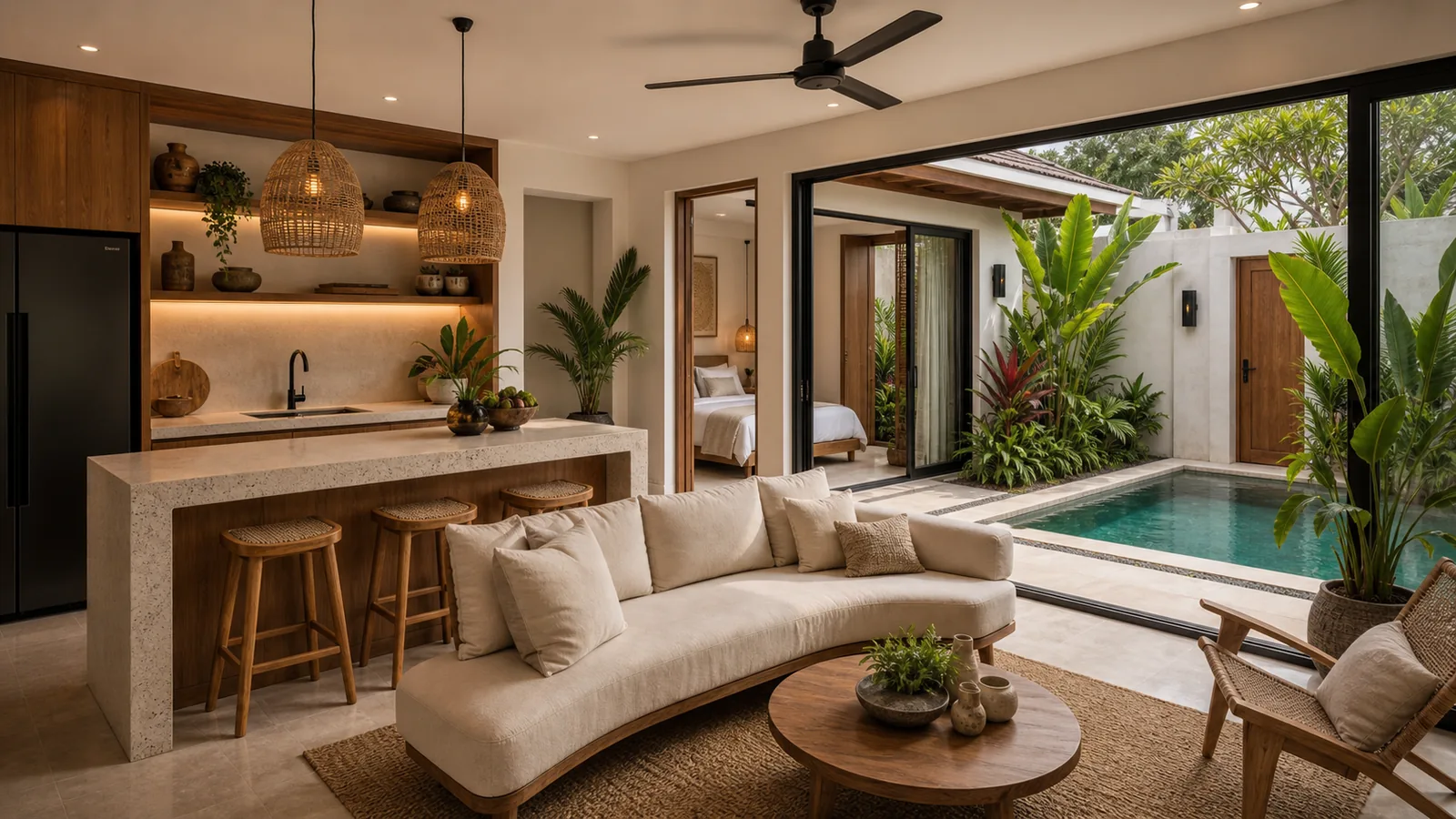
Off Plan: What You’re Actually Buying
Off-plan means committing capital before the villa exists, typically at a discount to projected completed value, in exchange for accepting construction risk, delivery risk, and a wait of twelve months or more before any income is possible.
What the purchase includes
- A contractual right to a future asset
- Early-investor pricing — if the developer’s assumptions and timeline hold
- A legal structure that must be verified before signing, not after
- Exposure to the developer’s financial position and execution track record
Where off-plan buyers run into trouble
Developer risk. Smaller Bali developers may not have the capitalisation to complete a project if sales slow mid-construction. Research completed projects, visit at least one in person, and speak with current owners rather than developer-provided references. The Bali off-plan villas section outlines the specific questions to ask before committing.
Specification drift. The finished product may differ materially from the renders. All finish specifications and material grades should be written into the contract — not attached as a separate marketing document that carries no legal weight.
Contractual yield promises. Some off-plan developers offer a rental guarantee clause — a contractual income promise for one to three years post-handover. These require careful scrutiny. If the promise is funded by building it into the purchase price, you are effectively pre-paying your own return while the developer retains flexibility over the actual operation. Understand the reserve mechanism, the recourse if it fails, and what happens after the promise period ends.
Ready Built vs Off Plan Bali: Side-by-Side Comparison
| Factor | Ready Built | Off Plan |
|---|---|---|
| Capital at signing | Higher — often full price or large deposit | Lower — staged during construction |
| Time to first income | Immediate if already operating | 12–24+ months post-handover |
| Physical inspection | Yes — inspect before committing | No — renders and contract only |
| Actual rental history | Often available from operator records | None — projections only |
| Construction risk | None | Significant; delays are common |
| Lease term | Must verify — may already be partly elapsed | Usually a full new term from the developer |
| Legal structure | Verifiable before purchase | Must verify developer’s structure upfront |
| Price versus completion | Premium reflects certainty | Discount reflects risk |
| Exit and resale | Active market for operating villas | Depends on market conditions at handover |
Yield Reality: Gross vs Net
Research into Bali rental yields and ROI analysis from operators active in 2025 consistently show the same gap between headline and realised figures. The table below illustrates typical deductions. Apply them consistently to any property you are comparing, regardless of route.
Illustrative operating cost deductions from gross revenue:
| Cost item | Typical range |
|---|---|
| Property management fee | 20–30% of gross revenue |
| Platform commissions | 3–15% |
| Maintenance reserve | 1–2% of property value per year |
| Insurance | Varies by size and location |
| Local taxes and levies | Varies by legal structure |
| Owner usage (unrented periods) | Depends on personal use pattern |
A villa quoted at twelve percent gross yield may realistically deliver five to seven percent net after these deductions. That net figure then needs to be weighed against total acquisition cost: purchase price, legal fees, agent commission, fit-out, and currency conversion costs.
For a downside scenario: model fifty-five percent occupancy rather than seventy-five, management fees at the upper end, and one month of unplanned maintenance per year. If the investment still makes sense under those conditions, the base case is credible. If it only works at eighty percent occupancy with no adverse events, it warrants more scrutiny. The Ayla ROI calculator provides a useful framework for building your own model with consistent inputs.
Common Objections, Examined
“Off-plan is always cheaper.” Not necessarily. Some off-plan projects in high-demand areas are priced at or above comparable completed properties, with the apparent discount reflecting lower immediate value rather than a genuine markdown. Compare on projected net income per dollar invested once the operating model is applied — not purchase price in isolation.
“Ready-built gives me certainty.” Certainty of physical delivery, yes. Not certainty of yield. An operating rental can carry embedded problems — weak occupancy, low review scores, a management contract you cannot exit — that suppress income for twelve to twenty-four months after acquisition. Review the operational track record, not just the physical asset.
“The rental guarantee clause protects me.” A contractual yield promise provides a floor for the stated period, and only while the developer remains solvent. Ask specifically how the reserve is funded, what recourse exists if it fails, and what the income profile looks like once the promise period expires. The presence of a guarantee clause is not itself a signal of project quality.
Before You Shortlist: Verification Checklist
Apply these checks to any property under either route.
- Ownership structure confirmed by an independent Indonesian notary — not only the developer’s recommended lawyer
- Lease term, extension option, and extension conditions written into the contract
- IMB/PBG and operational permits current and matching intended use
- Short-term rental legally registered where required under applicable zoning rules
- Management contract reviewed in full: termination clauses, fee structure, platform exclusivity
- Operating cost model built from comparable active properties, not developer projections
- Exit route confirmed: can the leasehold be resold, to whom, and at what transfer cost
- Off-plan only: developer’s completed project portfolio and financial references independently verified; permits confirmed as obtained before sales launched
- Ready-built only: actual booking records for the past twelve months reviewed, not summary figures provided by the seller
The Bali property due diligence checklist provides a structured walkthrough of each step with the specific documents to request.
Frequently Asked Questions
Can a foreigner legally buy either a ready-built or off-plan villa in Bali? Foreign nationals cannot hold freehold title (Hak Milik) directly. Common legal routes include a long-term leasehold, a PT PMA structure for buyers meeting investment thresholds, or Hak Pakai for permanent residents in qualifying conditions. These structures apply to both ready-built and off-plan purchases. This page is educational context, not legal advice — consult a qualified Indonesian notary before committing.
Is the deposit on an off-plan villa refundable if there are delays? This depends entirely on the contract. Some developers include delayed-completion penalties or refund provisions; others do not. Refundability must be explicitly written into the purchase agreement before any deposit is paid. Do not assume standard consumer protections apply.
How do I verify a developer’s track record? Request a list of completed projects, visit at least one in person, and speak directly with current owners rather than developer-provided contacts. Confirm that building permits were obtained before sales launched and that land title is clean before any funds are transferred.
What does “yield” actually mean in a Bali context? Gross yield is annual rental revenue divided by purchase price. Net yield subtracts all operating costs. Neither figure accounts for capital movement over time or leasehold depreciation. When comparing properties, use the same occupancy assumption and cost deductions for both — otherwise you are comparing projections built on different inputs.
Is there an active resale market for leasehold villas? Yes, but liquidity varies by area, lease term remaining, and market conditions. Villas with fewer than ten years remaining are significantly harder to resell to foreign buyers. Confirm the remaining term and any extension option before treating resale as a viable exit.
How does location affect the ready built vs off plan Bali comparison? Substantially. Areas with active short-term rental markets — Canggu, Uluwatu, Seminyak — offer more comparable occupancy data for due diligence. Emerging areas such as Tabanan or East Bali carry lower entry prices but fewer reliable benchmarks. An off-plan project in an unproven location adds market risk on top of developer and delivery risk at the same time.
Climate Data as an Operating-Cost Stress Test
We compared 2015–2025 hourly reanalysis at the representative Bali reference points below. The figures help screen maintenance exposure; they do not rank individual villas or replace drainage, material and building-condition checks.
| Reference point | Rainfall mm/year | Rainy days/year | Avg RH | ≥85% RH hours/year | Avg wind km/h | Strong-wind days/year† | Solar kWh/m²/day | Outdoor pressure* |
|---|---|---|---|---|---|---|---|---|
| Canggu coastal corridor | 1,662 | 245.7 | 85.5% | 4,968 | 12.2 | 6.4 | 5.71 | 49 |
| Ubud inland reference | 2,640 | 268.5 | 87.3% | 5,948 | 6.9 | 0.0 | 5.68 | 70 |
| Uluwatu and Pecatu reference | 1,630 | 261.6 | 80.2% | 1,944 | 14.4 | 31.5 | 5.69 | 29 |
| Sanur east-coast reference | 1,754 | 264.0 | 83.7% | 3,901 | 12.1 | 4.9 | 5.68 | 35 |
| Seminyak southwest-coast reference | 1,754 | 264.0 | 83.7% | 3,901 | 12.1 | 4.9 | 5.68 | 35 |
*Outdoor Maintenance Pressure is a relative index across five configured location requests, which resolve to four distinct populated grid cells. The raw weather metrics beside it remain the evidence. †A strong-wind day contains at least one hourly 10 m wind-speed value of 30 km/h or more; this is a comparison threshold, not a damage threshold.
Grid-resolution disclosures
- Uluwatu and Pecatu reference uses the nearest populated ERA5-Land cell at -8.8, 115.2 (13 km from the requested coordinate), so it is a broad-area proxy.
- Sanur east-coast reference and Seminyak southwest-coast reference resolve to the same populated land cell at -8.7, 115.2; identical values mean the grid cannot distinguish those requests, not that their parcel-level conditions are identical.
How to use this in due diligence
- Add explicit AC, drainage, exterior-finish, pool and landscape allowances to the operating model instead of hiding them inside one management percentage.
- Stress-test the reserve against the asset’s age, materials and service history; a relative climate score is not a forecast of cost, occupancy or yield.
- Confirm whether owner, operator, tenant or body corporate pays for routine and capital work before comparing net returns.
Source: Copernicus Climate Change Service (C3S) ERA5-Land, hourly reanalysis, 2015–2025, analysed in Asia/Makassar local time. Relative humidity, wet-bulb temperature and reference evapotranspiration are derived from the source variables using the documented methodology. Data: CC BY 4.0. See the climate data methodology for formulas, thresholds and limitations. Values are area-level model estimates, not measurements at a villa; relative indices compare five configured Bali location requests (four distinct populated grid cells), not engineering, insurance, cost or yield ratings.
Next Step
If you are comparing routes and want to see verified properties from both categories — with ownership structure and lease terms confirmed before you enquire — the starting point is a qualified shortlist, not a developer brochure.