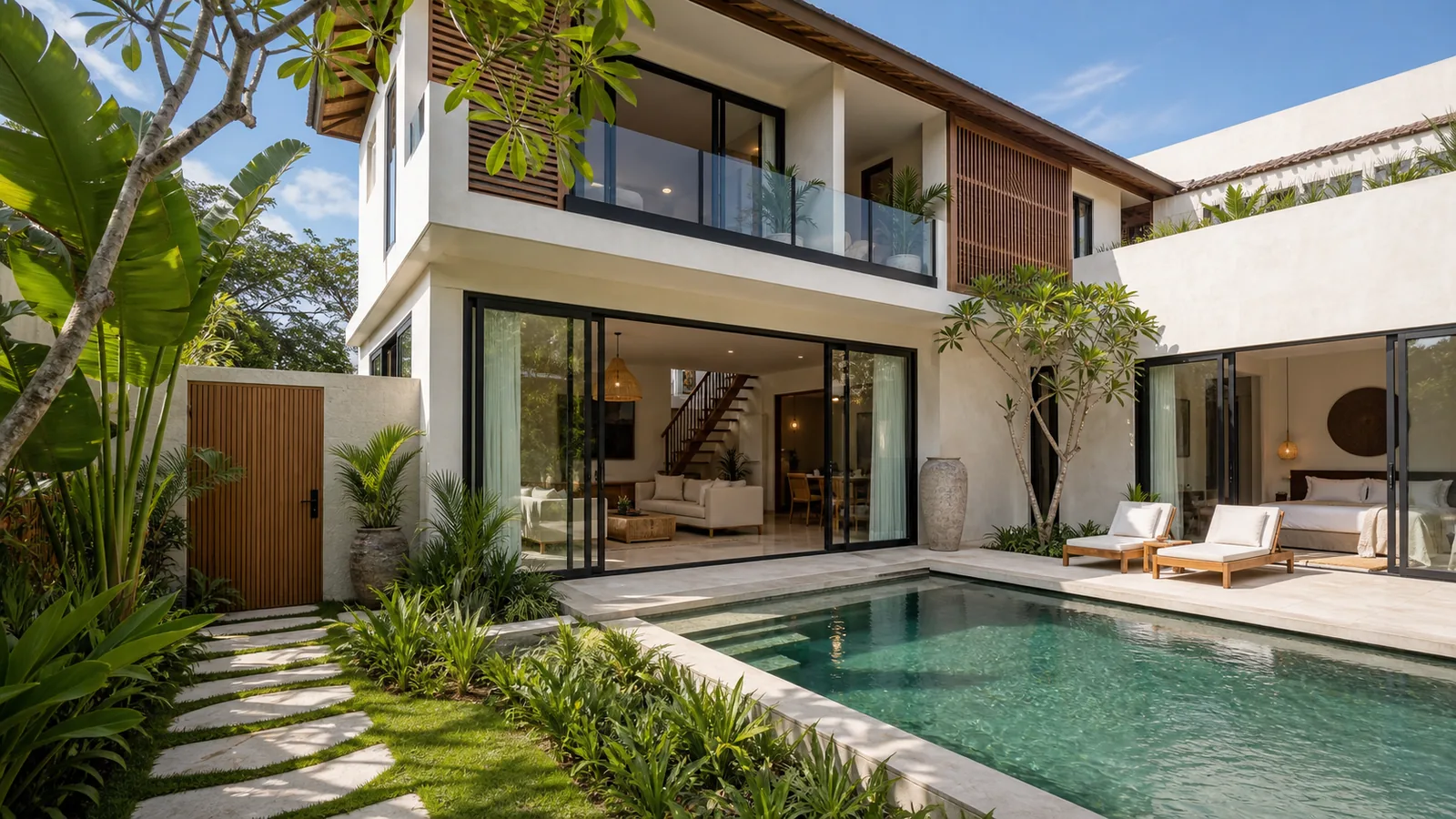
The first question when searching for property for sale in Bali is not which villa to view — it is which listings are worth trusting.
The market holds genuine, well-documented properties alongside stale postings, duplicate listings at different prices, and villas whose legal structure limits what a foreign buyer can actually own. The gap between those two categories is where buyers lose months and sometimes money.
This guide covers what to check before you contact an agent, how ownership structure shapes your shortlist, and the questions that reveal whether a property is transaction-ready or not.
Who this is for: Foreign buyers with a defined budget and area preference who want fewer wasted viewings and a clearer next step.
What Most Guides Miss
Most articles about property for sale in Bali follow one of two templates: a listing collection with attractive photos and no legal context, or a generic legal guide that never connects to how you actually choose a property.
Both consistently skip four things that matter most to a prepared buyer.
Listing freshness. A villa priced at a given figure three months ago may be under offer, re-priced, or withdrawn. The same property routinely appears across five or more agency websites with different prices, availability status, or lease terms stated — because agents in Bali operate on co-brokerage arrangements without a shared MLS. What you see on a listing page is often a snapshot from an earlier moment.
Ownership term as a first-pass filter. Leasehold and freehold are not interchangeable for foreign buyers. Whether a property is available on a legal ownership route that works for your residency status and intended use needs to be answered before you discuss the pool, the view, or the kitchen finish.
Certificate type. Listings rarely state the land or building certificate upfront. The certificate — SHM (Hak Milik), HGB (Hak Guna Bangunan), or Hak Pakai — determines which ownership routes are legally available and affects resale, financing, and exit options.
ROI figures presented as targets. Gross yield projections in listing materials are almost always calculated using 70–80% occupancy applied to rack rates. Net yield after management fees (typically 20–30% of gross revenue), maintenance reserves, void periods, Indonesian income tax, and any company compliance costs is a materially different number. A gross figure of 12% can net to 6–7% under realistic assumptions — which may still be worthwhile, but should be modelled, not assumed.
Ownership Routes: What a Foreign Buyer Can Actually Use
Indonesian land law does not allow foreigners to hold Hak Milik (freehold title) in their own name. Three practical routes exist for foreign buyers, each with different costs, terms, and requirements.
| Route | Who It Suits | Term | Key Requirement | Watch For |
|---|---|---|---|---|
| Leasehold (Hak Sewa) | Most foreign buyers | 25–30 yr + extensions | Notarially registered lease | Remaining term, extension documentation |
| Hak Pakai | Foreign nationals with KITAS/KITAP | 25 yr, renewable | Valid Indonesian stay permit | Land classification, residential use only |
| PT PMA (foreign company) | Investment buyers, longer horizons | Ongoing | Company setup + annual filings | Setup cost USD 3,000–8,000; compliance obligations |
A fourth option — nominee arrangements using an Indonesian national’s name — is not recommended. It is legally precarious and not reliably enforceable. No legitimate buyer-side advisor will suggest it.
“Freehold villa” in a listing typically means the land holds Hak Milik status — not that a foreign buyer can hold that title personally. Always ask to see the actual certificate. For a detailed comparison of the two routes most buyers use, see Leasehold vs Freehold Bali.

How to Filter Bali Property for Sale Before You Act
These filters are not a substitute for legal due diligence — they are the pre-screening questions that determine whether a property is worth the time. A seller or agent who is transaction-ready should be able to answer most of them within a few business days.
Pre-Shortlist Checklist
- Certificate type confirmed in writing (SHM, HGB, Hak Pakai, or other)
- Ownership route is compatible with your residency status and intended use
- Lease term confirmed: years remaining, and extension mechanism is documented — not just verbally expected
- Listed price confirmed as current — owner-verified within the last 90 days
- Property not simultaneously listed at a different price by another agent
- Short-term rental licensing confirmed: PONDOK WISATA or appropriate commercial equivalent
- Gross yield projection includes stated occupancy rate and nightly rate assumptions
- No known boundary, access, drainage, or water-rights disputes
- Build permit (IMB/PBG) status matches current use of the property
A property that clears this checklist is worth a viewing. One that cannot clear it within a working week is either not transaction-ready, or is being presented by an agent who has not done their own preparation.
What Buyers Get Wrong: Five Common Situations
“I’ve seen this villa on three different sites at different prices. Which is right?”
The owner’s last stated ask is the relevant number. In Bali’s co-brokerage market, agents do not always update each other when a price changes or an offer lands. Ask the agent to confirm the current price directly with the seller — in writing — before you negotiate.
“The lease only has 18 years left, but the agent says it’s fine.”
Whether it’s fine depends on your exit plan and holding period. A short remaining lease has real implications for resale value and any financing options. Any lease with fewer than 20 years remaining should have documented extension terms before you proceed — not a verbal assurance.
“The yield projection looks good. Can I rely on it?”
Treat gross yield as a starting assumption. Apply realistic occupancy (50–65% for stress-testing), deduct management fees, maintenance reserves, tax obligations, and any PT PMA compliance costs. A 10% gross figure commonly delivers 5–7% net under normal operating conditions. That may still suit your goals — but it needs to be modelled, not taken from a listing page.
“I don’t have a KITAS. Does that limit me?”
Only for Hak Pakai, which requires a valid Indonesian stay permit. Leasehold and PT PMA are available to non-resident foreign buyers. The choice between them depends on your investment horizon, appetite for ongoing compliance, and whether you intend to operate a formal rental business. Buying property in Bali explains the practical implications of each route.
“The agent says due diligence is standard and they’ll handle it.”
Agents represent sellers. Buyer-side due diligence — independent certificate verification, title chain review, permit checks — should be commissioned separately, through a notary or property lawyer you engage directly. This is not a duplication of effort; it is a different perspective.
Area Selection and Its Effect on Your Shortlist
Bali is not a single market. Area affects entry price, rental demand profile, certificate availability, and what development restrictions apply to the land.
Canggu and Seminyak carry high short-term rental demand, higher entry prices, and significant competition among operators. Best suited to buyers with a clear rental management plan already in place.
Uluwatu and the Bukit Peninsula offer a growing luxury segment with clifftop and hillside sites. Some zoning constraints on land use and build density apply — worth verifying early.
Ubud draws lifestyle-oriented buyers, longer guest stays, and different ROI dynamics compared to coastal corridors. Lower peak occupancy but a distinct buyer-and-guest market.
Sanur and Nusa Dua offer more established infrastructure and, in some cases, more straightforward certificate situations. Suits buyers who prioritise stability over maximum yield potential.
Settling on an area before you start viewing makes the pre-shortlist checklist faster to apply. For villa-specific inventory considerations by area, villas for sale Bali covers how villa type, area, and pricing interact.
Questions to Ask Before Any Viewing
A well-prepared agent or seller should be able to answer these without delay. Consistent inability to do so within a reasonable timeframe is itself information.
- What is the certificate type, and who is the current registered holder?
- For leasehold: what is the exact remaining term, and is the extension mechanism contractually documented?
- When was the listed price last confirmed by the owner?
- Is the property currently under offer or subject to any existing agreements?
- What rental license is in place, and is the property currently operating under it?
- Who manages the property, and on what fee terms?
- Are there any known boundary, access, drainage, or water-rights issues?
- What is the build permit (IMB/PBG) status, and does it match current use?
You do not need every answer before expressing interest. But a pattern of unanswered questions after a week of follow-up signals the property — or the representation — is not ready for a serious buyer.
Frequently Asked Questions
Can foreigners legally buy property in Bali?
Yes, through leasehold agreements, Hak Pakai (for qualifying residents), and PT PMA company ownership. No route provides personal freehold title to a foreign buyer, but leasehold and PT PMA are legally established and widely used. The right route depends on your residency status and intended use.
What is a typical leasehold term?
New leases are commonly structured at 25–30 years with a negotiated extension option of a further 25–30 years. Extensions are not automatic — the mechanism, and whether it is contractually guaranteed or subject to future renegotiation, is the detail that matters.
What rental yield is realistic in Bali?
Gross yields of 8–15% appear frequently in listing materials. Net yields — after management fees, maintenance, voids, taxes, and compliance — typically settle in the 5–9% range for well-run properties in established tourist corridors. Any projection should be stress-tested against 50–60% occupancy, not only the optimistic case.
What is the difference between PONDOK WISATA and a commercial villa license?
PONDOK WISATA is a home-stay license for smaller residential properties, typically up to five rooms. Larger or commercially operated rentals require a different licensing category. Confirm which license the property currently holds and whether it covers your intended operation before proceeding.
What does PT PMA setup involve?
A PT PMA is a foreign-owned Indonesian limited company that can hold property under Hak Guna Bangunan title. Setup typically costs USD 3,000–8,000 depending on the notary and structure chosen, with ongoing annual reporting and compliance obligations. It makes most sense for buyers with longer holding periods or formal rental business intentions.
How do I know if a listing is current?
Ask the agent when the price was last confirmed directly with the owner, and request that confirmation in writing before proceeding. If an agent cannot provide owner-verified pricing within a few business days, treat the listing as unverified for shortlist purposes.
Climate Exposure: A Physical-Asset Filter
We compared 2015–2025 hourly reanalysis at the representative Bali reference points below. The figures help screen maintenance exposure; they do not rank individual villas or replace drainage, material and building-condition checks.
| Reference point | Rainfall mm/year | Rainy days/year | Avg RH | ≥85% RH hours/year | Avg wind km/h | Strong-wind days/year† | Solar kWh/m²/day | Outdoor pressure* |
|---|---|---|---|---|---|---|---|---|
| Canggu coastal corridor | 1,662 | 245.7 | 85.5% | 4,968 | 12.2 | 6.4 | 5.71 | 49 |
| Ubud inland reference | 2,640 | 268.5 | 87.3% | 5,948 | 6.9 | 0.0 | 5.68 | 70 |
| Uluwatu and Pecatu reference | 1,630 | 261.6 | 80.2% | 1,944 | 14.4 | 31.5 | 5.69 | 29 |
| Sanur east-coast reference | 1,754 | 264.0 | 83.7% | 3,901 | 12.1 | 4.9 | 5.68 | 35 |
| Seminyak southwest-coast reference | 1,754 | 264.0 | 83.7% | 3,901 | 12.1 | 4.9 | 5.68 | 35 |
*Outdoor Maintenance Pressure is a relative index across five configured location requests, which resolve to four distinct populated grid cells. The raw weather metrics beside it remain the evidence. †A strong-wind day contains at least one hourly 10 m wind-speed value of 30 km/h or more; this is a comparison threshold, not a damage threshold.
Grid-resolution disclosures
- Uluwatu and Pecatu reference uses the nearest populated ERA5-Land cell at -8.8, 115.2 (13 km from the requested coordinate), so it is a broad-area proxy.
- Sanur east-coast reference and Seminyak southwest-coast reference resolve to the same populated land cell at -8.7, 115.2; identical values mean the grid cannot distinguish those requests, not that their parcel-level conditions are identical.
How to use this in due diligence
- Use the table as a physical-asset filter alongside title, zoning, access, build quality and demand—not as a neighbourhood ranking on its own.
- Ask for roof, drainage, AC, timber, pool, garden and exterior-finish records before treating a listing price as comparable across areas.
- Translate observed condition into an inspection plan and maintenance reserve; the climate indices do not predict a repair bill or investment return.
Source: Copernicus Climate Change Service (C3S) ERA5-Land, hourly reanalysis, 2015–2025, analysed in Asia/Makassar local time. Relative humidity, wet-bulb temperature and reference evapotranspiration are derived from the source variables using the documented methodology. Data: CC BY 4.0. See the climate data methodology for formulas, thresholds and limitations. Values are area-level model estimates, not measurements at a villa; relative indices compare five configured Bali location requests (four distinct populated grid cells), not engineering, insurance, cost or yield ratings.
Get Your Verified Shortlist
If you have a clear sense of budget, preferred area, ownership comfort, and whether this is a lifestyle or investment purchase, the next step is a filtered shortlist — not a broad listing collection.
Describe your criteria and receive a curated selection of verified properties for sale in Bali matched to your ownership route, budget, and intended use.
This page is for educational purposes only. It is not legal or financial advice. Property law and licensing requirements in Indonesia are subject to change — consult a qualified Indonesian property lawyer and licensed notary before completing any transaction. Yield figures and market observations reflect general conditions at time of writing and are not guarantees of future performance.
This guide is reviewed periodically by a licensed Bali property consultant to ensure factual accuracy. If you spot an error or outdated detail, use the contact page to let us know.