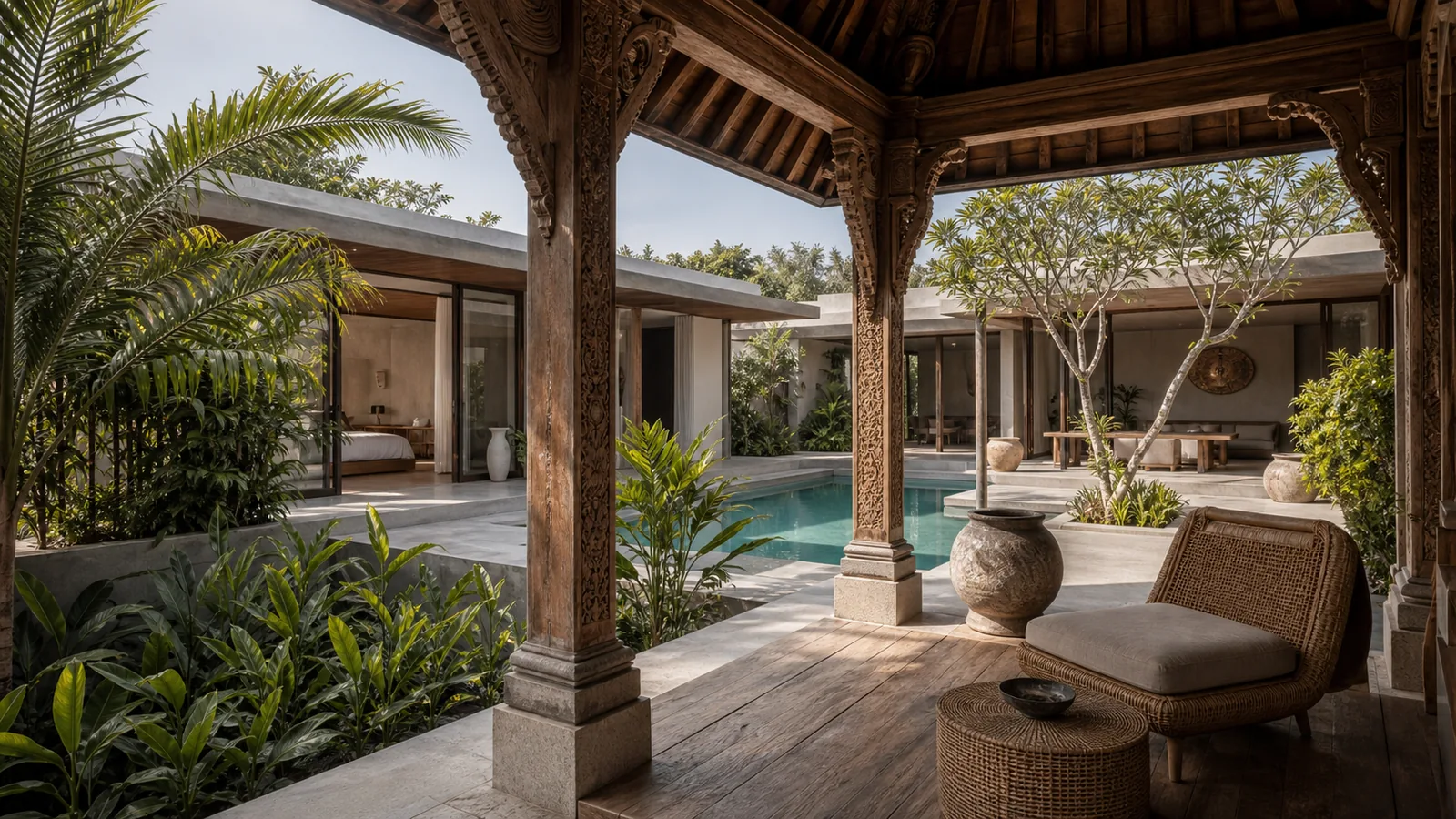
You are shortlisting Bali property and Canggu keeps appearing. You know the lifestyle pitch — surf breaks, co-working cafés, digital nomad infrastructure. What this page offers is something harder to find: a buyer-side read on whether is canggu still a good investment in 2026 once you look at the numbers, the legal structure, and the exit.
This page does not sell inventory. It helps you decide whether the corridor deserves a spot on your verified shortlist — and what to confirm before you spend time on the ground.
Quick take: Canggu-corridor property can still work in 2026 for buyers with a clear subarea focus, realistic net yield expectations, and proper due diligence. For buyers relying on operator projections or skipping legal review, the risk profile is higher than most guides acknowledge. The checklist below is where to start.
What Most Guides Miss
Most Canggu investment articles fall into two categories: lifestyle copy dressed as analysis, or listing grids with optimistic yield figures attached. Both skip the questions that determine whether a purchase actually works for you.
Here is what tends to go unmentioned:
Rental-use compliance. Not every villa in Canggu is licensed for short-term rentals. A property without a valid permit creates problems for insurance, operator agreements, and exit options. According to Villa Audit’s due diligence guide, this is one of the most commonly overlooked verification steps.
Duplicate listings. The same villa frequently appears across five or six agencies with different prices, different availability windows, and sometimes different lease terms. Buyers who skip this check waste time — and sometimes overpay.
Lease decay. Most foreign buyers access Bali property through a leasehold structure. A villa with 18 years remaining on a 25-year lease is a materially different asset from one with 25 years remaining. Yield projections rarely adjust for this.
Lane access and noise exposure. Canggu’s density means some streets are impassable at peak hours. Proximity to venues, construction, or main roads affects both rental desirability and resale demand. A quiet weekday viewing does not reveal this.
Gross-to-net gap. Headline yields of 10–15% often describe gross rental revenue divided by purchase price. After management fees, maintenance, vacancies, and platform costs, the net figure looks materially different — consistently so, as Balitecture’s villa rental income analysis confirms across the corridor.
The Canggu Corridor in 2026: What Buyers Are Actually Seeing
Canggu, Berawa, and Pererenan have attracted sustained foreign buyer interest for over a decade. That interest has brought real infrastructure but also supply growth that buyers need to factor in.
Listing volumes across the corridor have increased significantly since 2022, as tracked by aggregators including Bali Home Immo and Bali Realty. More supply does not automatically mean lower prices — premium pockets with ocean views or beach access have held firmer — but average-spec villas in dense lanes face more competition for rental bookings.
Subarea Orientation
| Subarea | Entry price signal | Lane quality | Rental demand profile | Noise/density risk |
|---|---|---|---|---|
| Berawa | Higher | Moderate | Beach access premium | Medium |
| Central Canggu | Mid-range | Poor at peak hours | High lifestyle demand | High |
| Pererenan | Lower–mid | Improving | Growing, less saturated | Low–medium, rising |
This is orientation, not a market report. Conditions vary street by street. A detailed Canggu versus Pererenan comparison is worth doing before you fix on a subarea.
Saturation matters in two ways: occupancy assumptions and exit liquidity. If your return model depends on 75–80% annual occupancy, that figure needs testing against current booking data, not marketing copy. When you eventually want to exit, you will be competing against the same supply that surrounds you now.

A Weather-Informed Maintenance Stress Test
We analysed 2015–2025 hourly reanalysis for one representative Canggu coastal corridor grid point. It is an area-level ownership baseline—not a weather station at the property and not evidence of mould, corrosion, flooding or repair incidence.
| Measured or derived metric | Canggu coastal corridor baseline |
|---|---|
| Mean annual rainfall | 1,662 mm/year |
| Rainy days (≥1 mm) | 245.7 days/year |
| Average relative humidity | 85.5% |
| Hours at ≥85% humidity | 4,968 hours/year |
| Longest observed wet run | 81 consecutive days |
| Average 10 m wind speed | 12.2 km/h |
| Strong-wind days (≥30 km/h in any hour) | 6.4 days/year |
| Mean daily shortwave energy | 5.71 kWh/m²/day |
| Daily mean temperature variability (standard deviation) | 0.97°C |
| Mean daily temperature range | 2.85°C |
| Mean wet-bulb temperature (derived) | 23.9°C |
| Mean first-layer soil moisture | 0.310 m³/m³ |
| FAO-56 reference evapotranspiration (derived) | 1,504 mm/year |
| Rainiest months (mean monthly rainfall) | November (251 mm), December (230 mm), January (230 mm) |
| Rain Burden (relative 0–100) | 12 |
| Humidity Burden (relative 0–100) | 75 |
| Outdoor Maintenance Pressure (relative 0–100) | 49 |
| Seasonal Weather Stability (relative 0–100) | 70 |
Grid-resolution note
One representative grid point is used for the corridor because the source resolution cannot support parcel- or micro-neighbourhood-level climate claims.
How to use this in due diligence
- Add an explicit maintenance reserve for AC, drainage, exterior finishes, pool equipment and landscaping.
- Run a downside case with higher inspection and replacement frequency, but anchor it to the asset’s condition and invoices.
- Do not translate an area-level climate index into a yield forecast or an expected repair rate.
Source: Copernicus Climate Change Service (C3S) ERA5-Land, hourly reanalysis, 2015–2025, analysed in Asia/Makassar local time. Relative humidity, wet-bulb temperature and reference evapotranspiration are derived from the source variables using the documented methodology. Data: CC BY 4.0. See the climate data methodology for formulas, thresholds and limitations. Values are area-level model estimates, not measurements at a villa; relative indices compare five configured Bali location requests (four distinct populated grid cells), not engineering, insurance, cost or yield ratings.
Is Canggu Still a Good Investment? Stress-Testing the Numbers
The honest version of a 2026 Canggu investment case requires separating marketing language from operating reality. Investlandbali’s rental yield breakdown and Prestige Property’s cost analysis both show how quickly gross yield assumptions erode once operating costs are applied.
Gross-to-Net Yield Sanity Check
| Line item | Typical range |
|---|---|
| Gross rental yield (marketed) | 10–15% |
| Platform and OTA fees | 3–5% of revenue |
| Management company fee | 20–30% of revenue |
| Maintenance and repairs | 1–3% of purchase price p.a. |
| Vacancy allowance | 15–30% of nights p.a. |
| Taxes and compliance costs | Variable |
| Realistic net yield | 5–9% in better cases |
These are illustrative ranges drawn from publicly available market data — not projections for any specific property. A structured gross-to-net yield framework for Canggu villas gives you a more rigorous way to test any deal before proceeding.
Lease length and renewal terms must be confirmed in writing before due diligence, not after. A contractual yield clause in a management agreement is a commercial commitment from the operator — it is not evidence that bookings will materialise at the stated level.
Exit liquidity in a leasehold market depends on remaining term and buyer appetite. Properties with fewer than 15 years remaining face a progressively smaller resale buyer pool. If your investment horizon is under ten years, lease decay is a material risk, not a footnote.
What Buyers Get Wrong About Canggu
“The operator promises X% returns.” An operator can make a contractual rental income promise. Whether that promise is backed by reserves, a verifiable track record, or optimistic projections is what due diligence is for. Ask for two years of actual booking data before accepting any yield figure.
“The price dropped — it must be a deal.” Listed prices in this market often lag actual transaction levels. A price reduction can reflect motivated selling, lease decay, a permit problem, or simply inflated original pricing. Understand why before treating it as value.
“I’ll sort the legal structure after I find the right villa.” Ownership structure determines what you can actually do with the asset. Foreign buyers who commit emotionally before confirming structure — and before getting independent legal review — sometimes discover constraints that change the entire investment case. Understanding Bali property locations and ownership options before shortlisting a specific asset is time well spent.
“Canggu is one area.” Berawa, central Canggu, and Pererenan have different price points, access conditions, noise profiles, and buyer demand. Treating them as interchangeable increases the chance of a poor fit between the asset and your actual goal.
Ownership Structure: Education, Not Legal Advice
Foreign nationals cannot hold freehold title to land in Indonesia. The structures most commonly used — leasehold (Hak Sewa), Indonesian company ownership (PT PMA or local PT), and nominee arrangements — each carry different risk profiles, costs, and practical constraints.
The right structure for a lifestyle-use buyer differs from the right structure for a pure-investment buyer, and the wrong choice can limit your options at exit. This is not legal advice. Qualified local counsel must be engaged before any commitment. Bali’s best areas guide covers how ownership structure varies by area and asset type as a starting reference.
Before You Book Viewings: Verification Checklist
Whether a specific property makes sense for your goals depends on the specifics of that asset, not the corridor as a whole. Verify these points before you spend time on the ground:
- Lease term — confirmed remaining years and renewal clause language
- Rental-use permit — is the property licensed for short-term rentals?
- Duplicate listing check — same property listed across multiple agents with matching terms?
- Price freshness — when was the listing price last updated?
- Occupancy evidence — at least 12 months of actual booking data from the operator
- Access and noise audit — visit at 5pm on a weekday and at night on a weekend
- Flood and construction exposure — flood history in the past three years; approved development nearby
- Management cost stack — full operating cost breakdown net of revenue, including vacancy periods
- Operator track record — how long has the management company run this or comparable properties?
- Legal structure review — independent counsel engaged before any payment or commitment
Frequently Asked Questions
Is Canggu oversupplied in 2026? Parts of the corridor show meaningful supply growth since 2022, particularly standard-spec villas in dense residential lanes. Premium pockets — ocean-facing Berawa, established beach-access properties — have been more resilient. Oversupply is subarea- and spec-specific, which is why individual property due diligence matters more than a corridor-wide verdict.
What net yield can a Canggu villa realistically achieve? After management fees, maintenance, vacancies, platform costs, and taxes, realistic net yields for well-run villas tend to sit in the 5–9% range. Some properties outperform this in strong years; some underperform significantly. Any projection above this range deserves scrutiny of its occupancy assumptions and cost exclusions. See the Canggu villa rental yield breakdown for a worked framework.
Can foreigners buy property in Canggu? Foreigners cannot hold freehold (Hak Milik) title. Common routes include leasehold, PT PMA company ownership, and nominee structures — each with different legal, tax, and practical implications. Independent legal review before committing to any structure is essential, not optional.
How long should a lease be before I consider buying? Properties with fewer than 15–18 years remaining carry meaningful exit risk given the smaller resale buyer pool. Longer leases with clear extension rights are preferable; the cost difference at purchase is usually worth it relative to the exit-liquidity risk you absorb with a shorter term.
How do I know if rental figures are real? Ask for platform-level booking data or host analytics exports covering at least 12 consecutive months, not promotional yield sheets. Cross-check peak season against shoulder season. A credible operator will provide this; one who cannot or will not is itself a data point.
Is Pererenan a better bet than central Canggu right now? Pererenan offers lower entry prices and less congestion, but supply is growing quickly and infrastructure gaps remain. It suits buyers with a longer investment horizon who want corridor exposure at a lower price point. Central Canggu retains stronger lifestyle-driven short-term rental demand but carries higher noise, congestion, and saturation risk. A direct Canggu versus Pererenan comparison is the better starting point than a single verdict.
Is the Corridor Worth Shortlisting?
For buyers with a clear subarea focus, a realistic ownership structure, and proper due diligence capacity — yes, Canggu-corridor property can still make sense in 2026. For buyers relying on operator projections, skipping legal review, or assuming the market moves in one direction — the risk profile is considerably higher than most guides acknowledge.
Pocket, asset quality, lease structure, and due diligence discipline separate viable investments from expensive mistakes. The corridor is not uniformly oversupplied or uniformly strong. The only way to know whether a specific property works is to verify it against the criteria above, not against the lifestyle pitch.
This article is produced by the Bali Villas editorial team and reviewed by an independent property consultant with active Canggu corridor experience. All yield figures are illustrative ranges based on publicly available market data and do not constitute projections for any specific property. Nothing on this page is legal or financial advice — engage qualified local counsel before making any commitment.