
You have seen the listing: jungle pavilions, a shared yoga shala, a rice-field view, a projected yield that looks compelling on a slide. Before you ask for the price, you need to answer a harder question — can this property legally operate as a retreat, who actually owns the land, and what does running it cost after licensing?
Every serious question about how to buy retreat property in Bali comes back to the same gap: the space between a retreat aesthetic and a retreat-licensed, retreat-operable asset. This guide starts at that gap.
What this page covers: ownership routes for foreign buyers, what to verify before viewings, the full licensing sequence, an operations reality check, a pre-signing checklist, and a direct path to a buyer-side call. We do not hold inventory or represent sellers.
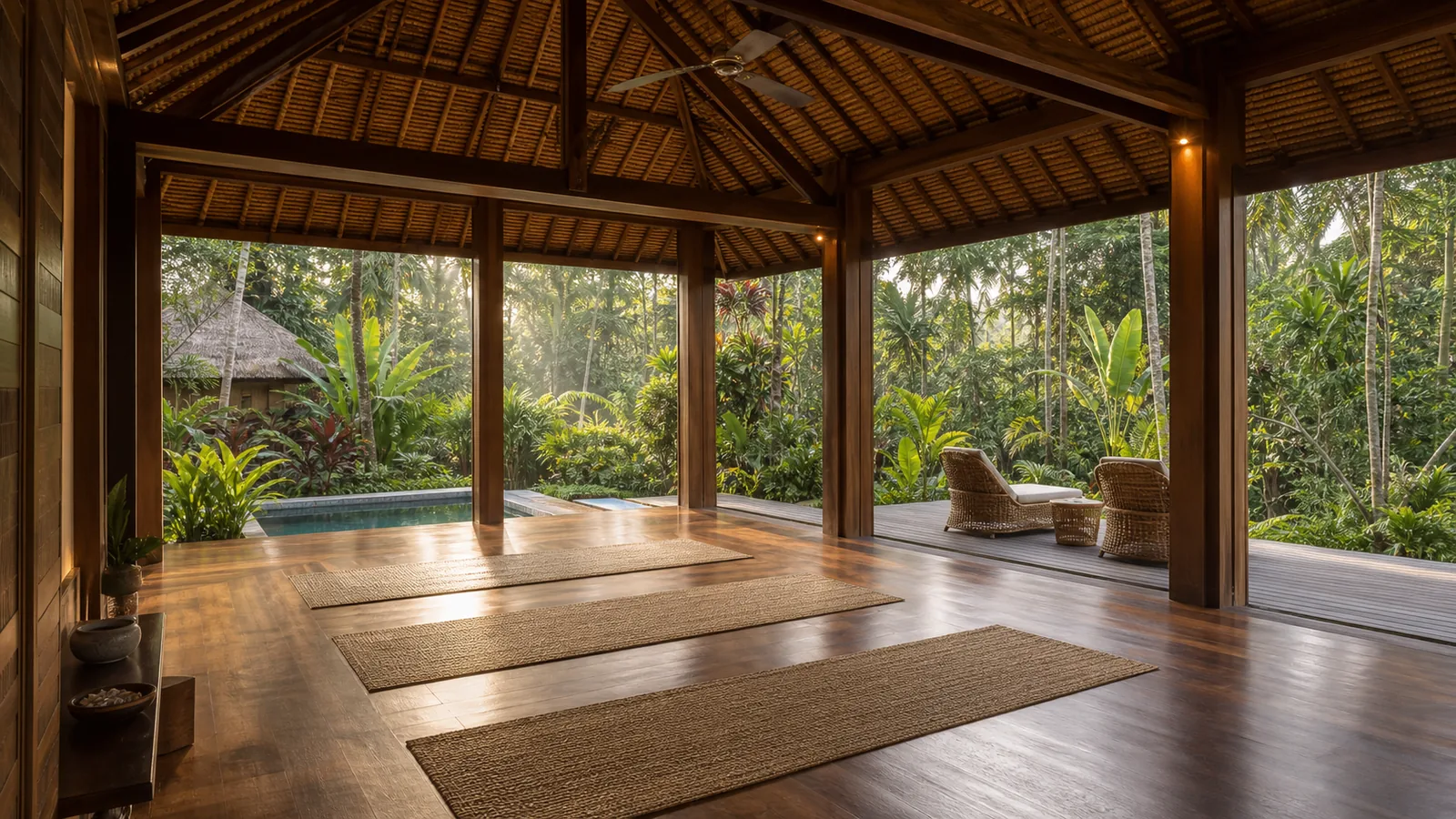
What Most Guides Miss
Most retreat-property content leads with ceremony candles and infinity pools. What it leaves out is the gap between beautiful photography and a property that can lawfully host paying guests.
Here is what typically goes unexamined:
Zoning and accommodation use. A parcel zoned for green-belt or agriculture cannot lawfully host paying guests. Ubud-area spatial plans — including Bali Province Perda No. 2/2023 and Gianyar Regency Perda No. 2/2023 — set the 2023–2043 framework. Parcel-level checks with a qualified local adviser come before any zoning assumption. Our Bali zoning guide explains how to read the spatial-plan registry correctly.
PBG and SLF status. A commercial accommodation needs a Building Approval (PBG) and Occupancy Certificate (SLF) before it can lawfully host guests. The government portal is SIMBG. Many listings cannot produce these documents on request.
KBLI fit. Short-term villa accommodation falls under KBLI 55193 on the OSS licensing platform. A retreat that adds food service, wellness treatments, or scheduled programs may require additional business classification codes — each with its own approval chain and timeline.
Access and operations. A property on a narrow gang with no parking is manageable for a private villa. It becomes a liability when twelve guests arrive with luggage on a retreat week.
Guides that skip these points are not wrong to show beautiful properties. They are just not written for buyers.
Who Can Own Retreat Property in Bali
Foreign nationals cannot hold freehold (Hak Milik) title in Indonesia. The two structures used by foreign buyers are a leasehold arrangement or a PT PMA company with a Hak Guna Bangunan (HGB) building right. PP No. 18/2021 is the current national regulation governing these rights; any ownership claim must be verified against current law with a licensed notary (PPAT).
| Structure | How it works | Key consideration |
|---|---|---|
| Leasehold | Fixed term, commonly 25–30 years plus extension options | No residual right after term; renewal clause must be documented, not assumed |
| PT PMA + HGB | Foreign-owned company holds renewable building right | Higher setup cost and ongoing accounting obligations; gives more defensible long-term control |
| Nominee arrangement | Indonesian national holds title on buyer’s behalf | Legally precarious; not recommended |
Ownership route is decided in parallel with — not instead of — zoning and license verification. Neither structure bypasses the need for parcel-level due diligence.
This page is buyer education, not legal advice. Consult a licensed Indonesian notary (PPAT) for advice specific to your situation and intended property.

Retreat Operations Reality
Seller projections often cite gross yields without separating operating costs. For a retreat-use property, those costs are structurally higher than a standard short-stay villa.
| Cost category | Standard villa | Retreat property |
|---|---|---|
| Staffing | Housekeeper, gardener | Adds yoga instructors, retreat coordinators, catering staff |
| Utilities and maintenance | Moderate | Higher — larger guest load, shala, water features |
| Platform and booking fees | 15–20% (OTA) | Variable — direct bookings cut OTA fees but require marketing spend |
| Food and wellness supplies | Minimal | Significant — ingredients, consumables, practitioner materials |
| Insurance and safety | Basic | Should include guest liability, food safety, wellness program coverage |
Bali tourism demand provides broad context, not a forecast for any specific asset. BPS Bali recorded 553,328 in-person foreign tourist visits in April 2026, with star-hotel room occupancy averaging 57.94% that month. These are sector-level figures; they do not predict occupancy or revenue at a specific retreat.
Always separate gross yield (revenue before costs) from net yield (after all costs above). A property projecting 12% gross may return 5–7% net under realistic assumptions — or less if licensing delays push back the opening timeline. A retreat running 35 weeks per year at moderate occupancy is a fundamentally different asset from one modeled at 48 weeks. Build your own conservative scenario rather than accepting a seller projection as a baseline.
How to Buy Retreat Property in Bali: The Buying Sequence
Step 1: Define the operating model before viewing properties
Are you buying to operate a weekly wellness retreat yourself, lease to an operator, or use personally and rent short-term between programs? Each model carries a different zoning threshold, license requirement, staffing cost, and income assumption. Clarifying this before viewings prevents you from falling in love with a property that cannot support your intended use. See what operating models look like in practice on our Ubud yoga retreat property page.
Step 2: Confirm ownership route and budget structure
Establish your entity before negotiating. Factor in structure costs, notarial fees, land and building tax (PBB), income tax on rental proceeds, and annual accounting if using a PT PMA. Our PT PMA guide covers the full cost framework.
Step 3: Run a pre-viewing property filter
Each candidate should pass a basic filter before a site visit:
- Live availability confirmed (not a duplicate, expired, or already-sold listing)
- Ownership term and title type stated and verifiable
- Zoning classification obtained from local authority or confirmed by adviser
- Vehicle access — can a standard car reach the gate?
- Slope, drainage, and damp risk assessable in person
- PBG/SLF status requested from seller or agent
Step 4: License and operating-approval sequence
For an accommodation-licensed villa or retreat, the typical sequence involves NIB registration, PBG, SLF, and any sector-specific health, food-service, or wellness permits. This sequence is time-consuming and does not complete on a fixed timeline. Buying a property that already holds valid PBG and SLF is meaningfully different from buying one where obtaining them is assumed to happen post-signing.
Step 5: Stress-test the operating assumptions
Model at least two scenarios — a realistic case and a downside case where occupancy runs 20% below expectation and one licensing permit takes six months longer than planned. Never treat a seller projection or nearby comparable as a floor.
Pre-Signing Checklist
Ownership and title
- Title type confirmed by certificate number and parcel ID
- Remaining lease term and renewal clause reviewed by notary
- No encumbrances, disputes, or awig-awig (customary community rules) affecting the land
Zoning and licensing
- Parcel-level zoning confirmed in writing for accommodation or commercial use
- PBG and SLF obtained for every built structure, or absence noted and priced into offer
- NIB active and KBLI code matches intended retreat use
- Additional wellness, food-service, or event permits identified with realistic timelines
Operations and access
- Vehicle access confirmed — standard car can reach the gate
- Structural condition, drainage, and damp assessed by independent inspector
- Current staff list, employment agreements, and monthly fixed costs reviewed
- Actual trading history and revenue (not projections) requested from seller
Financial assumptions
- Gross and net yield modeled separately under conservative occupancy
- Structure costs, annual tax, and accounting included in budget
- Exit route considered — who is the likely future buyer, and at what remaining term?
Common Buyer Objections
“The agent confirmed the zoning is fine.” Zoning confirmation from the selling agent is not parcel-level verification. Obtain a written zoning statement from the relevant local authority or have a qualified adviser check the spatial plan registry directly. The 2023 spatial plans for Bali Province and Gianyar Regency govern these determinations through 2043.
“The seller will sort the PBG after we sign.” A PBG and SLF that do not yet exist are not assets you are buying — they are promises. If these documents are absent, treat the property as unlicensed and factor remediation time and cost into your offer accordingly.
“Yield projections are based on comparable properties nearby.” Retreat income depends on your specific program, marketing, management, seasonality, and guest capacity. Review Ubud wellness retreat villas for context on operating properties before accepting any projection as a baseline.
Frequently Asked Questions
Can a foreign buyer legally operate a retreat in Bali? A foreign buyer can invest through a PT PMA structure, which allows the company to hold HGB title and obtain a business license. Operating licenses — NIB, KBLI-matched accommodation permit, PBG, SLF, and any wellness or food-service permits — are held by the entity. The specifics must be verified with a notary and local adviser for the intended parcel and operating model.
What is the difference between a villa rental license and a retreat operating license? A standard villa rental license covers short-stay accommodation under KBLI 55193. A retreat that adds structured wellness programs, food service, or practitioner services may require additional KBLI codes and sector-specific approvals. The more complex the operating model, the longer the licensing sequence.
How long should a leasehold be for a retreat investment? Buyers typically look for a total available term of at least 25–30 years, with renewal terms documented in the contract rather than left to future negotiation. A lease with fewer than 15 years remaining has limited exit liquidity — a future buyer will price the short remaining term into any offer.
Is Ubud better than Canggu for retreat property? Ubud attracts longer-stay wellness and spiritual retreat guests and has established retreat infrastructure. Canggu has higher short-stay demand and stronger coastal appeal but generally higher land costs in premium locations. The right area depends on your intended guest profile and operating model, not aesthetic preference alone.
What ongoing costs should I model after purchase? Annual recurring costs include PBB (land and building tax), income tax on revenue, PT PMA accounting fees, license renewals, staffing, utilities, maintenance, insurance, and platform commissions. Retreat properties carry higher per-guest operating costs than standard villas because of programming, catering, and safety obligations. A conservative model typically assumes 40–50% of gross revenue absorbed by operating costs before owner income.

Ubud Climate Baseline for Villa Owners
We analysed 2015–2025 hourly reanalysis for one representative Ubud inland reference grid point. It is an area-level ownership baseline—not a weather station at the property and not evidence of mould, corrosion, flooding or repair incidence.
| Measured or derived metric | Ubud inland reference baseline |
|---|---|
| Mean annual rainfall | 2,640 mm/year |
| Rainy days (≥1 mm) | 268.5 days/year |
| Average relative humidity | 87.3% |
| Hours at ≥85% humidity | 5,948 hours/year |
| Longest observed wet run | 107 consecutive days |
| Average 10 m wind speed | 6.9 km/h |
| Strong-wind days (≥30 km/h in any hour) | 0.0 days/year |
| Mean daily shortwave energy | 5.68 kWh/m²/day |
| Daily mean temperature variability (standard deviation) | 0.93°C |
| Mean daily temperature range | 4.87°C |
| Mean wet-bulb temperature (derived) | 24.0°C |
| Mean first-layer soil moisture | 0.231 m³/m³ |
| FAO-56 reference evapotranspiration (derived) | 1,487 mm/year |
| Rainiest months (mean monthly rainfall) | February (394 mm), January (387 mm), December (364 mm) |
| Rain Burden (relative 0–100) | 100 |
| Humidity Burden (relative 0–100) | 100 |
| Outdoor Maintenance Pressure (relative 0–100) | 70 |
| Seasonal Weather Stability (relative 0–100) | 7 |
Grid-resolution note
Used as an inland comparison point in production articles; it does not represent every Ubud hillside or valley.
How to use this in due diligence
- Inspect roof junctions, drainage routes, retaining conditions and shaded exterior surfaces for signs of persistent moisture.
- Review ventilation, bathroom extraction, AC condensate drainage and timber-finishing schedules; the dataset does not measure mould incidence.
- Budget garden, pool and exterior maintenance from the villa’s actual condition and service records, not from an Ubud label alone.
Source: Copernicus Climate Change Service (C3S) ERA5-Land, hourly reanalysis, 2015–2025, analysed in Asia/Makassar local time. Relative humidity, wet-bulb temperature and reference evapotranspiration are derived from the source variables using the documented methodology. Data: CC BY 4.0. See the climate data methodology for formulas, thresholds and limitations. Values are area-level model estimates, not measurements at a villa; relative indices compare five configured Bali location requests (four distinct populated grid cells), not engineering, insurance, cost or yield ratings.
Next Step
If you are comparing a specific Ubud pocket, a Penestanan or Sayan property, or weighing a Canggu alternative against a Ubud yoga retreat site, the fastest path to clarity is a structured conversation about your ownership comfort, operating model, and budget — before you view anything.
On the call, we will: confirm whether your shortlisted property type matches your intended operating model, identify the due-diligence questions to raise before signing, and help you map a realistic timeline from search to licensed operation. We are a buyer-side desk; we do not represent sellers or earn commission on transactions.
Written by the Bali Villas Buyer Desk. Reviewed for factual accuracy against Indonesian land regulation (PP No. 18/2021), Bali Province and Gianyar Regency spatial plans (2023), and OSS/SIMBG licensing frameworks. This page is buyer education, not legal or financial advice. Verify all ownership, zoning, and licensing claims with a licensed Indonesian notary (PPAT) and qualified local advisers before signing any agreement.