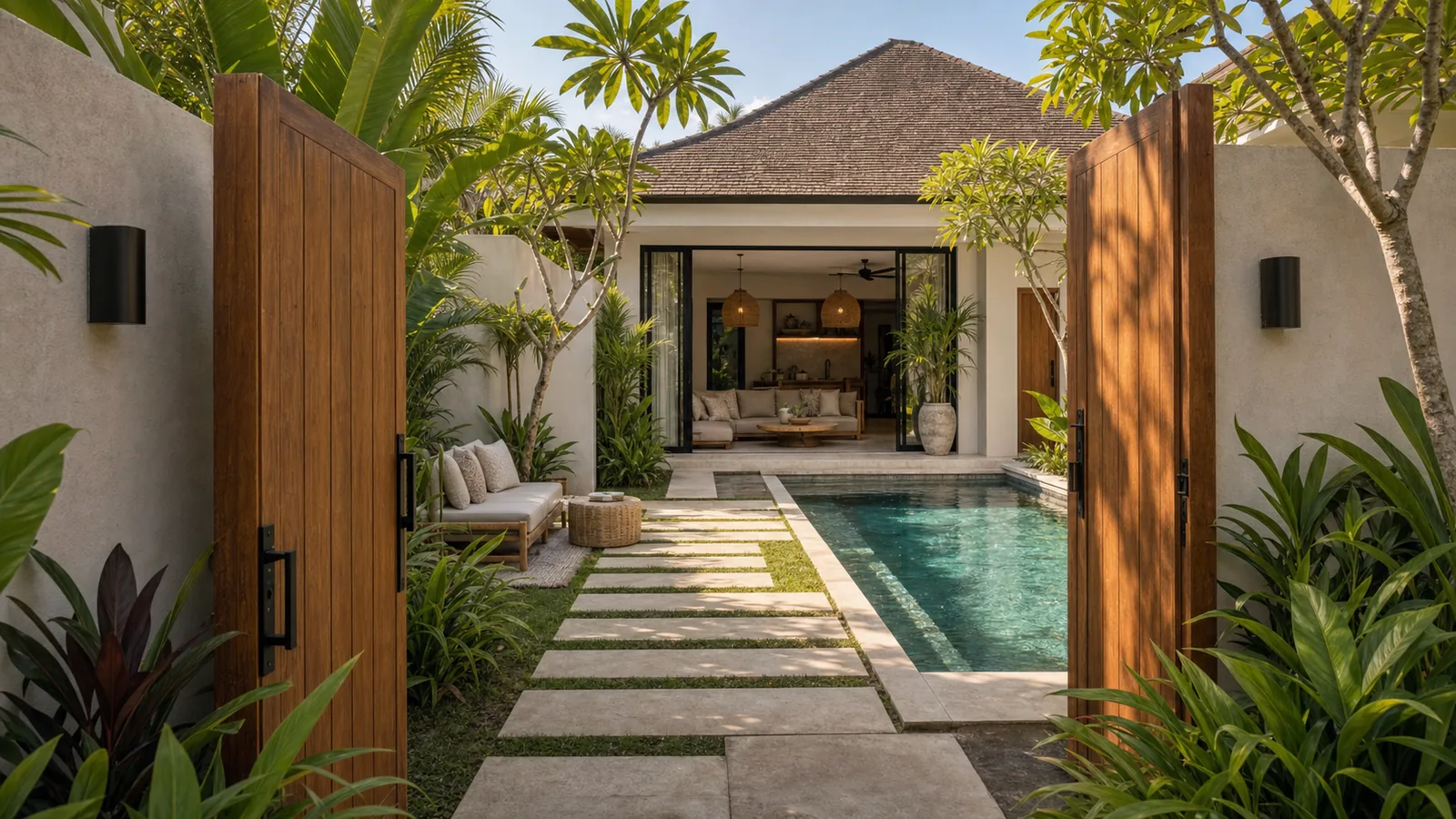
Buying Property in Bali as a Foreigner
You have a budget, maybe a preferred area, possibly a villa you have already walked through twice. What stops most buyers at this point is not a lack of listings — it is not knowing which ownership structure applies to them, what due diligence they are responsible for, and what the projections they have been shown actually mean.
This guide answers those questions directly. It does not list available properties, and nothing here is legal advice. Its purpose is to prepare you for the conversations you need to have with a notary, a lawyer, and an agent — in that order.
Editorial note: This article reflects general buyer education only, updated periodically against publicly available Indonesian property law sources. Engage an independent Indonesian lawyer before committing funds — not one introduced by the selling party.

What Most Guides Miss
Most articles on buying property in Bali as a foreigner land in one of two places: a curated listing collection, or a generic legal summary that stops well before the point of decision. Neither is useful when you are about to move money.
Three things get consistently skipped:
Structure determines everything else. Lease length, resale flexibility, financing options, and which hospitality license a villa can operate under all follow from the ownership structure. If you are choosing a structure after you have chosen a villa, you are working in the wrong order.
Verification is the buyer’s job, not the agent’s. Agents represent sellers. Developers represent themselves. No party in a Bali property transaction is legally required to flag a zoning problem, a short remaining lease, or a missing operating license on your behalf. Buyer-side due diligence is not a bureaucratic formality — it is the only protection available to you.
ROI figures are assumptions, not disclosures. Yield projections typically draw from best-performing properties or peak periods. They rarely account for extended vacancy, rate compression, or management cost changes over time. A number on a developer brochure is a starting point for questions, not a basis for a purchase decision.
The Three Ownership Routes for Foreign Buyers
Indonesia does not permit foreigners to hold freehold title (Hak Milik) directly. Three routes are used in practice. Knowing which applies to your situation before you select a property is the first decision to make.
| Structure | Title Type | Typical Term | Best For | Key Risk |
|---|---|---|---|---|
| Leasehold | Hak Sewa (lease) | 25–30 yr + extensions | Lifestyle buyers, shorter horizons | Extension not guaranteed; short remaining term harms resale |
| PT PMA | Hak Guna Bangunan | 30 yr, renewable | Larger investments, commercial use | Setup and compliance cost; not equivalent to freehold |
| Nominee | Hak Milik (informally) | Indefinite | Not recommended | Not legally recognised; material risk of total loss |
Leasehold (Hak Sewa)
The most common route for foreign buyers. You hold a lease — typically 25 to 30 years with one or more extension options — rather than the underlying land title. As Balitecture and Propertia both note, this is the dominant structure used by foreign villa buyers across Bali.
What to confirm before purchase:
- The total available term including all extension options, in writing
- Who holds the freehold title and whether any encumbrances exist on that land
- What happens to the lease if the landowner dies or sells the underlying title
- The conditions attached to extensions — automatic renewal, renegotiated rate, or landlord discretion
Leasehold is legal and widely used. It is also the structure most commonly misrepresented — by omitting extension conditions, presenting a 25-year lease as equivalent to ownership, or obscuring a remaining term that is shorter than advertised.
PT PMA (Foreign-Owned Company)
A foreign-owned Indonesian limited liability company can hold Hak Guna Bangunan (right to build) title. This is the only route that gives a foreigner a form of title rather than a lease. As Magnum Estate explains, HGB remains a distinct title class from freehold — with its own renewal requirements — not a path to outright ownership.
PT PMA involves registration and ongoing compliance costs, and it suits buyers with larger investment budgets or commercial development plans. It is not a workaround for most lifestyle buyers.
For a direct comparison of these routes, see our foreign ownership explainer.
Nominee Structures
Some older transactions placed freehold title in an Indonesian national’s name on behalf of a foreign buyer. Indonesian law does not recognise or protect these arrangements. The nominee can legally claim the property, and the foreign buyer has no enforceable recourse. This guide does not recommend them under any circumstances.

Objections Worth Examining Honestly
“The developer is well known, so due diligence is a formality.” Developer brand and title cleanliness are separate. A reputable developer can still sell on land with a shorter lease than advertised, or a building with unpermitted additions. Independent checks are standard practice regardless of who the seller is.
“The agent said the license will be sorted before settlement.” If it matters to the purchase — and operational licenses do — it belongs in the contract, not in conversation. Specify what happens if the license is not resolved, who covers the cost, and what the buyer’s exit looks like. A verbal assurance is not enforceable.
“I’ll sort the legal structure after I agree the price.” Structure affects price materially. A leasehold with 14 years remaining is worth significantly less than one with 28. A villa operating without a valid short-term letting license cannot legally generate the income used to justify the asking price. Locking in a number before confirming the structure means you may be buying something different from what you priced.
“The ROI projection from the developer looks solid.” Developer-supplied yield figures typically reflect gross revenue, peak periods, and optimistic occupancy rates. Management fees alone run 20–30% of gross revenue. Ask for independently verified historical data — occupancy records, actual nightly rate history, management accounts — before treating any projection as a baseline.
Licenses a Rental Villa Must Have
A villa without the correct operating license cannot legally rent to short-term guests. This is a buyer-side issue because it directly affects both yield assumptions and your legal exposure after purchase.
Request documentation of:
- IMB / PBG — building permit under the regulation in force when the structure was built
- NIB — business registration number, required to operate commercially
- Pondok Wisata or Villa classification — the hospitality classification that permits short-term letting
- Zoning certificate — confirming the land is classified for the intended use
License gaps are not always deal-breakers. But they require legal advice on remediation cost and timeline before you agree a price. Our Bali villa buying costs guide covers how license remediation fits into total acquisition spend.
Pre-Purchase Checklist
Work through this before any funds are committed. Items marked (lawyer required) should be handled by an independent Indonesian notary or lawyer — not one introduced by the selling party.
Title and encumbrances (lawyer required)
- Land certificate verified at BPN
- No mortgages, liens, or disputes attached to the title
- Legal seller confirmed as the certificate holder; all co-owners in agreement
Lease terms — leasehold purchases (lawyer required)
- Full duration including all extension options confirmed in writing
- Extension conditions documented (automatic / negotiated / at market rate)
- Lease agreement notarised
Building and zoning
- Building permit covers the structure as it currently exists
- Zoning certificate confirms permitted use
- No green belt, rice field buffer, or coastal setback violations
Operational licenses
- Valid business license for short-term letting confirmed
- Management contract reviewed if a third-party operator is included
- Historical occupancy and revenue records requested and reviewed
Tax and transfer costs
- BPHTB (transfer tax, typically ~5% of transaction value) budgeted
- PPh (seller’s income tax) confirmed as seller’s obligation and settled before transfer
- NJOP (assessed land value) compared against agreed price
Questions to Ask Your Lawyer or Notary
These are for an independent Indonesian lawyer or notary — not the selling agent:
- What class of title will I hold, and what are the renewal conditions?
- Has this land certificate been verified at BPN in the last twelve months?
- Does the building permit cover every structure currently on the site?
- What is the current zoning classification, and does it permit commercial villa operation?
- Are there any disputes, claims, or court actions attached to this title?
- What licenses are in place, which are missing, and what does remediation cost?
- Who is the legal seller, and are all co-owners formally in agreement?
What This Page Cannot Confirm
Indonesian property law is subject to change. The Omnibus Law introduced amendments to foreign ownership provisions that are still being implemented across regional land offices — as ASEAN Briefing notes. Regional rules in Bali can also differ from national defaults.
Nothing on this page is legal advice. Before committing funds, engage an independent Indonesian notary (PPAT) and a lawyer who does not have a relationship with the selling party. The cost of that review is small relative to the transaction and the risk of proceeding without it.
For a broader overview of the purchase process, see buying property in Bali.
Frequently Asked Questions
Can foreigners legally own property in Bali? Not in the freehold sense. Foreign buyers use leasehold (a long-term lease on land held by an Indonesian national or entity) or a PT PMA company to hold Hak Guna Bangunan title. Both routes are legal and regularly used. Nominee arrangements are not legally recognised and carry significant risk of loss.
How long does a leasehold last? Initial terms typically run 25–30 years, with extensions that can bring total duration to 50–80 years. The critical issue is whether extensions are contractually secured, on what conditions, and what the remaining term will be when you plan to sell. Confirm the full term in writing before purchase.
What is a PT PMA and when does it make sense? A foreign-owned Indonesian limited liability company that holds HGB title. Setup and ongoing compliance costs make it most appropriate for larger investments or commercial development plans. It is not the right structure for every buyer and should be assessed with a local lawyer.
What licenses does a rental villa need? A valid building permit, a business registration number (NIB), and a hospitality classification (such as Pondok Wisata). Zoning must also permit commercial use. Missing licenses affect both the legality of rental income and resale value.
How much does buying property in Bali cost beyond the listed price? Transfer tax (BPHTB, around 5%), notary fees, legal fees, and potentially license remediation. Management fees for rental villas typically run 20–30% of gross revenue. See our Bali villa buying costs guide for a full breakdown.
Is it safe to buy without a local lawyer? No. Title verification, lease review, and license checks require access to local registries and Indonesian legal knowledge that foreign buyers cannot reasonably obtain independently. Legal fees are a small fraction of a typical transaction value.

Climate Exposure in Property Due Diligence
We compared 2015–2025 hourly reanalysis at the representative Bali reference points below. The figures help screen maintenance exposure; they do not rank individual villas or replace drainage, material and building-condition checks.
| Reference point | Rainfall mm/year | Rainy days/year | Avg RH | ≥85% RH hours/year | Avg wind km/h | Strong-wind days/year† | Solar kWh/m²/day | Outdoor pressure* |
|---|---|---|---|---|---|---|---|---|
| Canggu coastal corridor | 1,662 | 245.7 | 85.5% | 4,968 | 12.2 | 6.4 | 5.71 | 49 |
| Ubud inland reference | 2,640 | 268.5 | 87.3% | 5,948 | 6.9 | 0.0 | 5.68 | 70 |
| Uluwatu and Pecatu reference | 1,630 | 261.6 | 80.2% | 1,944 | 14.4 | 31.5 | 5.69 | 29 |
| Sanur east-coast reference | 1,754 | 264.0 | 83.7% | 3,901 | 12.1 | 4.9 | 5.68 | 35 |
| Seminyak southwest-coast reference | 1,754 | 264.0 | 83.7% | 3,901 | 12.1 | 4.9 | 5.68 | 35 |
*Outdoor Maintenance Pressure is a relative index across five configured location requests, which resolve to four distinct populated grid cells. The raw weather metrics beside it remain the evidence. †A strong-wind day contains at least one hourly 10 m wind-speed value of 30 km/h or more; this is a comparison threshold, not a damage threshold.
Grid-resolution disclosures
- Uluwatu and Pecatu reference uses the nearest populated ERA5-Land cell at -8.8, 115.2 (13 km from the requested coordinate), so it is a broad-area proxy.
- Sanur east-coast reference and Seminyak southwest-coast reference resolve to the same populated land cell at -8.7, 115.2; identical values mean the grid cannot distinguish those requests, not that their parcel-level conditions are identical.
How to use this in due diligence
- Keep legal ownership verification separate from physical-condition verification: a valid structure does not establish that roofs, drainage, AC or exterior materials are fit for the site’s exposure.
- Define responsibility for weather-related inspection, routine maintenance and capital replacement in the lease, management agreement or handover documents where relevant.
- Use an independent property inspection and actual maintenance records; area-level reanalysis cannot prove damage, mould, flooding or compliance at a villa.
Source: Copernicus Climate Change Service (C3S) ERA5-Land, hourly reanalysis, 2015–2025, analysed in Asia/Makassar local time. Relative humidity, wet-bulb temperature and reference evapotranspiration are derived from the source variables using the documented methodology. Data: CC BY 4.0. See the climate data methodology for formulas, thresholds and limitations. Values are area-level model estimates, not measurements at a villa; relative indices compare five configured Bali location requests (four distinct populated grid cells), not engineering, insurance, cost or yield ratings.
Start With Structure, Not With Listings
The most useful conversation a foreign buyer can have covers ownership structure, budget, preferred area, and investment or lifestyle goal — before committing to a specific villa. Understanding the full picture of buying property in Bali as a foreigner means resolving structure, title, and due diligence first, then finding the right property within that framework.
Book foreign buyer call to work through your ownership route, due-diligence checklist, and the questions worth asking before you engage a selling agent.