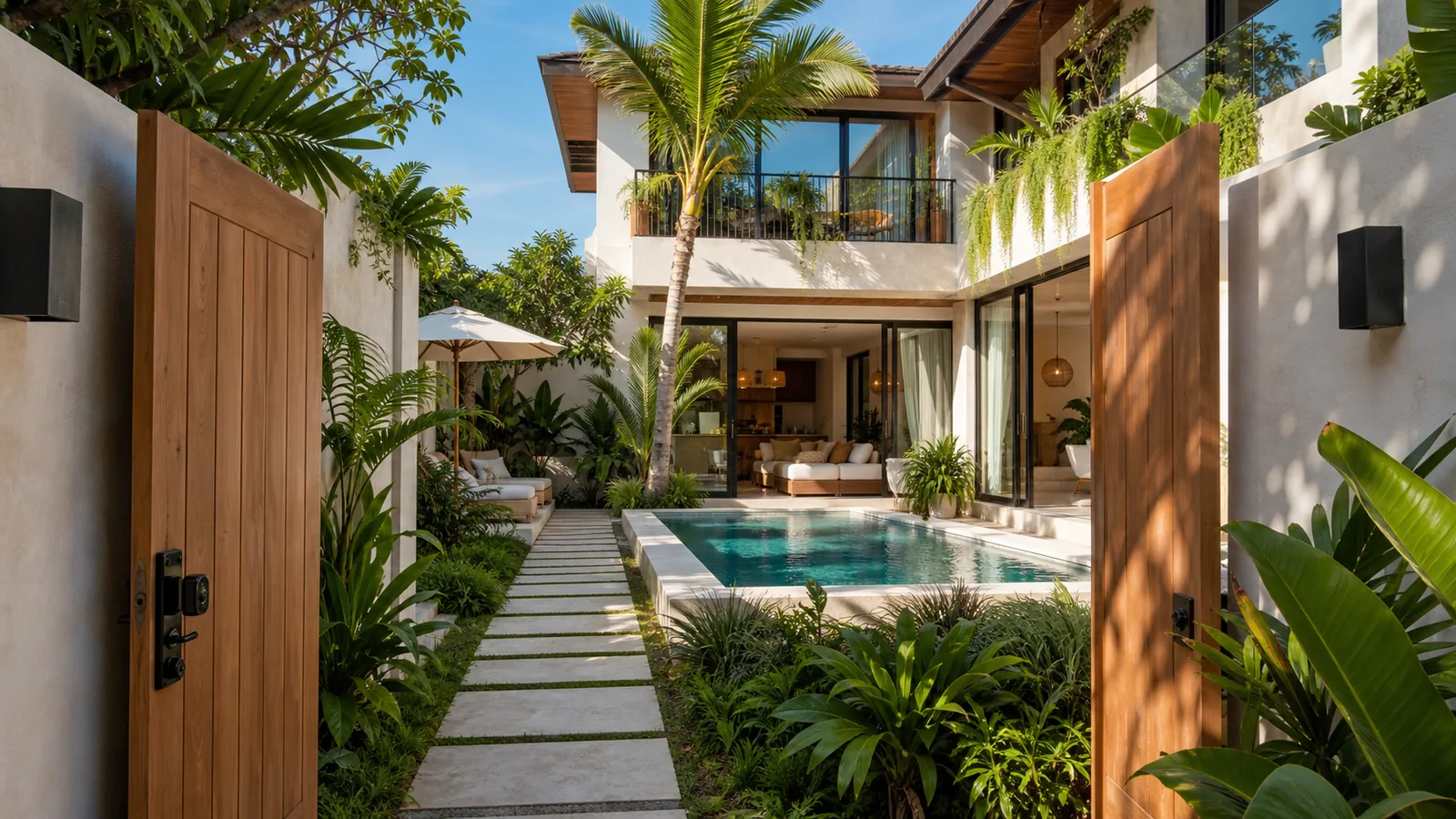
The question isn’t which villa looks best. It’s whether that villa is legally structured for foreign ownership, actually available at the price shown, and documented well enough to close.
When you decide to buy property in Bali, most search results serve you listing aggregators or optimistic investment guides. Neither answers the structural question. This page does — and it explains how to filter listings before you spend time on viewings.
What this page covers: ownership routes for foreigners, the listing duplication problem, how to filter before you browse, due diligence steps, and the buyer questions worth answering before you contact anyone.
What Most Guides Miss
The Bali villa market has a duplication problem. The same property regularly appears across six or more listing platforms simultaneously — sometimes with different prices, different availability flags, and different ownership terms in the headline. Agents often market identical inventory. That doesn’t make any individual agent dishonest, but it means a high search-result count tells you almost nothing about real available supply.
The second gap is ownership route. Foreigners cannot hold Indonesian freehold title (Hak Milik) directly in their own name. The legal routes available — long-term leasehold, PT PMA company structure, or older nominee arrangements — carry different costs, control rights, and exit conditions. A guide that shows attractive photos and a headline price without naming the ownership route is missing the most important column in the table.
Third: lease term. A leasehold with 22 years remaining and one with 55 years plus two documented extension options are not the same asset, even at the same price. Remaining term directly affects resale value, rental yield assumptions, and your ability to exit cleanly.
None of these are reasons not to buy. They are reasons to filter before you browse.
What It Actually Means to Buy Property in Bali as a Foreigner
Legal Ownership Routes Compared
This is educational context, not legal advice. Every structure must be reviewed with a licensed Indonesian notary before any offer is made.
| Route | Who it suits | Typical term | Key risk |
|---|---|---|---|
| Leasehold (Hak Sewa) | Individual foreign buyers | 25–30 years + extensions | Short remaining term if not checked upfront |
| PT PMA | Commercial rental investors | Land title held by company | Setup cost, ongoing compliance, correct share structure required |
| Nominee (Hak Milik via local) | Legacy market practice | Indefinite on paper | Not protected under Indonesian law — treat as a red flag |
The most common route for individual buyers is leasehold. The most important thing to confirm: remaining term and whether extension options are documented in the original deed, not just promised verbally.
PT PMA suits buyers acquiring for active commercial rental who want stronger structural control. Setup and annual compliance add overhead, but the structure gives better title security than leasehold.
Nominee arrangements appear in the market, particularly on older listings. Indonesian law does not reliably protect a foreigner’s interest in a nominee-held property. Its presence is a disqualifying signal, not a workaround.
For a full breakdown of each route and what Indonesian law actually permits, see Can Foreigners Buy Property in Bali?
Location and What It Affects
Location is not just a lifestyle preference. It changes what ownership structure is practically available, what commercial villa permits cost and how long they take, and what your realistic buyer pool looks like at exit.
| Area | Rental demand | Buyer profile | Infrastructure |
|---|---|---|---|
| Canggu / Seminyak | High | Yield and lifestyle | Strong |
| Ubud | Moderate | Lifestyle and retreat | Moderate |
| Bukit / Uluwatu | Growing | Yield-focused, newer | Thinner |
| Sanur / Nusa Dua | Stable | Family, longer stay | Good |
| Tabanan / North | Emerging | Land banking, lifestyle | Limited |
Filtering Listings Before You Request a Shortlist
Listing sites like Bali Realty, Bali Home Immo, The Bali Homes, and Prestige Property Bali are useful for market orientation — price ranges, area comparisons, villa typologies. Treat them as a discovery layer, not a verification layer.
What a Verified Listing Should Show
- Ownership route named explicitly (leasehold, PT PMA, or freehold held via PT PMA)
- Remaining lease term with extension options confirmed in writing, not verbally
- Price confirmed within the last 60–90 days
- Operating permits noted: IMB/PBG building permit and relevant tourism or villa rental license
- No active disputes flagged on preliminary title check
Red Flags to Filter Out First
- Ownership route absent or listed only as “freehold options available” without structure named
- Lease term under 20 years remaining with no extension documentation
- Price listed only in USD on a platform that hasn’t been updated in over a year
- Same listing appearing across five or more platforms with inconsistent details
- Seller resists or delays a buyer-commissioned title search
Common Buyer Objections — Answered Honestly
“The agent said the lease can always be extended.” Verbal extension promises are not enforceable. Extension rights must be written into the original lease deed and confirmed by a notary. An oral assurance from a selling agent is not a substitute.
“Everyone uses nominee structure — it must be fine.” Prevalence does not equal legality or protection. Indonesian courts have not consistently protected foreign interests in nominee-held properties. The structure persists because it is cheap and easy to set up, not because it is safe.
“The ROI numbers I’ve seen look strong.” Rental yield projections in Bali marketing material tend to use peak occupancy figures, exclude management fees, and omit tax, maintenance, and permit renewal costs. Return assumptions should be modelled conservatively with a local property manager’s actual data before you factor yield into your decision. For realistic return assumptions by area and license type, see Bali Property Investment.
“I don’t need a notary — the agent handles everything.” The notary represents the transaction, not the buyer. A buyer-side legal review is separate and must be commissioned independently. Budget for it as a fixed cost of acquisition.
“There’s a lot of supply — I can take my time.” Visible supply is not actual supply. Much of what appears on listing platforms is duplicated, stale, or already under offer. Verified available stock in any specific area and price band is narrower than aggregated listings suggest.
Buyer Pre-Qualification Checklist
Before requesting a shortlist or booking a site visit, confirm your answers to these:
- Total budget — acquisition price plus notary fees, taxes (BPHTB and PPh, typically around 5% each on transaction value), legal review, and setup costs
- Ownership route preference — leasehold acceptable, or PT PMA required for commercial operation?
- Primary goal — rental yield, capital growth, lifestyle use, or a combination?
- Minimum lease term — will you accept under 25 years remaining?
- Area shortlist — specific area, or open to recommendation based on goal?
- Timeline — active purchase in the next six months, or still in orientation?
- Due diligence budget confirmed — notary, title search, permit audit, and legal review allocated
Buyers who can answer all of these clearly get a shortlist that actually closes. Buyers who cannot tend to view the same overexposed villas as everyone else and stall at the due diligence stage.
For current listings filtered by structure and area, see Property for Sale in Bali.
The Step Most Buyers Skip: Buyer-Side Due Diligence
Due diligence in Bali is not handed over by the seller at exchange. It must be commissioned and paid for by the buyer. A clean purchase requires at minimum:
- Title search — confirm ownership, encumbrances, and existing liens with a licensed notary
- Permit audit — verify IMB/PBG building permit, tourism or villa rental license, and any outstanding compliance issues
- Lease deed review — confirm remaining term, extension clauses, and that the deed matches what was represented
- Land zone check — confirm the parcel’s zoning permits the intended use (residential or commercial tourism)
- Tax clearance — confirm no outstanding land and building tax (PBB) arrears
Budget IDR 15–25 million (approximately USD 900–1,500 at common exchange rates) for a thorough independent review, depending on complexity. Any seller who resists buyer-commissioned due diligence is a disqualifying signal.
Climate Exposure: A Physical-Asset Filter
We compared 2015–2025 hourly reanalysis at the representative Bali reference points below. The figures help screen maintenance exposure; they do not rank individual villas or replace drainage, material and building-condition checks.
| Reference point | Rainfall mm/year | Rainy days/year | Avg RH | ≥85% RH hours/year | Avg wind km/h | Strong-wind days/year† | Solar kWh/m²/day | Outdoor pressure* |
|---|---|---|---|---|---|---|---|---|
| Canggu coastal corridor | 1,662 | 245.7 | 85.5% | 4,968 | 12.2 | 6.4 | 5.71 | 49 |
| Ubud inland reference | 2,640 | 268.5 | 87.3% | 5,948 | 6.9 | 0.0 | 5.68 | 70 |
| Uluwatu and Pecatu reference | 1,630 | 261.6 | 80.2% | 1,944 | 14.4 | 31.5 | 5.69 | 29 |
| Sanur east-coast reference | 1,754 | 264.0 | 83.7% | 3,901 | 12.1 | 4.9 | 5.68 | 35 |
| Seminyak southwest-coast reference | 1,754 | 264.0 | 83.7% | 3,901 | 12.1 | 4.9 | 5.68 | 35 |
*Outdoor Maintenance Pressure is a relative index across five configured location requests, which resolve to four distinct populated grid cells. The raw weather metrics beside it remain the evidence. †A strong-wind day contains at least one hourly 10 m wind-speed value of 30 km/h or more; this is a comparison threshold, not a damage threshold.
Grid-resolution disclosures
- Uluwatu and Pecatu reference uses the nearest populated ERA5-Land cell at -8.8, 115.2 (13 km from the requested coordinate), so it is a broad-area proxy.
- Sanur east-coast reference and Seminyak southwest-coast reference resolve to the same populated land cell at -8.7, 115.2; identical values mean the grid cannot distinguish those requests, not that their parcel-level conditions are identical.
How to use this in due diligence
- Use the table as a physical-asset filter alongside title, zoning, access, build quality and demand—not as a neighbourhood ranking on its own.
- Ask for roof, drainage, AC, timber, pool, garden and exterior-finish records before treating a listing price as comparable across areas.
- Translate observed condition into an inspection plan and maintenance reserve; the climate indices do not predict a repair bill or investment return.
Source: Copernicus Climate Change Service (C3S) ERA5-Land, hourly reanalysis, 2015–2025, analysed in Asia/Makassar local time. Relative humidity, wet-bulb temperature and reference evapotranspiration are derived from the source variables using the documented methodology. Data: CC BY 4.0. See the climate data methodology for formulas, thresholds and limitations. Values are area-level model estimates, not measurements at a villa; relative indices compare five configured Bali location requests (four distinct populated grid cells), not engineering, insurance, cost or yield ratings.
Frequently Asked Questions
Can a foreigner own a villa in Bali outright? Not in their personal name under Indonesian freehold law. The two practical routes are long-term leasehold (most common for individuals) and freehold title held via a PT PMA company. Both are legitimate; both have different cost and control profiles. See Can Foreigners Buy Property in Bali?
How long does it take to buy property in Bali? A straightforward leasehold transaction with clean documentation typically takes 6–12 weeks from offer to signed deed. PT PMA setup adds time if the company doesn’t already exist. Complex titles, missing permits, or ownership disputes extend this significantly.
What taxes apply when buying property in Bali? The buyer pays BPHTB (land and building acquisition duty) at 5% of the transaction value above a threshold. The seller pays PPh income tax at 2.5% of the gross transaction value. Both are normally settled at notarial signing.
Are rental yields in Bali realistic? Yields depend heavily on location, villa specification, management quality, occupancy assumptions, and cost accounting. Marketed projections often omit management fees (typically 20–30% of gross revenue), maintenance, permit renewals, and vacancy. Conservative modelling with real operator data is more useful than headline figures. See Bali Property Investment for area-specific context.
What is the difference between leasehold and freehold in Bali? Freehold (Hak Milik) is full perpetual ownership — not available to foreigners in their own name. Leasehold (Hak Sewa) is a time-limited right to use and occupy, typically 25–30 years with extension options. PT PMA structures can hold Hak Guna Bangunan, a right-to-build title with a defined term that can be renewed. Each affects exit value and resale market differently.
How do I know if a listing is genuine and currently available? You cannot determine this from a listing platform alone. Price freshness, true availability, and ownership structure must be confirmed through direct contact with the listing agent and independently verified by a notary.
When you’re ready to filter the market against your structure, budget, and area preference:
This page covers general education about Bali property ownership routes and buyer due diligence. It is not legal advice, financial advice, or a guarantee of availability, returns, or title status. Engage a licensed Indonesian notary and independent legal counsel before signing or transferring funds. Content reviewed by our buyer desk; last updated July 2026.