
The gap between a compelling clifftop photograph and a viable development project on the Bukit peninsula comes down to six questions: zoning, access, water, legal structure, lease term and coastal setbacks. Buyers who resolve these before signing a letter of intent have a materially different experience than those who answer them after.
This page is written for foreign buyers who have moved past the lifestyle research phase and are now weighing whether a specific Uluwatu or Bukit peninsula plot is worth pursuing. Bukit land for villa development carries genuine opportunity — but also a set of infrastructure, legal and zoning risks that most agents do not surface unprompted. This guide covers them.
Editorial note: This article is for educational purposes only and does not constitute legal, tax or financial advice. Ownership structures, zoning classifications and lease terms must be verified by an independent Indonesian notaris or qualified property lawyer before any transaction. We do not have access to live listings or verified inventory; all examples are illustrative.
What Most Guides Miss
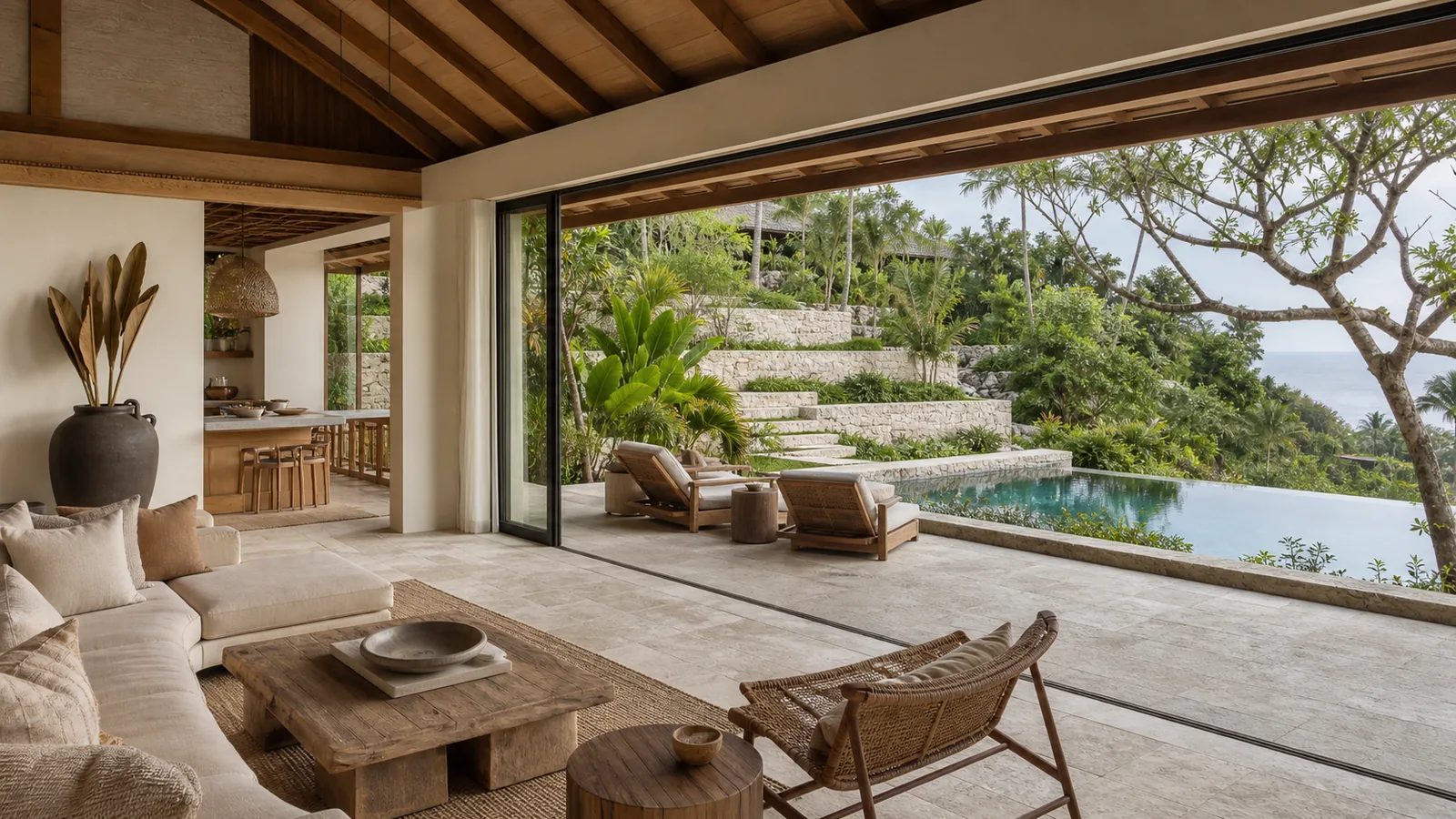
Most Uluwatu and Bukit content sells a mood: surf breaks, cliff-edge pools, golden-hour views and broad yield ranges that make the peninsula sound like a straightforward investment market.
What those pages rarely cover:
- Zoning is plot-specific, not area-wide. A parcel 200 metres from a popular villa may sit in an agricultural or conservation zone that prohibits villa construction. Coastal proximity triggers additional setback rules under Indonesian spatial planning law.
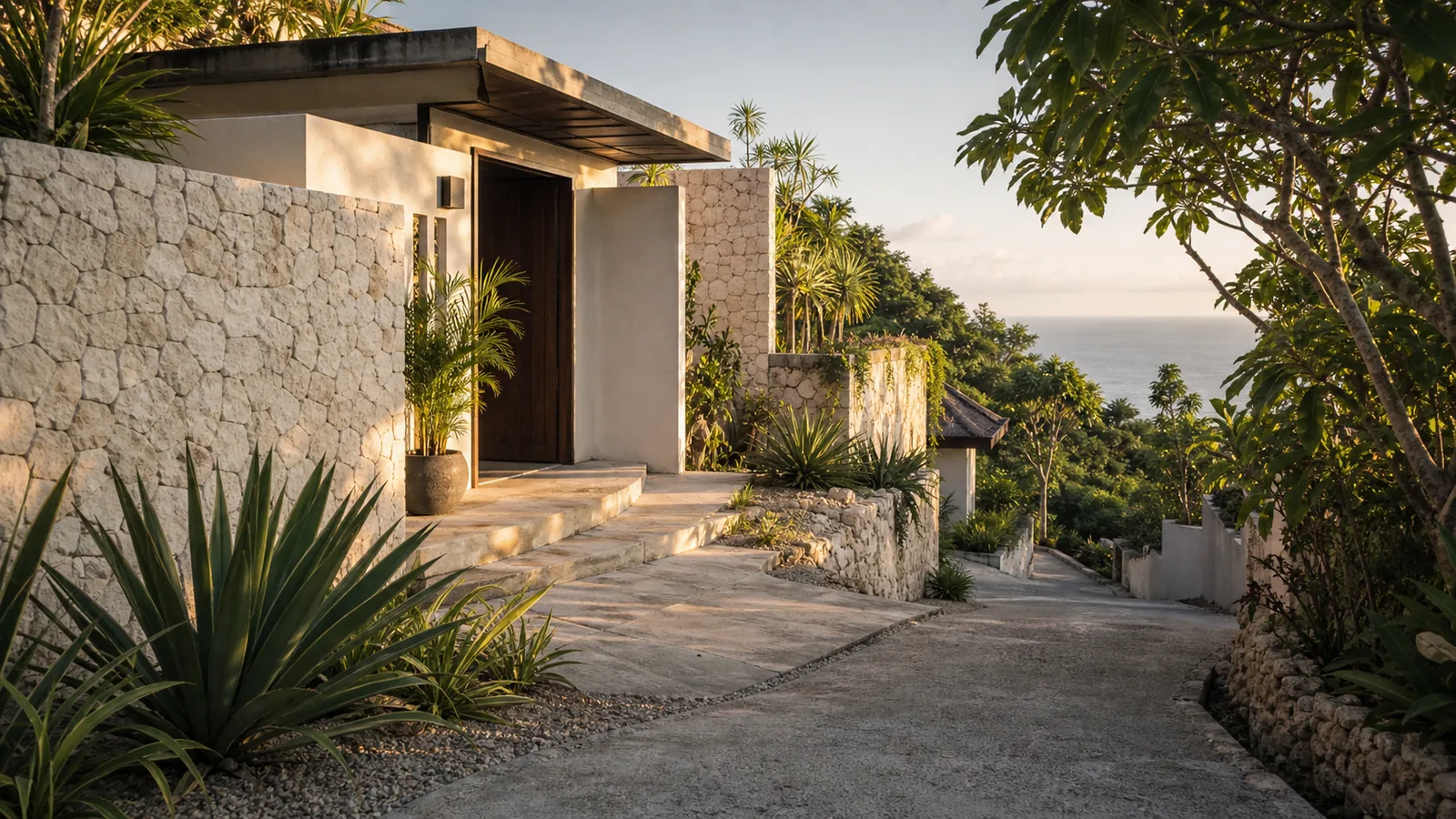
- Access affects buildability as much as view value. Narrow gang roads, steep descents and seasonal erosion can make a clifftop plot physically unbuildable to a commercial standard — or expensive enough to eliminate development margin entirely.
- Water supply is not guaranteed by location. PDAM coverage is patchy across the Bukit peninsula. Many developments rely on water trucking or private bore wells, both of which carry ongoing cost and supply risk.
- The Bingin enforcement story is not a footnote. In 2025, Indonesian authorities demolished dozens of cliff-edge businesses in Bingin as part of a coastal zoning enforcement action (The Guardian, August 2025). Buyers who treat coastal zoning risk as remote should read that history before committing to any coastal plot.
- Lease length decay is a first-order financial variable. A lease with 25 years remaining is a materially different asset from one with 50, regardless of view quality. Yield assumptions must be stress-tested against remaining term and exit liquidity.
- Published yield figures are starting points, not projections. Sources such as Invest Land Bali publish Uluwatu ranges, but net returns after management fees (typically 20–30% of gross revenue), taxes, maintenance, vacancy and capex are site-specific and must be modelled independently.
Why the Bukit Peninsula Draws Buyers
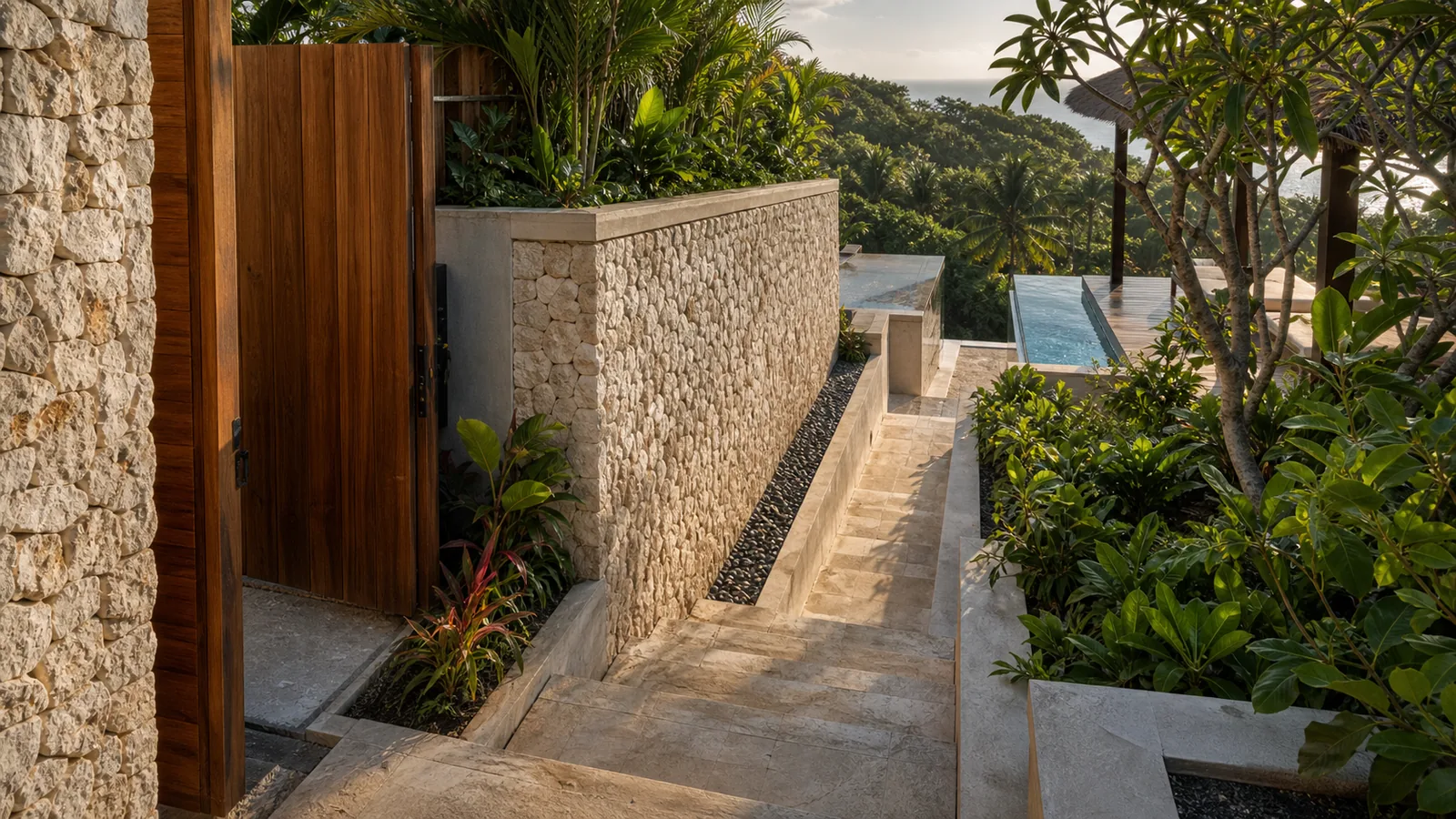
The Bukit peninsula — encompassing Uluwatu, Pecatu, Bingin, Padang Padang, Balangan and Ungasan — concentrates ocean-view land that is genuinely scarce in Bali. Proximity to surf breaks, clifftop elevation and privacy drives sustained demand from both lifestyle buyers and investors (Ulu Homes area guide).
Buyers typically arrive with one of three scenarios:
- Build-to-rent: Develop a villa or small compound for short-term holiday rental income.
- Build-to-use with rental offset: Create a private retreat that generates income when unoccupied.
- Land hold or partner deal: Acquire a plot with development potential and either hold or structure a joint venture with a local operator.
Each scenario carries different zoning requirements, permit paths, capital exposure and exit assumptions. A plot that suits the first scenario may be legally or physically unsuitable for the third.
Bukit Land for Villa Development: Due Diligence Matrix
Before any site visit, map every plot against these risk dimensions. A single unresolved column is grounds to pause or stop a deal.
| Risk Area | What to Confirm | Red Flag |
|---|---|---|
| Zoning | GISTARU/KKPR/SKRK classification permits commercial villa use | Agricultural, conservation or coastal buffer designation |
| Access | Road width allows construction vehicles; road is formally designated | Gang access only; privately held by third party; slope >30% |
| Water | PDAM connection confirmed or bore well licensed and tested | Water trucking as sole source; no extraction permit |
| Land title | Certificate matches cadastral boundary; no encumbrance or dispute | Girik (letter C) only; inherited claims unresolved |
| Lease structure | Minimum 25 years remaining; renewal mechanism documented | Sub-10 years remaining; verbal lease only |
| Coastal setback | Plot boundary sits outside 100 m high-water buffer | Any proposed structure within national setback zone |
See the Bali zoning property guide for a fuller explanation of how Indonesian spatial planning categories interact with villa development approvals.

Common Buyer Objections — and the Honest Response
“The agent says the zoning is fine.” Agents are not qualified to interpret spatial planning documents and carry no liability if they are wrong. The only reliable confirmation is written KKPR or SKRK documentation from the relevant government authority, reviewed by an independent property lawyer.
“Other villas nearby got built, so this plot must be buildable.” Zoning is applied at the cadastral parcel level. Adjacent builds may predate current regulations, operate without valid permits, or have been approved under a different land classification. The Bingin enforcement action affected businesses that had operated for years under the assumption of implicit approval.
“The lease is only 20 years but it can be extended.” Lease extension is not automatic. It requires a willing landowner, renegotiated terms and a new notarial deed. If the landowner dies, is in dispute or raises renewal pricing significantly, extension is not guaranteed. Model the project on the lease term you have, not the one you hope to get.
“The view premium justifies the asking price.” Views command premiums in Uluwatu and Bukit markets (Bali Realty), but a view does not offset unbuildable zoning, inaccessible road conditions or an unresolvable water supply. Price a plot on what can be independently verified.
“I can sort out the permits after I buy.” Permit applications after acquisition expose you to denial risk, design changes mandated by compliance and construction delays that erode returns. Buildability must be confirmed before the LOI, not after.
Pre-LOI Checklist for a Bukit Development Plot
Complete every item before signing a letter of intent or paying a holding deposit. Items marked (L) require an independent licensed notaris or property lawyer — not one introduced by the seller.
- Land certificate obtained and cross-checked against cadastral map (L)
- GISTARU/KKPR/SKRK zoning confirmation for commercial villa use received in writing
- Coastal setback position confirmed — plot boundary marked on site against 100 m buffer
- Access road width measured at narrowest point; road ownership established (L)
- Geotechnical or slope assessment completed where gradient is material
- Water source confirmed: PDAM connection, licensed bore well or trucking cost model
- Power and telecoms confirmed at plot boundary
- IMB/PBG precedent established for comparable structures on adjacent certificates
- Environmental assessment requirement (AMDAL/UKL-UPL) determined by consultant
- Maximum permitted footprint and floor-area ratio documented from zoning authority
- Title search completed: no active dispute, encumbrance or inherited claim (L)
- Ownership structure for foreign buyer confirmed: leasehold, Hak Pakai or PT PMA (L)
- Construction cost estimate obtained from a contractor who has physically assessed the site
- Rental income model built from subarea-specific occupancy and ADR data, not peninsula averages
For further reference, Invest Land Bali’s due diligence guide and Prestige Property Bali’s buyer checklist are useful starting points.
Exit Options: Develop, Hold, Partner or Avoid
Not every Bukit plot should be developed. A clear-eyed assessment before LOI always includes the option to walk away.
- Develop: Proceed once zoning, access, water, legal structure and construction budget are independently confirmed.
- Hold: Secure the lease at current pricing if fundamentals are sound but timing or capital is not right for immediate development.
- Partner: Bring in a local developer or operator as a joint venture partner in exchange for reduced capital exposure. For how off-plan joint structures are typically documented, see Bali off-plan villas.
- Avoid: If zoning is unconfirmed, access is restricted, water supply is unresolved or the legal structure cannot be clarified by independent counsel, walk away. Clifftop views on the Bukit peninsula are not so scarce that unresolved structural risk is worth carrying.
Frequently Asked Questions
Can a foreigner buy land outright on the Bukit peninsula? No. Indonesian law reserves Hak Milik (freehold) for Indonesian citizens. Foreign buyers access land through long-term leasehold (Hak Sewa), Hak Pakai structures set up via notary, or acquisition through an Indonesian-registered foreign-investment company (PT PMA). Each route has different constraints, renewal mechanisms and exit options. Independent legal review before signing anything is essential.
How long should a leasehold be to make a development project viable? A general rule of thumb used by Bali property practitioners is that remaining lease term should exceed the expected payback period by at least a decade, allowing for operating maturity and exit. On a project that takes two years to build and targets a 7–10 year payback, a lease with fewer than 20–22 years remaining carries meaningful exit-liquidity risk.
Is it safe to use a nominee arrangement to hold land? Nominee structures — where an Indonesian citizen holds title on behalf of a foreigner — are not legally recognised as valid foreign ownership mechanisms under Indonesian property law and carry significant legal and practical risk. PT PMA or Hak Pakai structures are the legally safer routes. Independent counsel consistently advises against nominees for development assets.
What operating licence does a rental villa on the Bukit peninsula need? Commercial short-term rental operation typically requires a valid business identification number (NIB) and a hospitality classification — either pondok wisata for smaller properties or a vila classification under the relevant licensing framework. Operating without the correct licence creates enforcement exposure. Confirm the licence pathway with a legal adviser before committing to a rental-income plan.
How should I interpret published yield figures for Uluwatu? Published gross yield ranges are modelling starting points, not projections for your specific asset. Net returns depend on your occupancy rate, average daily rate, management fee structure, tax obligations, maintenance budget, capex cycle and remaining lease term. Build a conservative downside model using subarea-comparable data — not peninsula-wide averages — and have it reviewed independently before any purchase decision.
What subareas on the Bukit peninsula carry the highest development risk? Coastal-edge plots in Bingin and Padang Padang carry the most acute zoning and enforcement risk given their proximity to the high-water boundary and the enforcement precedent set in 2025. Inland plots in Ungasan and upper Pecatu carry lower coastal setback exposure but may have different access and water constraints. Risk profile varies by individual parcel, not by subarea alone.

Bukit Climate Proxy: Wind, Rain and Humidity
We analysed 2015–2025 hourly reanalysis for one representative Uluwatu and Pecatu reference grid point. It is an area-level ownership baseline—not a weather station at the property and not evidence of mould, corrosion, flooding or repair incidence.
| Measured or derived metric | Uluwatu and Pecatu reference baseline |
|---|---|
| Mean annual rainfall | 1,630 mm/year |
| Rainy days (≥1 mm) | 261.6 days/year |
| Average relative humidity | 80.2% |
| Hours at ≥85% humidity | 1,944 hours/year |
| Longest observed wet run | 52 consecutive days |
| Average 10 m wind speed | 14.4 km/h |
| Strong-wind days (≥30 km/h in any hour) | 31.5 days/year |
| Mean daily shortwave energy | 5.69 kWh/m²/day |
| Daily mean temperature variability (standard deviation) | 0.80°C |
| Mean daily temperature range | 2.31°C |
| Mean wet-bulb temperature (derived) | 24.0°C |
| Mean first-layer soil moisture | 0.261 m³/m³ |
| FAO-56 reference evapotranspiration (derived) | 1,645 mm/year |
| Rainiest months (mean monthly rainfall) | February (258 mm), January (255 mm), December (248 mm) |
| Rain Burden (relative 0–100) | 24 |
| Humidity Burden (relative 0–100) | 0 |
| Outdoor Maintenance Pressure (relative 0–100) | 29 |
| Seasonal Weather Stability (relative 0–100) | 33 |
Grid-resolution note
The western Bukit coordinates resolve to a populated ERA5-Land cell at -8.8, 115.2, approximately 13 km from the requested point. Treat it as a broad Bukit proxy only; cliff exposure and salt deposition still require site inspection.
How to use this in due diligence
- Treat the figures as a broad Bukit proxy and inspect the actual cliff, slope, wind and drainage exposure at the parcel.
- Check roof fixings, glazing hardware, exterior coatings, water storage and landscape irrigation against maintenance records.
- Assess salt spray separately: ERA5-Land measures weather variables, not salt deposition or corrosion incidence.
Source: Copernicus Climate Change Service (C3S) ERA5-Land, hourly reanalysis, 2015–2025, analysed in Asia/Makassar local time. Relative humidity, wet-bulb temperature and reference evapotranspiration are derived from the source variables using the documented methodology. Data: CC BY 4.0. See the climate data methodology for formulas, thresholds and limitations. Values are area-level model estimates, not measurements at a villa; relative indices compare five configured Bali location requests (four distinct populated grid cells), not engineering, insurance, cost or yield ratings.
Before You Request a Shortlist
The Uluwatu and Bukit market contains legitimate development opportunities alongside plots with title ambiguity, zoning constraints, infrastructure gaps and access limitations that are not disclosed upfront. The difference between a good outcome and a costly one is almost always the quality of verification done before any money moves.
If you are ready to look at specific options, the Uluwatu villas for sale page covers verified listings with ownership structure and subarea context. Bring your subarea preference, budget range, ownership structure comfort and intended use — build-to-rent, private retreat or partner deal — to the first conversation.
To ask a specific question about zoning verification, access assessment, legal structure or what a due diligence process should cover for a plot you have already identified:
Ask land due diligence question
Reviewed by a Bali property specialist with experience in Uluwatu and South Kuta land transactions. This article is written for educational purposes only and does not constitute legal, tax or financial advice. Verify all ownership structures, zoning classifications and lease terms with an independent Indonesian notaris or property lawyer before any transaction.