
A Bali villa priced at $300,000 projecting 15% gross yield sounds compelling. After management fees, fixed operating costs, a maintenance reserve, and licensing obligations, that same villa is more likely to return 6%–10% net — depending on how honestly the assumptions were built.
Bali villa management costs are where most investor projections quietly break down. This page shows the full cost stack, what agents rarely surface upfront, and the questions to ask before you commit.
Key numbers at a glance
- Management commission: 20%–30% of gross booking revenue (plus common add-ons)
- Fixed operating costs: 15%–20% of gross revenue, year-round
- Maintenance reserve: 5%–10% of gross revenue recommended
- Realistic net yield range: 5%–10% after all deductions
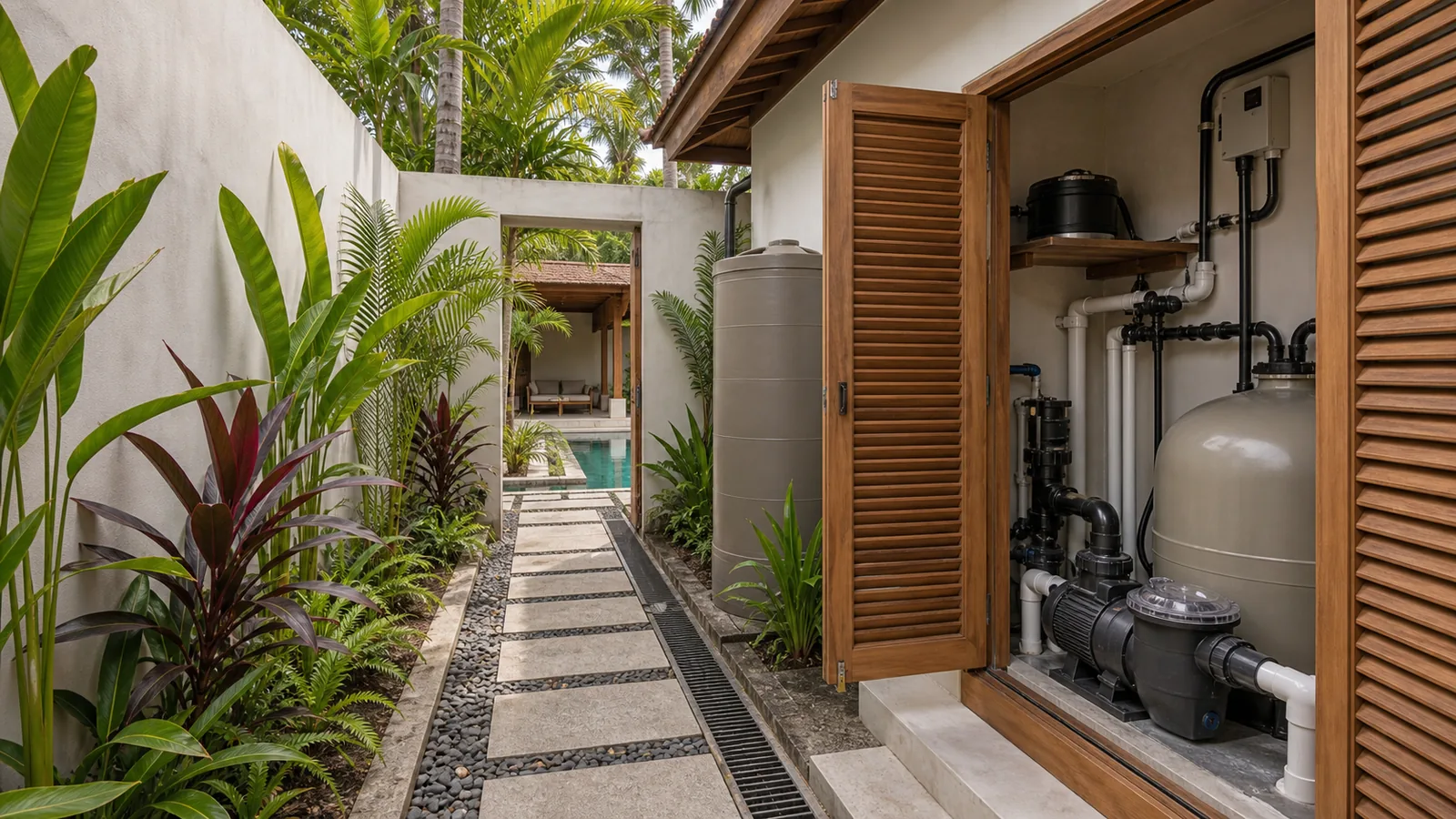
What Most Guides Miss
Most Bali investment guides present a gross yield figure alongside an optimistic occupancy projection and leave you to assume the gap is profit. They rarely show:
- The full management fee structure — not just the commission headline but every charge below it
- Fixed operating costs that run regardless of occupancy
- Maintenance reserves appropriate for tropical climates and intensive short-term rental use
- License and compliance costs required before rental income can be legally collected
- Lease term decay — how a leasehold’s resale value compresses as remaining years shorten
- Exit liquidity reality — the Bali resale market is slower and narrower than most buyers expect
The gap between gross and net yield in Bali is not a rounding error. See how yields are typically modelled across different holding structures.

How Bali Villa Management Costs Are Structured
Management in Bali is a layered cost structure, not a single fee. Foreign buyers consistently underestimate their total exposure because they focus on the commission rate without auditing what sits outside it.
Management Commission
Most villa management companies charge 20% to 30% of gross booking revenue. Some quote lower headline rates and charge separately for marketing, OTA channel management, and guest services. Always request a full written fee schedule before comparing providers.
Sources tracking Bali villa ROI structures — including Investland Bali and Rumavi’s 2025 investor guide — note that commission-only comparisons frequently obscure true management costs by 5–8 percentage points of gross revenue.
What the Commission Covers — and What It Doesn’t
Typically included:
- Guest communication and check-in coordination
- OTA channel management (Airbnb, Booking.com, Agoda)
- Basic housekeeping coordination
- Monthly occupancy and revenue reporting
Often charged separately or excluded:
- Deep cleaning between long-stay guests
- Maintenance callouts and repair coordination
- Pool and garden servicing
- Linen replacement and consumable restocking
- Owner stays that bypass OTA revenue tracking
Fixed Villa Operating Costs
Every villa carries fixed monthly costs whether occupied or not. These do not disappear in low season.
| Cost Category | Notes |
|---|---|
| Staff wages | Villa manager, 1–2 housekeepers, pool attendant, gardener |
| Electricity | AC, pool equipment, and guest-grade broadband drive bills significantly above residential use |
| Pool and garden maintenance | Chemical treatment, equipment servicing, landscaping |
| Internet and security | Guest-grade broadband plus basic monitoring |
| Building and contents insurance | Increasingly required; rarely bundled into management packages |
| Accounting and reporting | Local bookkeeping if operating through an Indonesian entity |
Balitecture’s rental income analysis estimates that combined fixed operating costs (excluding management commission) typically represent 15% to 20% of gross revenue on a well-managed villa — a figure most headline yield projections fail to isolate.
Maintenance Reserves
Tropical climates accelerate wear on roofing, structural timber, aircon systems, pools, and outdoor furniture. Experienced operators recommend a maintenance reserve of 5% to 10% of gross annual revenue for planned and reactive repairs. Air conditioning units, pool equipment, and garden structures are recurring capital items. Omitting this reserve is one of the most common modelling errors among first-time Bali investors.

License and Compliance Costs
Short-term villa rental in Bali requires a valid rental license. Operating without one is a compliance risk and affects the legal basis on which you collect income. Understand the licensing process before you commit to any property.
License fees, permit renewals, and local government levies vary by municipality and villa classification. Confirm current requirements with a qualified Indonesian legal adviser — the information on this page is educational context, not legal advice. Tax obligations on rental income also apply and should be reviewed by an Indonesian tax professional before you sign anything.
Climate Data as an Operating-Cost Input
We compared 2015–2025 hourly reanalysis at the representative Bali reference points below. The figures help screen maintenance exposure; they do not rank individual villas or replace drainage, material and building-condition checks.
| Reference point | Rainfall mm/year | Rainy days/year | Avg RH | ≥85% RH hours/year | Avg wind km/h | Strong-wind days/year† | Solar kWh/m²/day | Outdoor pressure* |
|---|---|---|---|---|---|---|---|---|
| Canggu coastal corridor | 1,662 | 245.7 | 85.5% | 4,968 | 12.2 | 6.4 | 5.71 | 49 |
| Ubud inland reference | 2,640 | 268.5 | 87.3% | 5,948 | 6.9 | 0.0 | 5.68 | 70 |
| Uluwatu and Pecatu reference | 1,630 | 261.6 | 80.2% | 1,944 | 14.4 | 31.5 | 5.69 | 29 |
| Sanur east-coast reference | 1,754 | 264.0 | 83.7% | 3,901 | 12.1 | 4.9 | 5.68 | 35 |
*Outdoor Maintenance Pressure is a relative index across five configured location requests, which resolve to four distinct populated grid cells. The raw weather metrics beside it remain the evidence. †A strong-wind day contains at least one hourly 10 m wind-speed value of 30 km/h or more; this is a comparison threshold, not a damage threshold.
Grid-resolution disclosures
- Uluwatu and Pecatu reference uses the nearest populated ERA5-Land cell at -8.8, 115.2 (13 km from the requested coordinate), so it is a broad-area proxy.
- The nearest populated land cell is -8.7, 115.2. It is shared with the Seminyak request, so this dataset cannot support a Sanur-versus-Seminyak climate ranking.
How to use this in due diligence
- Use rainfall and high-humidity exposure to set inspection frequency and a maintenance reserve, not to predict a fixed repair bill.
- Separate routine AC, roof, drainage, timber, pool and garden work from one-off capital replacements in the operating model.
- Verify invoices and condition on site: reanalysis data cannot show whether a particular villa was well designed or maintained.
Source: Copernicus Climate Change Service (C3S) ERA5-Land, hourly reanalysis, 2015–2025, analysed in Asia/Makassar local time. Relative humidity, wet-bulb temperature and reference evapotranspiration are derived from the source variables using the documented methodology. Data: CC BY 4.0. See the climate data methodology for formulas, thresholds and limitations. Values are area-level model estimates, not measurements at a villa; relative indices compare five configured Bali location requests (four distinct populated grid cells), not engineering, insurance, cost or yield ratings.
Gross vs Net Yield: Conservative Assumptions in Practice
No projection can tell you what a specific villa will earn. What a rigorous buyer can do is make the assumptions visible. The table below illustrates how management fees and villa operating costs in Bali affect net yield at three occupancy levels, using illustrative figures on a $300,000 villa priced at around $250 per night.
| Occupancy | Gross Revenue | Management (25%) | Fixed Operating Costs | Maintenance Reserve (7%) | Estimated Net Yield |
|---|---|---|---|---|---|
| 55% (low-season weighted) | $41,250 | $10,313 | $12,000 | $2,888 | ~5.3% |
| 70% | $52,500 | $13,125 | $12,000 | $3,675 | ~7.9% |
| 80% | $60,000 | $15,000 | $12,500 | $4,200 | ~9.4% |
These figures are illustrative only. Actual outcomes depend on villa size, location, nightly rate, management provider, and maintenance history. No contractual yield promise removes the underlying cost exposure — the line items above apply regardless of what an operator’s agreement states about minimum returns. Use the ROI calculator to model your specific scenario.
Common Questions From Buyers — Honest Answers
“The management company is showing a contractual yield promise of 12% net.” A contractual yield promise shifts income risk to the operator — until that operator encounters difficulty. Understand what underpins it: occupancy track record, the operator’s capitalization, and the termination clauses. The promise is only as strong as the business behind it. Villa Audit’s due diligence guide covers how to stress-test management company claims.
“The developer shows occupancy data from neighbouring villas.” Ask for independently verified data, not marketing materials. Occupancy at a comparable villa depends on its vintage, condition, channel mix, and management quality — not its proximity to yours.
“The yield looks strong enough to absorb unexpected costs.” High gross yield projections built on peak-season assumptions often collapse when modelled across a full year. Request full-year occupancy data, not peak-period extrapolations.
What to Ask a Management Company Before You Sign
Request written answers to the following before engaging any provider:
- Full fee schedule — all charges, not commission only
- Are staff wages included in the commission or invoiced separately?
- How are maintenance callouts authorised and billed?
- Which OTA channels do you use, and who controls the listing account?
- Can I review occupancy and revenue reports from comparable villas you currently manage?
- What notice period applies if I change management companies, and who retains future bookings?
- Is there an owner usage policy, and how does personal use affect revenue reporting?
- Are pool and garden servicing costs included or additional?
A management company that declines to answer these in writing is a risk signal, not an administrative inconvenience.
Downside Cases and Exit Liquidity
Projections that assume stable occupancy deserve stress-testing. Realistic downside scenarios to model:
- Extended low-season occupancy — some Bali tourism markets have prolonged seasonal troughs
- Management company instability — operators close, change ownership, or decline in service quality
- Lease term decay — a leasehold with fewer than 10 years remaining is materially harder to resell and unlikely to attract financing for your buyer
- Regulatory change — short-term rental licensing requirements in Bali have evolved over time and may continue to
Exit liquidity for Bali leaseholds is lower than buyers from freehold markets expect. The buyer pool is primarily other foreign investors. Resale timelines are longer, price discovery is thin, and leases with limited remaining term trade at significant discounts. Build your exit assumption into the investment thesis before you enter.
Frequently Asked Questions
What is a typical management fee for a Bali villa? Most villa management companies in Bali charge 20% to 30% of gross booking revenue. This headline rate understates true cost — additional charges for maintenance coordination, pool servicing, and consumables commonly add 5% to 8% more.
What villa operating costs apply beyond the management fee? Fixed operating costs typically include staff wages, electricity, pool and garden maintenance, internet, insurance, and local accounting. These run whether the villa is occupied or not, and commonly represent 15% to 20% of gross revenue.
How much should I budget for maintenance? A maintenance reserve of 5% to 10% of gross annual revenue is a commonly cited benchmark for short-term rental villas in tropical climates. Air conditioning systems, roofing, and pool equipment are recurring capital items.
Can I change management companies if performance is poor? Yes, but review the management agreement carefully before signing. Notice periods, OTA listing control, and future booking ownership are the three clauses that matter most if you need to switch operators.
Do I need a license to rent my Bali villa short-term? Yes. Short-term rental requires a valid rental license. Operating without one carries compliance risk. Requirements vary by municipality and should be confirmed with a qualified local legal adviser. More detail on the licensing process is here.
What is the realistic net yield on a Bali villa after all costs? Net yield after management fees, operating costs, and a maintenance reserve typically ranges from 5% to 10%, depending on occupancy, villa size, and management quality. Gross yield projections of 12%–15% generally reflect figures before these cost layers are applied.

Next Step: Build Your Net Yield Estimate
Understanding bali villa management costs is not pessimism — it is the difference between a projection that survives contact with reality and one that does not. A villa returning 7% net on conservative, documented assumptions is a stronger investment case than one projecting 15% gross with no cost transparency.
Before engaging any agent or signing a reservation agreement, model the full cost stack for the specific property you are considering.
This article was prepared by the editorial team, a buyer-side resource for foreign investors researching verified Bali villas. Content is reviewed for factual accuracy against publicly available sources and updated when market conditions change. Nothing on this page constitutes legal or financial advice. Consult a qualified Indonesian legal adviser and tax professional before entering any property transaction.