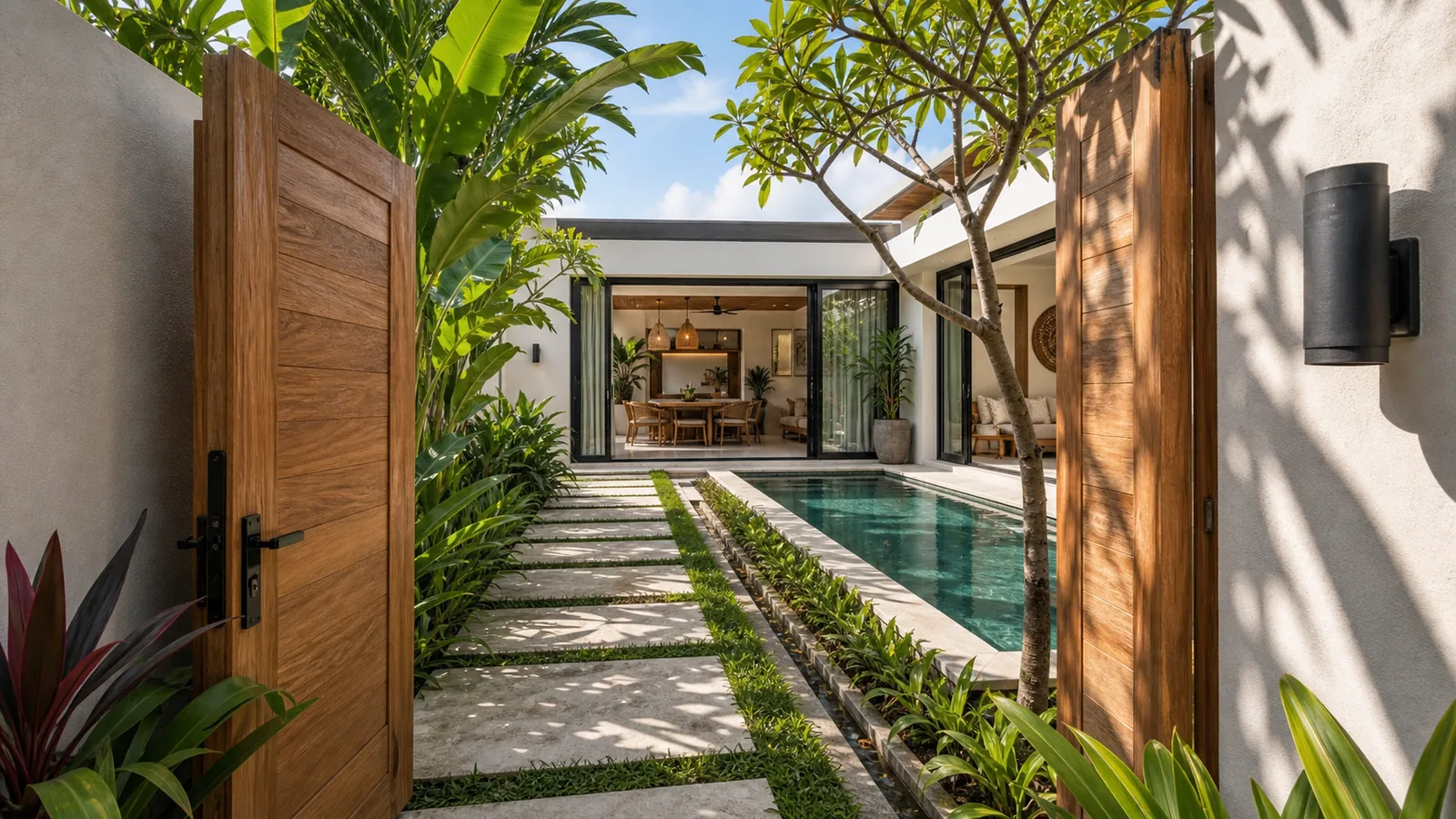
Bali Property Due Diligence Checklist
The most expensive question in a Bali villa purchase is one most buyers ask too late: what am I actually buying, and can I verify it independently?
This bali property due diligence checklist exists because the answer is almost never as simple as the marketing suggests. Foreign buyers routinely move from research to reservation with significant gaps in their understanding of ownership structure, zoning rights, and licensing status — gaps that only surface when it matters most.
Work through this list before you make any offer, pay any reservation deposit, or rely on any verbal assurance about documents.
What Most Guides Miss
Most buyer guides for Bali fall into two categories: optimistic investment content built around yield projections and lifestyle imagery, and generic legal explainers that list title types without connecting them to anything you can actually do in a transaction. Neither helps you walk into a meeting knowing which documents to request, which questions expose a weak deal, and what “clean title” really means in practice.
Three gaps appear in almost every transaction that creates problems later:
Ownership structure is described loosely. Hak Milik (freehold) is reserved for Indonesian citizens — foreign individuals cannot hold it directly. Leasehold is a contractual right to use land for a defined term, typically 25–30 years with an option to extend, but that extension depends on the landowner’s cooperation and is rarely automatic in practice. PT PMA (foreign-owned Indonesian company) can hold property but carries ongoing business compliance obligations. None of these is inherently the right answer; suitability depends on your holding period, risk tolerance, and intended use. See: Leasehold vs Freehold in Bali
A clean certificate is not a clean deal. A land certificate confirms the title category and registered holder. It does not confirm zoning compatibility, absence of encumbrances, or the seller’s legal authority to sell. Those are separate searches, each requiring separate steps.
Licensing and ownership are different things. If you intend to rent the property commercially, the villa needs an appropriate hospitality license. That license is independent of who owns the land. Ownership alone does not grant commercial rental rights — a point that is routinely omitted from investment-focused marketing.

Ownership Routes at a Glance
Due diligence is structure-dependent. Before examining any specific property, clarify which route applies and what that demands from the document review.
| Route | Who Can Use It | Title Held | Primary Risk |
|---|---|---|---|
| Leasehold | Foreign individuals | Contractual use right | Extension not guaranteed |
| PT PMA | Foreign-owned company | HGB or HGU | Business compliance burden |
| Nominee | Not recommended | Hak Milik via Indonesian national | Very limited enforceability |
Leasehold: You are acquiring a long-term use agreement, not land ownership. Key items to verify: total term including extension, how extension is triggered and by whom, what happens if the landowner dies, and whether the lease is notarised and registered at the Land Office. Unregistered leases are significantly harder to enforce.
PT PMA: A foreign-owned company can hold HGB (Right to Build) or HGU (Right to Cultivation) title. Setting one up requires time, capital commitment, and ongoing tax and reporting obligations. It is a business structure with obligations — not a simplified workaround.
Off-plan: Buying pre-completion adds a further layer: developer financial standing, payment security arrangements, and whether the building permit (IMB, or the newer PBG framework) has been issued for the specific plot. See: Bali Off-Plan Villas

The Bali Property Due Diligence Checklist
Request and verify the following before committing to any transaction. This is a framework for conversations with a notaris (PPAT) or independent Indonesian property lawyer — not a substitute for their review.
Land Title
- Obtain a copy of the land certificate (SHM, HGB, or HGU) and confirm what rights it actually conveys
- Verify the registered holder’s name matches the seller’s identity documents
- Request a current certificate validity check (pengecekan sertifikat) at the local Land Office (BPN) — no older than 30 days at the time of transaction
- Confirm no encumbrances, liens, mortgages, or active disputes are registered
Zoning and Spatial Planning
- Confirm the land’s current zoning classification (residential, commercial, agricultural, conservation)
- Cross-reference the spatial plan (RTRW) for the specific regency — Badung, Gianyar, Buleleng, and Karangasem have different frameworks
- Verify that your intended use, including rental use, is permitted under current zoning
- Check for planned infrastructure or reclassification that could affect access or permitted use
Building Permits and Physical Compliance
- Request the building permit (IMB or PBG, depending on issue date)
- Confirm the constructed building matches the permitted footprint, floor area, and height
- Check for outstanding violations or unapproved extensions
- For older properties: verify whether renovations have been permitted or can be regularised
Rental Licensing
- Identify what rental license category is required for the intended operation (Pondok Wisata for smaller villas, or the relevant commercial classification)
- Verify current license status directly with the local government office — not through the agent
- Understand what is required to maintain, renew, or transfer the license when ownership changes
- Confirm the license is in the name of the correct legal entity
Seller Authority
- Confirm the seller has legal authority to sell — individual title holder, company director with board authorisation, or heir with probate documentation
- For company sales: review the company deed, shareholder register, and director authorisation
- Obtain and verify any power of attorney documentation if the seller is represented by a third party
Financial and Tax
- Confirm no outstanding property tax (PBB) arrears — request recent payment receipts
- Clarify transaction tax obligations: BPHTB (acquisition duty, typically 5% of transaction value, buyer-side) and PPh (income tax, seller-side)
- Agree in writing on who pays which costs before proceeding
- Understand currency and payment mechanics — transfers to Indonesian accounts have reporting requirements
What Agents Say — and What to Ask Instead
“The lease has an automatic extension.”
Extension is contractual. “Automatic” in marketing language typically means there is an option clause — exercising it requires the landowner’s cooperation and usually a renegotiated rate. Ask to see the clause in the original lease document, translated.
“The IMB is in process.”
In-process is not issued. Buying into a structure without a permit creates legal exposure. Ask for the expected timeline, a penalty clause in the SPA if the permit is not issued before handover, and your lawyer’s view on the risk.
“It’s been renting successfully for three years.”
Past operational success does not confirm current compliance. Licensing enforcement in Bali tightens periodically. Verify the actual license status independently.
“The PT PMA is already set up — you just step in.”
Stepping into an existing company means taking on its full history: any outstanding liabilities, tax arrears, or undisclosed obligations. A clean-company check — legal and tax — is not optional before this type of acquisition.
Questions to Put to Your Notaris, Lawyer, or Agent
These are calibration questions. A professional providing buyer-side advice should answer them directly:
- Can you confirm in writing that the zoning permits short-term rentals at this address?
- Has the BPN certificate check been completed in the last 30 days, and can I see the document?
- What is the exact lease term, what triggers the extension option, and what happens if the landowner does not agree?
- Who holds the funds during the transaction, under what documentation, and under what conditions are they released?
- If I want to exit in five to seven years, what does the resale process look like for this specific structure?
Redirecting these questions toward the investment opportunity rather than answering them directly is a signal worth noting.
What This Checklist Cannot Confirm
This page is buyer education — not legal advice.
Indonesian property law has evolved through changes including the Omnibus Law, which expanded some foreign ownership categories while leaving significant restrictions in place. Zoning rules, licensing requirements, and title conditions vary by regency and change over time.
Any specific transaction requires independent verification by a licensed Indonesian notaris (PPAT) and, for complex structures, an independent property lawyer engaged by the buyer — not referred by the selling agent.
This checklist does not confirm the availability or pricing of any listing. ROI projections depend on occupancy, management costs, maintenance, and market conditions that cannot be guaranteed.
Frequently Asked Questions
Can foreigners legally buy property in Bali? Foreign individuals cannot hold Hak Milik (freehold) title. Available routes are leasehold, ownership through a PT PMA company structure, or — under updated Omnibus Law provisions — certain apartment units. Each route has conditions requiring professional legal advice for a specific transaction.
How long does a leasehold typically last? Common initial terms are 25–30 years, with an option clause for renewal. Total contracted periods of 50–80 years exist but must be explicitly agreed and documented in the notarised lease. Extension depends on the original contract terms and the landowner’s agreement — it is not automatic.
What is a notaris (PPAT)? A Pejabat Pembuat Akta Tanah is a state-authorised notary who prepares and registers property transaction documents. Using one is legally required for property transfers. A notaris manages the transaction process — they are not independent legal counsel for either party. For complex structures, an independent lawyer in addition to the notaris is advisable.
What is the BPN? The Badan Pertanahan Nasional is Indonesia’s National Land Agency, which maintains the land certificate register. A BPN certificate check confirms the current registered holder, title type, and whether any encumbrances are registered. This check should be current — within 30 days of the transaction — not a historical copy provided by the seller.
What licenses are needed to rent commercially? Short-term rental operations typically require a hospitality license (such as Pondok Wisata for smaller villas) separate from the land ownership title. Requirements vary by property type and regency and have been revised periodically. Verify current requirements with the local government office.
Climate Exposure in Property Due Diligence
We compared 2015–2025 hourly reanalysis at the representative Bali reference points below. The figures help screen maintenance exposure; they do not rank individual villas or replace drainage, material and building-condition checks.
| Reference point | Rainfall mm/year | Rainy days/year | Avg RH | ≥85% RH hours/year | Avg wind km/h | Strong-wind days/year† | Solar kWh/m²/day | Outdoor pressure* |
|---|---|---|---|---|---|---|---|---|
| Canggu coastal corridor | 1,662 | 245.7 | 85.5% | 4,968 | 12.2 | 6.4 | 5.71 | 49 |
| Ubud inland reference | 2,640 | 268.5 | 87.3% | 5,948 | 6.9 | 0.0 | 5.68 | 70 |
| Uluwatu and Pecatu reference | 1,630 | 261.6 | 80.2% | 1,944 | 14.4 | 31.5 | 5.69 | 29 |
| Sanur east-coast reference | 1,754 | 264.0 | 83.7% | 3,901 | 12.1 | 4.9 | 5.68 | 35 |
| Seminyak southwest-coast reference | 1,754 | 264.0 | 83.7% | 3,901 | 12.1 | 4.9 | 5.68 | 35 |
*Outdoor Maintenance Pressure is a relative index across five configured location requests, which resolve to four distinct populated grid cells. The raw weather metrics beside it remain the evidence. †A strong-wind day contains at least one hourly 10 m wind-speed value of 30 km/h or more; this is a comparison threshold, not a damage threshold.
Grid-resolution disclosures
- Uluwatu and Pecatu reference uses the nearest populated ERA5-Land cell at -8.8, 115.2 (13 km from the requested coordinate), so it is a broad-area proxy.
- Sanur east-coast reference and Seminyak southwest-coast reference resolve to the same populated land cell at -8.7, 115.2; identical values mean the grid cannot distinguish those requests, not that their parcel-level conditions are identical.
How to use this in due diligence
- Keep legal ownership verification separate from physical-condition verification: a valid structure does not establish that roofs, drainage, AC or exterior materials are fit for the site’s exposure.
- Define responsibility for weather-related inspection, routine maintenance and capital replacement in the lease, management agreement or handover documents where relevant.
- Use an independent property inspection and actual maintenance records; area-level reanalysis cannot prove damage, mould, flooding or compliance at a villa.
Source: Copernicus Climate Change Service (C3S) ERA5-Land, hourly reanalysis, 2015–2025, analysed in Asia/Makassar local time. Relative humidity, wet-bulb temperature and reference evapotranspiration are derived from the source variables using the documented methodology. Data: CC BY 4.0. See the climate data methodology for formulas, thresholds and limitations. Values are area-level model estimates, not measurements at a villa; relative indices compare five configured Bali location requests (four distinct populated grid cells), not engineering, insurance, cost or yield ratings.
Before You Contact an Agent
The bali property due diligence checklist above is most useful before you begin viewing specific properties — because it shapes the questions you ask from the first conversation. If you are still comparing structures or areas, buying a villa in Bali explains what to expect at each stage of the process.
When you are ready to move from research into verified, buyer-side support for a specific property or ownership structure, the right next step is to Request due diligence support.
This article is reviewed periodically against current Indonesian property law and Bali regency regulations. It is buyer education only and does not constitute legal or financial advice. For any specific transaction, engage a licensed Indonesian notaris (PPAT) and, where appropriate, an independent property lawyer acting solely for the buyer.