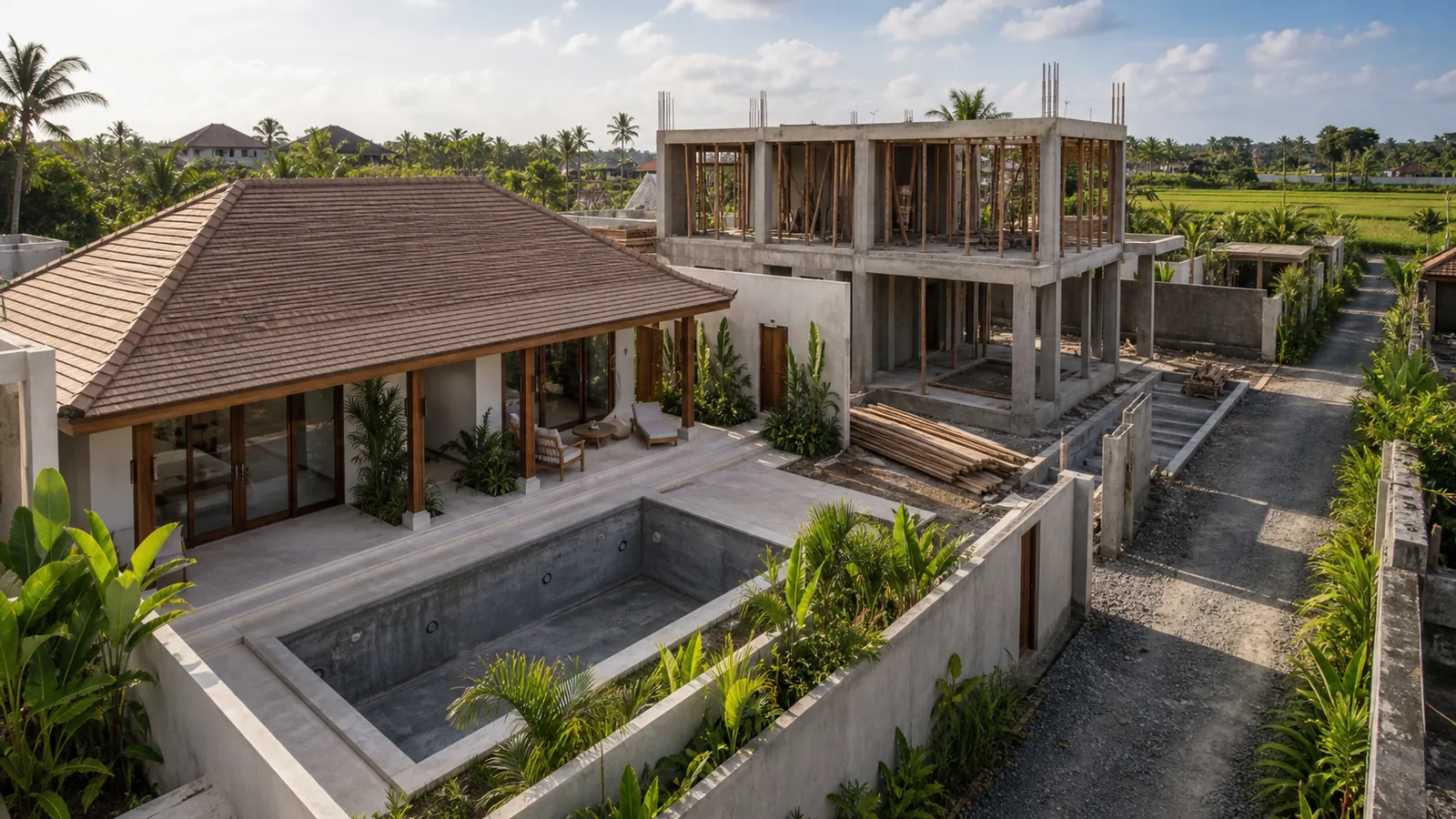
You are considering committing capital to a property that does not yet exist — in a legal environment that restricts foreign freehold ownership, on the strength of renders, projected yields, and a developer’s track record.
That is worth taking seriously. The buyers who navigate off plan villas Bali successfully are not those who moved fastest. They are the ones who separated the developer’s projected scenario from a realistic base case before signing anything.
This guide gives you that framework.
Quick orientation: Jump to What to Check Before You Act for the verification list, or Yield and Cost Assumptions for the financial modelling section.
What Most Guides Miss
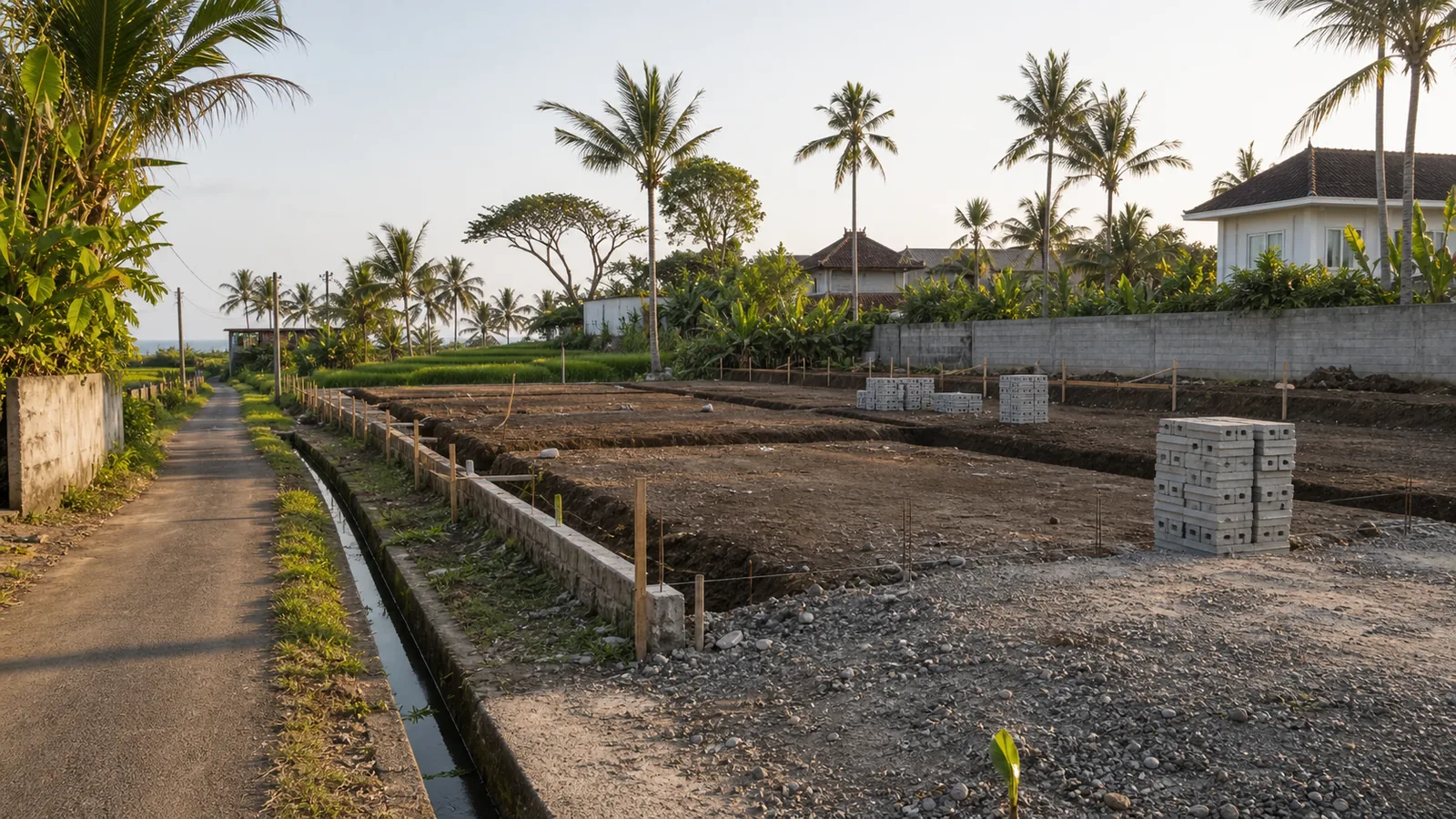
Most Bali property content falls into two camps: listing aggregators that show headline prices and projected returns, or legal overviews that explain ownership structures in abstract terms. Very few connect both to buyer-side verification.
Here is what consistently gets left out.
The gap between gross and net yield. Developers typically publish gross yield figures — gross rental income divided by purchase price. The number that actually reaches your account is net of management fees (typically 20–30% of revenue), maintenance and upkeep (often 1–3% of villa value annually), property taxes, insurance, pool and garden costs, and periodic refurbishment. A villa quoted at 12% gross may net 6–8% in a well-run scenario, and less if occupancy assumptions are optimistic or costs are underestimated. Industry operator data consistently shows this gap is wider than developer materials suggest.
Lease length and residual value. Most foreign buyers in Bali hold via leasehold, typically 25–30 years with an option to extend. A villa with 22 years remaining on a 30-year lease does not hold the same value as one with 28 years remaining. Off plan projects extend from a lease that begins when the land title is issued — not when you sign. Understanding what lease term you are actually buying is a due diligence essential.
Developer delivery risk. Off plan means your capital is deployed during a construction period before the asset starts generating income. Developer delays, cost overruns, or project stalls transfer significant risk to buyers who have already paid deposits or staged payments. Track record, escrow arrangements, and stage-payment terms are not optional reading.
Exit liquidity. Bali’s resale market for leasehold villas is thinner than developers typically acknowledge. Finding a qualified buyer when you want to exit — at a price that reflects your original investment — is not guaranteed, especially as lease terms shorten.
How Off Plan Purchases Work in Bali
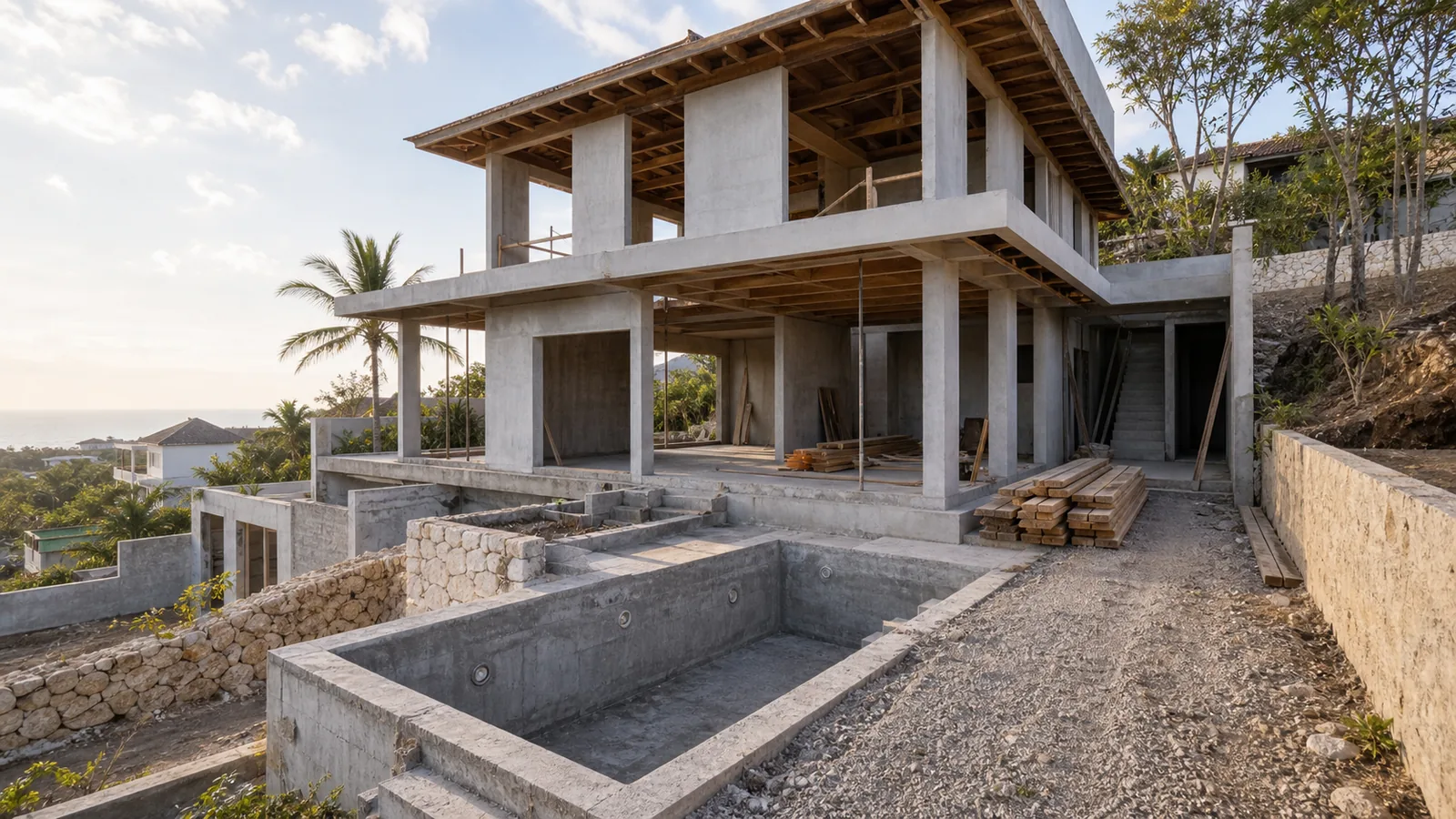
Off plan purchases in Bali follow a broadly similar structure across developers, though terms vary considerably.
Ownership Structure for Foreign Buyers
Foreign nationals cannot hold freehold (Hak Milik) title in Indonesia. The three main legal routes are:
- Leasehold (Hak Sewa): A direct lease agreement, typically 25–30 years with a renewal option. The most straightforward route for foreign buyers, but dependent on lease terms and the landowner’s position at renewal.
- Hak Pakai: Right-of-use title available to foreigners holding a valid KITAS (residence permit). Offers stronger protections than pure leasehold but requires maintained residency status.
- Nominee structures (PT PMA or local nominee): Common in practice but carry legal and practical risks. Independent legal advice is essential before using any nominee arrangement.
The ownership route affects what you can do with the property, how you can exit, and what happens at lease end. Treat any explanation of ownership structures — including this one — as educational context, not legal advice. Engage a qualified Indonesian property lawyer before proceeding.
Payment Stages and Developer Risk
Off plan projects typically involve a reservation deposit (often 5–10%), stage payments tied to construction milestones, and a final payment on handover.
The critical question is where your money sits during the construction period. Established developers with dedicated escrow accounts offer materially different risk profiles from those where payments flow directly into a project company. Ask for the escrow or payment protection arrangement in writing and have it reviewed by your legal adviser. Due diligence frameworks for Bali acquisitions consistently flag payment structure as the highest-risk variable in off plan transactions.
Yield and Cost Assumptions
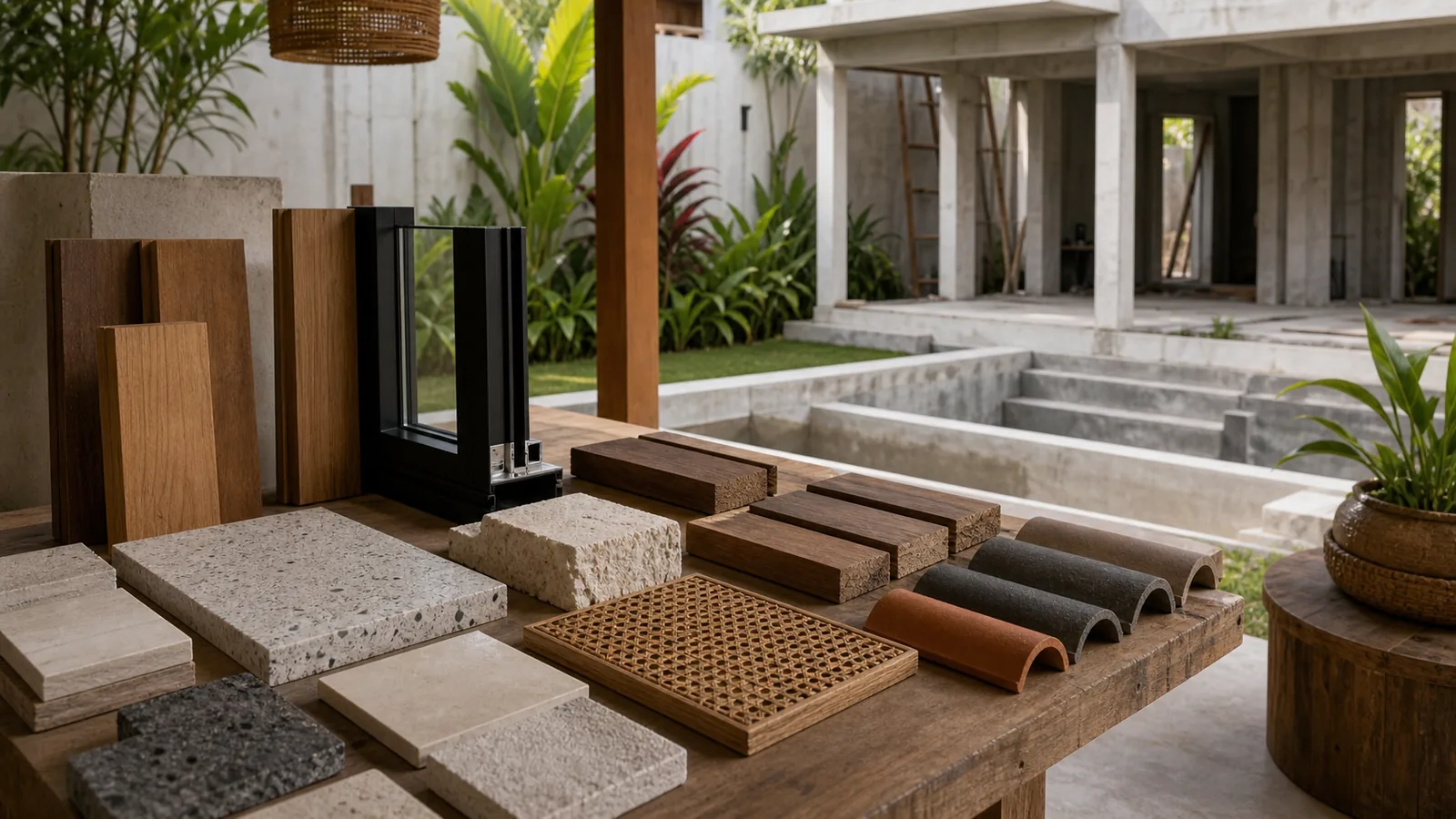
The figures below reflect commonly cited ranges in the Bali villa market based on publicly available operator and analyst data. They are planning assumptions, not projections or promises. Use them to stress-test what you are being shown, not to forecast a specific outcome.
| Item | Typical Range | Notes |
|---|---|---|
| Quoted gross yield | 8–15% | Developer brochure figure; pre-cost |
| Management fee | 20–30% of rental revenue | Charged on gross revenue |
| Maintenance / upkeep | 1–3% of villa value per year | Higher in humid, coastal locations |
| Property tax (PBB) | ~0.5% of assessed value | Assessed value often below market |
| Insurance | 0.3–0.5% of rebuild value | Varies by coverage |
| Developer occupancy assumption | 70–80% | Typically peak-season-weighted |
| Realistic long-run occupancy | 55–70% | Area and spec dependent |
| Net yield (conservative scenario) | 5–8% | After all operating costs |
Sources: Rumavi investor overview 2025; InvestLandBali rental yield data.
For a worked calculation using your own inputs, the rental yield overview walks through each cost line in detail.
Common Buyer Objections — Addressed Honestly
“The developer is offering a contractual yield promise of 10% for two years.”
A contractual yield promise is a sales-period mechanism, not a long-term rental performance commitment. Read who is making the promise: a management company with a thin balance sheet cannot cover a shortfall if occupancy underperforms. Ask what happens in year three when the promise period ends, and what recourse you have if the management company changes or exits. InvestLandBali’s off plan analysis notes that operator promises tied to a specific management entity carry counterparty risk that buyers rarely model.
“I can sell at a profit before the lease decays.”
This is possible, but the resale market in Bali is smaller and slower than primary sales activity suggests. Buyers at resale see the same lease clock you do. A villa with 20 years remaining is priced accordingly by informed buyers. Exit timing matters: a project acquired at pre-launch pricing in a rising market in year one can look very different at year eight with a compressed lease.
“Property values are rising, so capital gain offsets any yield shortfall.”
Leasehold capital appreciation is not comparable to freehold appreciation in other markets. The asset value decays as the lease shortens, regardless of land price trends. The distinction between land value (which can rise) and leasehold asset value (which decays) is something buyers seeking appreciation exposure need to understand clearly. The Ayla Property ROI calculator lets you model this decay against projected income.
“The area is booming — occupancy will be much higher.”
Supply growth in Canggu, Pererenan, and the Bukit has been significant. More villas entering the short-term rental pool increases competition for the same guest demand. Developer occupancy assumptions are typically modelled on current market conditions rather than projected supply. Ask the selling agent for occupancy data from comparable completed villas in the same subdistrict — not Bali-wide averages.
What to Check Before You Act
Use this as a working list, not a formality. Each item represents a category of risk that has caught buyers out.
Developer Track Record
- Completed and delivered projects (not just announced)
- Years of operation in Bali
- Whether existing owners can be contacted for reference
- Current litigation or complaints (public registry search)
Legal and Title
- Underlying land title type, verified with the national land registry (BPN)
- Exact lease term and effective start date
- Renewal mechanism and renewal price, in writing
- Building permit (IMB/PBG) status and zoning compliance
- Operational license appropriate to intended use (PONDOK WISATA, VHR, or equivalent)
Financial Assumptions
- Gross yield calculation basis — peak-season or annual average occupancy?
- Whether a contractual yield promise is included, who backs it, and for how long
- Full operating cost schedule from the management company
- Management company identity, contract terms, and exit clause
Exit and Liquidity
- Resale restriction clauses in the purchase agreement
- Developer’s stated buy-back policy, if any, and the conditions it applies under
- Whether the lease is transferable and at what cost
For a structured approach to this whole process, the Bali property due diligence checklist is a useful companion document.
Location Context: Where Off Plan Activity Concentrates
Off plan development in Bali is not evenly distributed. As of 2026, the primary areas attracting foreign buyer interest include Canggu and its northern extension into Pererenan, Seminyak and Petitenget, Uluwatu and the Bukit peninsula, and the broader Ubud corridor.
Each area has a distinct rental profile, occupancy seasonality, and development density. Headline yield figures for “Bali” may not reflect the specific location, spec tier, or management quality of a given project. Pererenan villas for sale covers one of the currently active off plan corridors in more depth.

Climate Data as an Operating-Cost Stress Test
We compared 2015–2025 hourly reanalysis at the representative Bali reference points below. The figures help screen maintenance exposure; they do not rank individual villas or replace drainage, material and building-condition checks.
| Reference point | Rainfall mm/year | Rainy days/year | Avg RH | ≥85% RH hours/year | Avg wind km/h | Strong-wind days/year† | Solar kWh/m²/day | Outdoor pressure* |
|---|---|---|---|---|---|---|---|---|
| Canggu coastal corridor | 1,662 | 245.7 | 85.5% | 4,968 | 12.2 | 6.4 | 5.71 | 49 |
| Ubud inland reference | 2,640 | 268.5 | 87.3% | 5,948 | 6.9 | 0.0 | 5.68 | 70 |
| Uluwatu and Pecatu reference | 1,630 | 261.6 | 80.2% | 1,944 | 14.4 | 31.5 | 5.69 | 29 |
| Sanur east-coast reference | 1,754 | 264.0 | 83.7% | 3,901 | 12.1 | 4.9 | 5.68 | 35 |
| Seminyak southwest-coast reference | 1,754 | 264.0 | 83.7% | 3,901 | 12.1 | 4.9 | 5.68 | 35 |
*Outdoor Maintenance Pressure is a relative index across five configured location requests, which resolve to four distinct populated grid cells. The raw weather metrics beside it remain the evidence. †A strong-wind day contains at least one hourly 10 m wind-speed value of 30 km/h or more; this is a comparison threshold, not a damage threshold.
Grid-resolution disclosures
- Uluwatu and Pecatu reference uses the nearest populated ERA5-Land cell at -8.8, 115.2 (13 km from the requested coordinate), so it is a broad-area proxy.
- Sanur east-coast reference and Seminyak southwest-coast reference resolve to the same populated land cell at -8.7, 115.2; identical values mean the grid cannot distinguish those requests, not that their parcel-level conditions are identical.
How to use this in due diligence
- Add explicit AC, drainage, exterior-finish, pool and landscape allowances to the operating model instead of hiding them inside one management percentage.
- Stress-test the reserve against the asset’s age, materials and service history; a relative climate score is not a forecast of cost, occupancy or yield.
- Confirm whether owner, operator, tenant or body corporate pays for routine and capital work before comparing net returns.
Source: Copernicus Climate Change Service (C3S) ERA5-Land, hourly reanalysis, 2015–2025, analysed in Asia/Makassar local time. Relative humidity, wet-bulb temperature and reference evapotranspiration are derived from the source variables using the documented methodology. Data: CC BY 4.0. See the climate data methodology for formulas, thresholds and limitations. Values are area-level model estimates, not measurements at a villa; relative indices compare five configured Bali location requests (four distinct populated grid cells), not engineering, insurance, cost or yield ratings.
Frequently Asked Questions
Can foreigners buy off plan villas in Bali?
Yes, through leasehold agreements or Hak Pakai title if you hold a valid KITAS. Freehold ownership is not available to foreign nationals under Indonesian law. The ownership route you use affects resale, rental licensing, and what happens at the end of the lease term. Take independent legal advice before committing to any structure.
What is a realistic net yield for a Bali villa after costs?
Net yields in the 5–8% range are a reasonable conservative assumption for a well-located, well-managed villa at realistic occupancy. Gross figures quoted by developers — often 10–15% — do not account for management fees, maintenance, taxes, insurance, or vacancy. Model both scenarios before making a decision.
How long is a typical off plan lease in Bali?
New off plan projects typically offer 25–30 year initial lease terms, often with a renewal option. The lease starts from when the underlying land title is registered — clarify the effective start date in writing, as it may differ from your signing date.
What happens if the developer does not complete the project?
If stage payments have been made without escrow protection, recovery is difficult. There is no equivalent of a government-backed buyer protection scheme comparable to some Western markets. Escrow arrangements, payment staging tied to verifiable construction milestones, and developer track record checks are critical for this reason.
Is off plan cheaper than buying a completed villa?
Off plan prices are typically lower than comparable completed stock in the same area, reflecting the construction risk the buyer takes on. Whether that discount adequately compensates for delivery risk and the income gap during construction depends on specific project terms.
What does a contractual yield promise actually mean?
A contractual yield promise is a commitment from a management company or developer to pay a specified return for a defined period, typically one to three years. It is a sales-period mechanism. The promise is only as strong as the balance sheet behind it — assess who is making it, for how long, and what happens when the period expires.
Off plan villas Bali represent a genuine route for foreign buyers who approach the process with clear assumptions, verified terms, and independent legal review in place before signing. The buyers who do well are those who stress-tested the developer’s numbers against realistic costs and occupancy — not those who relied on the brochure.
If you are comparing specific projects, the next step is reviewing verified shortlists with deal-specific context.